


Chronic Fatigue Syndrome Symptoms and Do I Have Chronic Fatigue?


Chronic fatigue syndrome symptoms include fatigue that rest does not relieve, worse symptoms after activity and unrefreshing sleep. Memory problems or dizziness on standing may also occur. The CDC says up to 3.3 million people in the US have myalgic encephalomyelitis/chronic fatigue syndrome (ME/CFS). More than 9 in 10 of them are undiagnosed. This guide covers criteria, severity and testing.
Key Takeaways
- The IOM 2015 criteria require 3 core symptoms plus at least 1 of 2 additional symptoms.
- Post-exertional malaise, a symptom crash that typically starts 12 to 48 hours after activity, is required for diagnosis.
- No test confirms ME/CFS, so doctors use history, an exam and routine labs to rule out other illnesses.
- NICE advises suspecting ME/CFS after 6 weeks and diagnosing it after 3 months, while US criteria use more than 6 months.
- Both the CDC and NICE state that exercise is not a curative treatment, and NICE advises against graded exercise therapy.
What Are the Main Chronic Fatigue Syndrome Symptoms?
The main chronic fatigue syndrome symptoms are fatigue that limits activity, post-exertional malaise and unrefreshing sleep. The CDC calls these the 3 required symptoms among 5 core symptoms. Diagnosis also needs at least 1 of the other 2, which are memory and thinking problems or trouble staying upright.
The Institute of Medicine (IOM), now the National Academy of Medicine, published these criteria in 2015. The IOM criteria cover adults and children. The list below gives the 3 required symptoms.
- A substantial drop in pre-illness activity that lasts more than 6 months, with new-onset fatigue that rest does not relieve.
- Post-exertional malaise, a worsening of symptoms after physical, mental or emotional exertion.
- Unrefreshing sleep, meaning a full night in bed does not restore energy.
The IOM adds a severity rule for post-exertional malaise, unrefreshing sleep and cognitive impairment. Each one must occur at least half of the time at moderate, substantial or severe intensity. Doctors therefore ask about how often and how strongly each symptom appears.

The graphic above shows the 3 required symptoms beside the 2 additional symptoms. Body Blu reviews immune, adrenal and nutrient status as part of ME/CFS care, and that review supports a medical diagnosis. The review does not replace one. Post-exertional malaise needs its own explanation because it separates this illness from ordinary tiredness.
What Is Post-Exertional Malaise in ME/CFS?
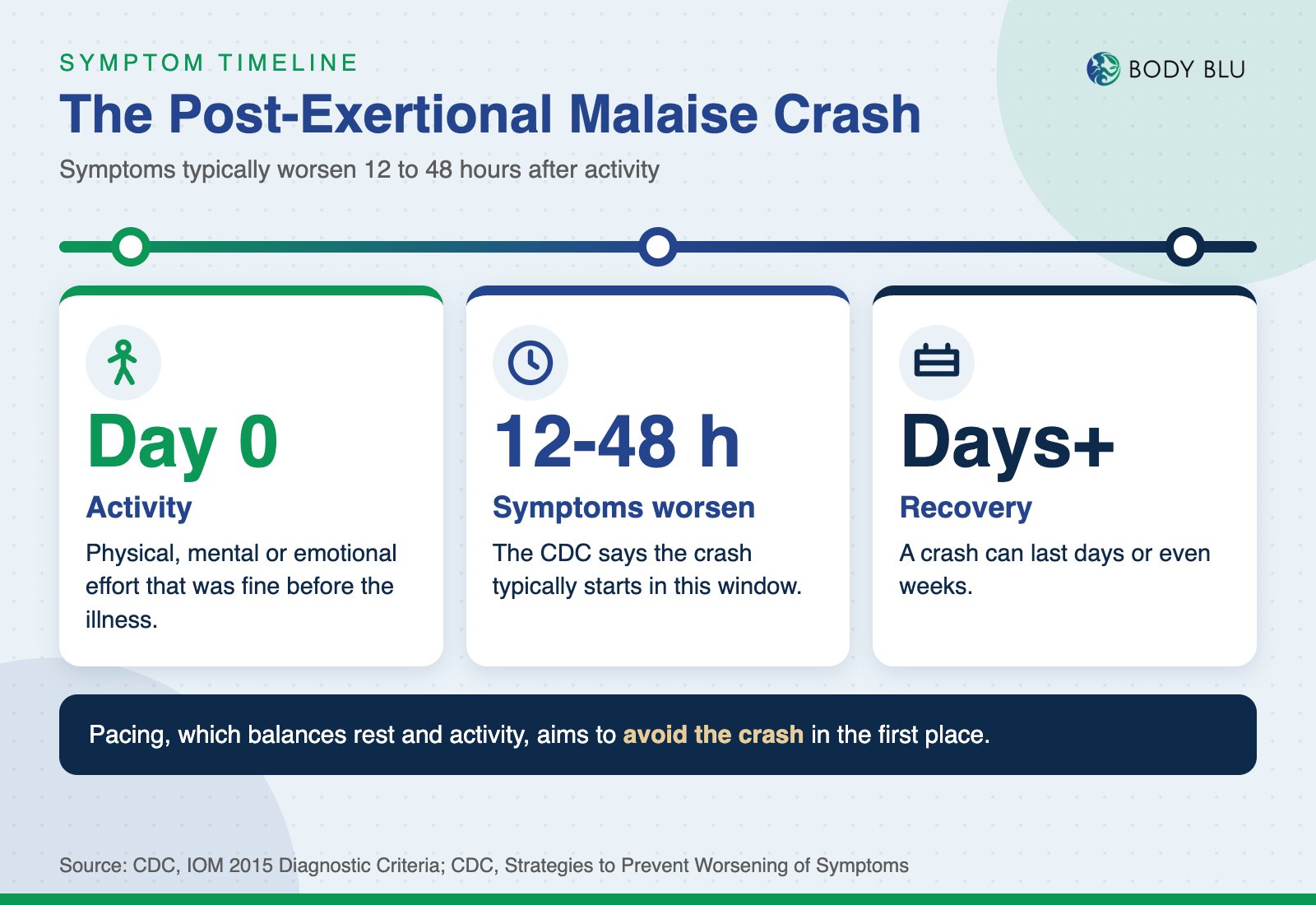
Post-exertional malaise (PEM) is a worsening of symptoms after activity that would not have caused a problem before the illness. The CDC says symptoms typically worsen 12 to 48 hours after the activity. A crash can last for days or even weeks.
The CDC gives everyday examples of PEM. A shower may leave a person bed-bound for days, and a school event may leave a person house-bound. Grocery shopping may require a nap in the car before the drive home.
Mental effort and sensory overload count as activity too. The IOM notes that light and sound can trigger PEM for some patients. Pushing through a good day can lead to a crash, which the CDC calls a "push and crash" cycle.
NICE adds that PEM is often delayed by hours or days and is out of proportion to the activity. The CDC states that the fatigue in ME/CFS is not relieved by sleep or rest. The graphic below maps the PEM timeline, and the next section describes how the illness feels day to day.
What Does Chronic Fatigue Syndrome Feel Like?
Chronic fatigue syndrome feels like profound exhaustion, often with flu-like symptoms, that rest does not fix. Cleveland Clinic says symptoms can look and feel like the flu and can vary in intensity over time. Mayo Clinic adds that severity can change from day to day.
The 2 additional IOM symptoms complete the criteria. Cognitive impairment means trouble with thinking, memory, attention and information processing, which people often call brain fog. Orthostatic intolerance means symptoms worsen when standing or sitting upright and ease when lying down. The IOM lists lightheadedness, fainting, headaches and nausea as examples.
Many people report other symptoms that are not required for diagnosis. Body Blu addresses memory and concentration complaints through cognitive symptom support. The list below follows the CDC.
- Muscle pain and joint pain without swelling or redness
- New or worsening headaches
- Tender lymph nodes in the neck or armpits
- Frequent sore throat
- Chills and night sweats
- Sensitivity to foods, odors, chemicals, light and noise
- Digestive issues such as irritable bowel syndrome
The CDC calls pain very common in ME/CFS, and an injury does not explain it. The type, location and severity of the pain vary widely between people. The way the illness starts also shapes how doctors recognize it.
What Are the Early Signs of Chronic Fatigue Syndrome?
The early signs of chronic fatigue syndrome are persistent fatigue, post-exertional malaise and unrefreshing sleep that begin after normal health. The IOM criteria require fatigue of new onset, which means the fatigue is not life-long. Cleveland Clinic says many people receive a post-viral syndrome label before they meet the criteria.
Infections are one recognized trigger. Cleveland Clinic lists Epstein-Barr virus, Ross River virus, Coxiella burnetii and COVID-19 as infections that may start ME/CFS. Mayo Clinic adds that some people report an injury, surgery or emotional stress shortly before symptoms began.
Early recognition can be hard. The CDC notes that PEM may be delayed after other symptoms start, and some patients do not recognize it at first. NICE advises doctors to suspect ME/CFS in adults after 6 weeks of persistent symptoms and in children after 4 weeks.
Are Symptoms of Chronic Fatigue Syndrome Different in Women and Men?
The IOM criteria use the same symptom list for women and men, although doctors diagnose women more often. Symptoms of chronic fatigue syndrome in women therefore follow the same required list as the criteria above. Symptoms of chronic fatigue syndrome in men follow that list as well.
The Office on Women's Health says women are 2 to 4 times more likely than men to be diagnosed. A 2024 review reports a ratio of women to men as high as 4 to 1 among diagnosed people. Mayo Clinic notes that women may be more likely to report their symptoms.
The CDC says anyone can get ME/CFS, whatever their age, gender or ethnicity. The CDC also reports that it is most common in middle age but affects children, teens and older adults. Severity is the next factor that separates one person from another.
What Are Severe Chronic Fatigue Syndrome Symptoms?
Severe chronic fatigue syndrome symptoms are an inability to do more than basic daily tasks, with the person often housebound or bedbound. The NHS says most cases are mild or moderate, but 1 in 4 people have severe symptoms. The CDC reports that about 1 in 4 people with ME/CFS are confined to bed at some point.
The NHS describes 4 levels of severity. The table below compares them.
| Level | Daily function | Typical signs |
|---|---|---|
| Mild | Can care for self, with possible problems moving around | May work or study but has little energy for anything else |
| Moderate | Difficulty moving around easily and with daily activities | May be unable to work or study, needs frequent rest and may sleep poorly at night |
| Severe | May do no activity, or only very basic tasks such as brushing teeth | May be housebound or bedbound, sensitive to noise and light, slow to recover after effort |
| Very severe | Spends all time in bed and depends on carers | May need help eating, washing and toileting, and may need tube feeding |
Severe symptoms call for specialist input, according to the NHS. NICE defines severe ME/CFS as being unable to do any activity or only minimal tasks such as washing the face. Diagnosis for any severity level follows the same process, which the next section explains.
How Do I Know If I Have Chronic Fatigue Syndrome?
A doctor can tell you whether you have chronic fatigue syndrome by matching symptoms to the criteria and excluding other illnesses. The CDC states that no confirmatory test exists. NICE states that ME/CFS is recognized on clinical grounds alone.
What Are the Criteria for Chronic Fatigue Syndrome?
The criteria for chronic fatigue syndrome differ by body, mainly in the time threshold and whether post-exertional malaise is required. The table below compares 3 sets. The IOM 2015 set is the one the CDC lists for US clinicians.
| Criteria set | Time threshold | PEM required | Symptom rule |
|---|---|---|---|
| IOM 2015 | More than 6 months | Yes | 3 required symptoms plus 1 of 2 additional symptoms |
| Fukuda 1994 (CDC) | 6 consecutive months | No | At least 4 of 8 listed symptoms |
| NICE 2021 (UK) | Suspect at 6 weeks, diagnose at 3 months | Yes | All 4 listed symptoms and reduced activity |
The Fukuda criteria do not require post-exertional malaise, which a 2024 review names as a main criticism. NICE lists fatigue, PEM, unrefreshing sleep and cognitive difficulties as the symptoms to suspect the illness. The IOM 2015 criteria remain the reference point in this guide.
Is There a Chronic Fatigue Syndrome Symptoms Test?
No chronic fatigue syndrome symptoms test confirms the illness, according to the CDC. Biomarkers found in studies lack enough sensitivity and specificity to serve as a diagnostic test. Doctors therefore order routine labs to rule out other fatiguing illnesses.
- Complete blood count and erythrocyte sedimentation rate
- Thyroid tests: thyroid-stimulating hormone and free thyroxine
- Iron studies, including ferritin
- Celiac disease screening
- Fasting glucose, kidney and liver function, C-reactive protein and urinalysis
The CDC says most people with ME/CFS have routine results within normal ranges. Providers may order antibody tests as part of an autoimmune evaluation when the history points that way. The CDC also warns that extensive testing without clinical suspicion raises the risk of false-positive results.
Do I Have Chronic Fatigue Syndrome or Another Condition?
Having chronic fatigue syndrome is confirmed only when the required symptoms persist and no other condition explains them. The CDC describes the evaluation as a sequence of steps, shown in the list below.
- Take a detailed history, including how activity changes symptoms and how long recovery takes.
- Complete a physical, neurological and mental health exam.
- Order targeted labs to rule out other fatiguing illnesses.
- Compare the findings with the criteria once the time threshold is met.
- Re-evaluate periodically, because symptoms can change over time.
The CDC suggests a symptom and activity diary for a couple of weeks to document patterns. A person can have ME/CFS and a co-existing fatigue condition at the same time. The graphic below shows when each time threshold applies.

What Else Should You Know About Chronic Fatigue Syndrome?
What Is the Current Name for Chronic Fatigue Syndrome?
The current name is myalgic encephalomyelitis/chronic fatigue syndrome (ME/CFS), the term both the CDC and NICE use. The IOM proposed a third name in 2015, systemic exertion intolerance disease. It said the older names are inaccurate or can trivialize the illness. The ICD-10-CM code G93.32 covers ME/CFS, chronic fatigue syndrome and myalgic encephalomyelitis.
What Is the Most Common Cause of Chronic Fatigue Syndrome?
No single cause of chronic fatigue syndrome has been established, according to the CDC and Mayo Clinic. Genetics, infections, physical or emotional trauma and energy metabolism are the factors Mayo Clinic lists. Epstein-Barr virus is one listed trigger, and our Epstein-Barr testing looks at that pattern alongside immune status.
What Are the Treatments for Chronic Fatigue Syndrome?
The treatments for chronic fatigue syndrome are symptom management and activity pacing, because no curative or approved treatment exists. The CDC says providers should treat the most disruptive symptom first, as the patient prioritizes. NICE states that no curative option exists, either non-pharmacological or pharmacological.
Pacing means balancing rest and activity to avoid crashes. The CDC calls staying inside personal limits the energy envelope. Some people organize that plan within a functional care plan alongside their medical team. NICE also advises against any medicines or supplements offered as a curative treatment.
Does Graded Exercise Therapy Help Chronic Fatigue Syndrome?
Graded exercise therapy is not recommended by NICE, and neither the CDC nor NICE treats exercise as a curative treatment. NICE defines the therapy as setting a baseline and then making fixed incremental increases in activity. Its 2021 guideline says not to offer graded exercise therapy or any therapy based on exercise as a curative treatment.
The CDC pages reviewed for this guide do not name graded exercise therapy as a treatment. They state that standard exercise recommendations for healthy people can substantially harm patients with ME/CFS. The CDC adds that expectations must be managed because exercise is not a curative treatment.
Both agencies allow individualized activity for people who can tolerate it. The CDC says carefully increasing exercise may help fitness for patients who know how to listen to their bodies. NICE says any programme should be voluntary and overseen by a physiotherapist in an ME/CFS specialist team. The plan starts below the person's baseline.
How Is Long COVID Related to ME/CFS?
Long COVID is related to ME/CFS because COVID-19 is one infection that may trigger the illness, according to Cleveland Clinic. The CDC coding guidance directs the code U09.9 for post-COVID condition, which makes it clearer when ME/CFS follows SARS-CoV-2 infection. Body Blu covers related long COVID support on its own page.
How Does Body Blu Help With Chronic Fatigue?
Body Blu reviews persistent fatigue with a root-cause approach that starts with a full history and any recent lab work. Our team, led by Dr. Joseph Scarpuzzi, a licensed naturopathic doctor, then looks at immune, hormone and nutrient status. We work alongside your primary care provider or specialist and do not replace a medical diagnosis.
Further testing can add markers that routine screening does not cover, which is where lab panels fit. Those results guide a symptom-focused plan built around your limits, your pacing and your most disruptive symptoms.
Anyone who recognizes chronic fatigue syndrome symptoms in themselves should see a provider early. Persistent fatigue deserves a careful work-up and a plan that respects pacing. The ME/CFS evaluation at Body Blu follows the same principles as the CDC guidance above.
A plan for ME/CFS rests on pacing and on the symptoms the patient finds disruptive, as the CDC describes. Body Blu supports that plan by reviewing history, labs and daily limits in one place.
Patients who want a second look at a long fatigue history can book a visit. Bring your symptom diary, your pacing notes and any lab results already on hand. We review each of them with you during the first conversation.
Questions about long-lasting fatigue are welcome, and the Body Blu staff will help you plan next steps.


Resources
From Our Blog
Naturopathic insights, wellness tips, and updates from the Body Blu team.

Treatments
What Is BPC-157 Peptide and What Does BPC-157 Peptide Do?
BPC-157 peptide is a lab-made chain of 15 amino acids that the FDA has not approved for any use. Evidence comes mainly from animal studies, and only 3 small human studies exist.

Treatments
BPC 157 Side Effects and BPC 157 Peptide Side Effects for Women
BPC 157 side effects reported by users include injection-site pain, fatigue and anxiety, but only 3 small human studies exist. The FDA has not approved BPC-157, so risks remain unknown.

Treatments
Sermorelin Before and After Results for Face, Women and Men
Sermorelin before and after changes in studies are small, slow and measured in blood tests. Trials of 11 to 19 adults found higher IGF-1 within 2 weeks, but no change in body weight.