


Sermorelin Before and After Results for Face, Women and Men


Sermorelin before and after changes build over weeks to months, because the peptide prompts the pituitary gland to release growth hormone. In a 16-week trial of 19 adults aged 55 to 71, a close sermorelin analog raised growth hormone within 2 weeks. Body weight did not change. This guide covers the evidence only, including FDA status and realistic timelines.
Key Takeaways
- Published sermorelin data come from small trials of 11 to 19 adults that lasted 6 to 20 weeks.
- Insulin-like growth factor 1 (IGF-1) rose within 2 weeks in a placebo-controlled trial, and skin thickness rose by week 16.
- Men gained lean mass in that trial, and women did not.
- Neither trial found a change in body weight, and PubMed lists 0 records linking sermorelin to hair.
- FDA withdrew approval of the brand drug GEREF in 2009, and compounded sermorelin is not FDA-approved.
- A licensed provider should review any peptide plan before a person starts.
What Does Sermorelin Before and After Look Like in Studies?
Sermorelin before and after in studies means blood-test and exam changes measured over 6 to 20 weeks, not photo comparisons. Sermorelin is a lab-made copy of the first 29 amino acids of growth hormone-releasing hormone (GHRH). GHRH is the signal that tells the pituitary gland, a small gland at the base of the brain, to release growth hormone. Researchers therefore track growth hormone and IGF-1, a liver-made marker of growth hormone activity.
A placebo-controlled trial tested a close sermorelin analog in 19 healthy adults aged 55 to 71, including 10 women and 9 men. Khorram and colleagues at the University of California, San Diego reported the results in 1997. Participants injected placebo nightly for 4 weeks and then injected the analog nightly for 16 weeks.
We do not list sermorelin as a service. A provider reviews peptide options case by case, and the peptide therapy overview explains how that works. Education comes first, because sermorelin has an unusual regulatory history. That history explains why the evidence below looks so different from clinic marketing.
Is Sermorelin FDA Approved?
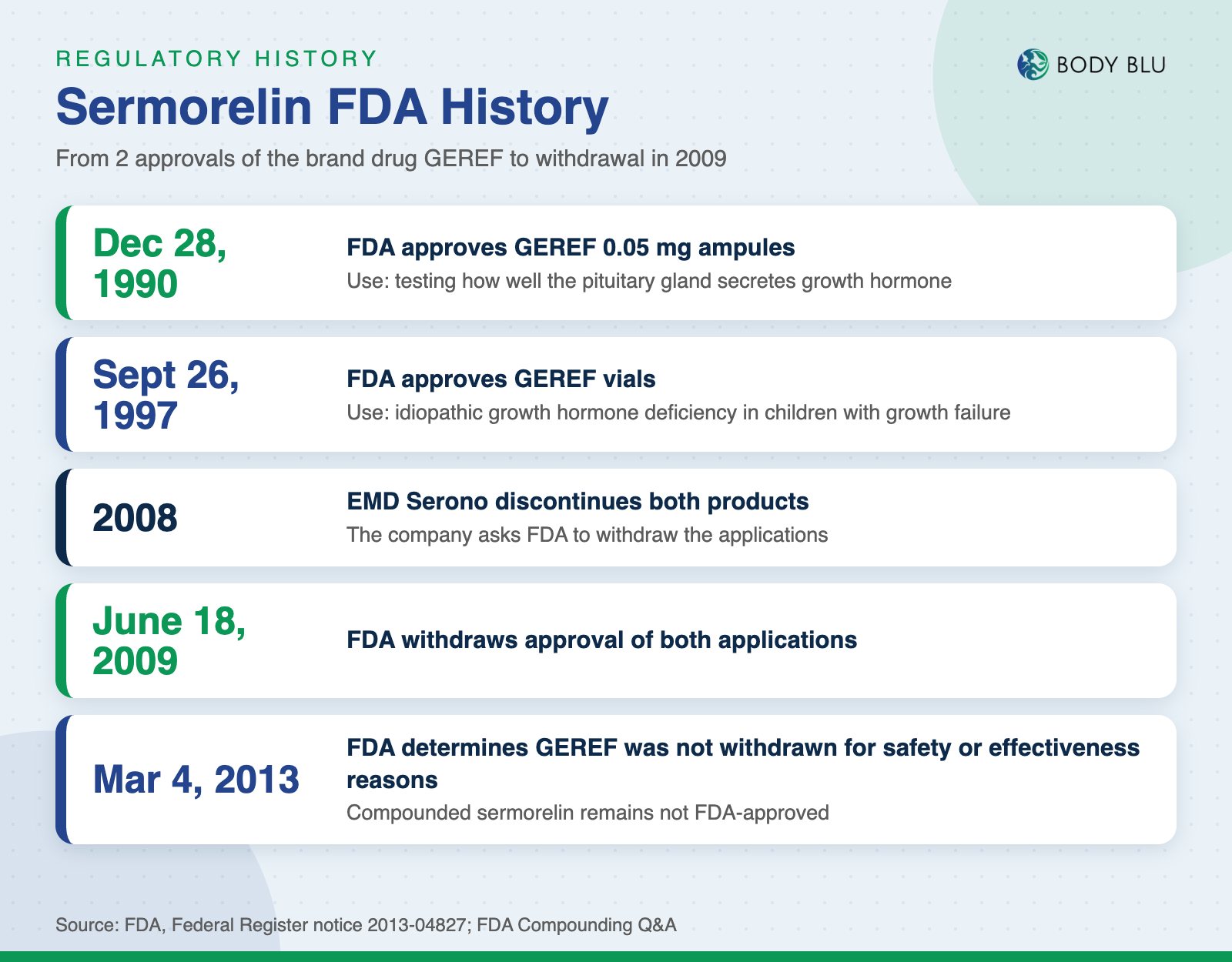
Sermorelin is not a currently approved drug, although FDA approved its brand version, GEREF, twice. The Federal Register records both approvals. The dates and uses below come from FDA's 2013 notice about GEREF.
- December 28, 1990: FDA approved GEREF 0.05 mg ampules to test how well the pituitary gland secretes growth hormone.
- September 26, 1997: FDA approved GEREF vials for idiopathic growth hormone deficiency in children with growth failure.
- 2008: manufacturer EMD Serono discontinued both products and asked FDA to withdraw the applications.
- June 18, 2009: FDA withdrew approval of both applications.
FDA later determined, on March 4, 2013, that GEREF was not withdrawn for reasons of safety or effectiveness. The company stopped selling the drug for other reasons. No approved use covered appearance, weight or anti-aging goals.
Pharmacies now supply sermorelin as a compounded drug. FDA states that compounded drugs are not FDA-approved, so FDA does not verify their safety, effectiveness or quality before marketing. Sermorelin does not appear on FDA's Category 2 list of bulk substances with significant safety risks. That page was current as of April 22, 2026. The final 503A bulks list in 21 CFR 216.23 names 6 substances, and sermorelin is not one of them. Compounding rules change, so the dispensing pharmacy should confirm the current status.
How Long Does Sermorelin Take to Work?
Sermorelin takes about 2 weeks to change IGF-1 and about 16 weeks to show measured body changes in trials. Growth hormone release starts within 10 minutes of an injection and lasts about 2 hours. The 1997 trials by Khorram and colleagues tracked the steps below.
- Within 10 minutes: a nightly injection triggers a growth hormone release that lasts about 2 hours.
- By week 2: IGF-1 and its carrier protein, IGFBP-3, rise above placebo levels.
- By week 4: IGF-1 is 28% higher, and 12-hour growth hormone secretion is 107% higher in men and 70% higher in women.
- Through week 12: IGF-1 stays elevated, then returns toward baseline by week 16.
- At week 16: skin thickness is higher in both sexes, and lean body mass is higher in men.
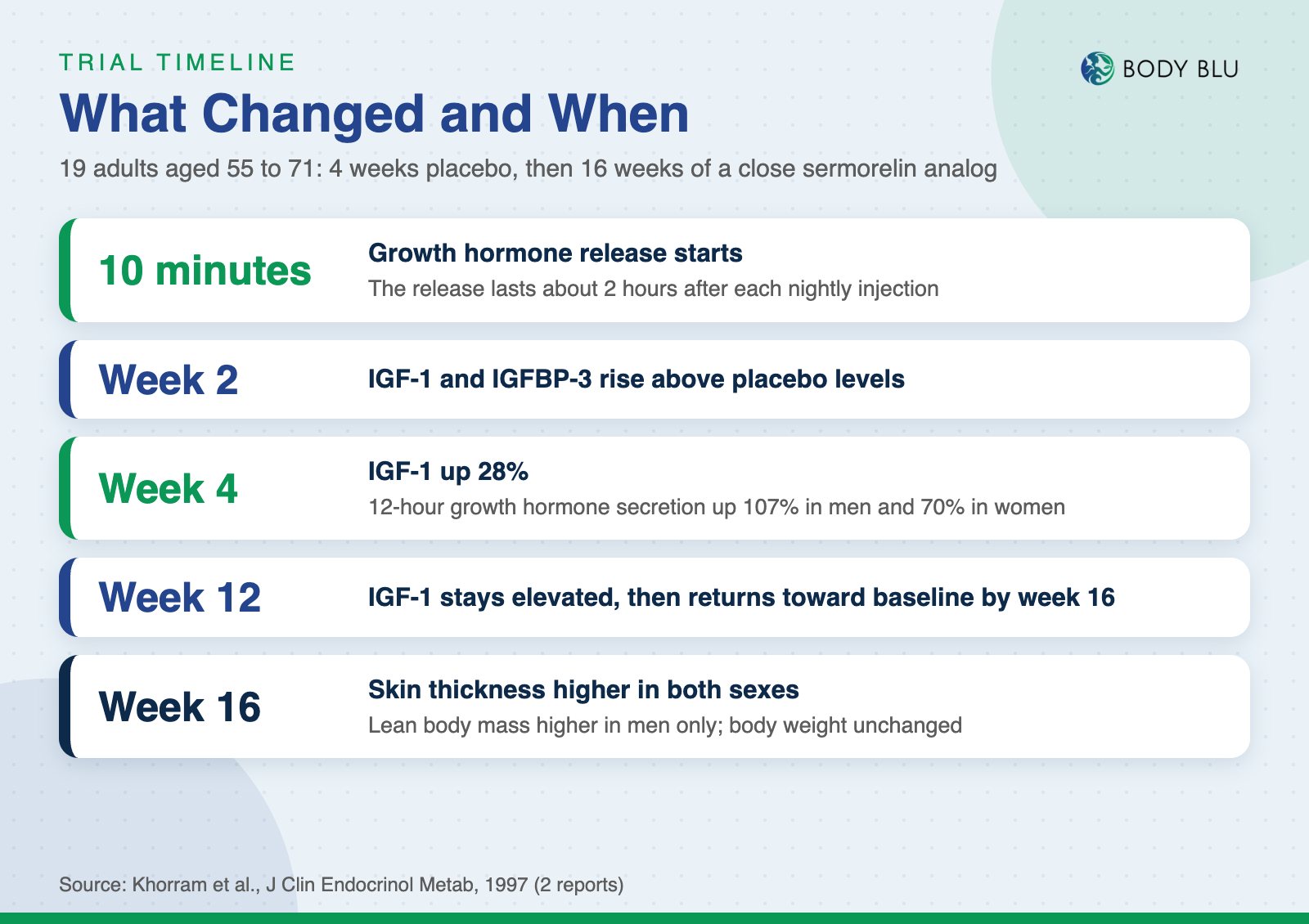
The graphic above maps each step to the week it was measured. Shorter and smaller studies found less. The table compares the 3 human studies that most clinic pages rely on.
| Study | People | Length | Main finding |
|---|---|---|---|
| Khorram 1997, J Clin Endocrinol Metab | 19 adults aged 55 to 71 | 4 weeks placebo, then 16 weeks | Higher IGF-1 and skin thickness; lean mass up in men only |
| Vittone 1997, Metabolism | 11 men aged 64 to 76 | 6 weeks | More nighttime growth hormone; IGF-1, weight and body fat unchanged |
| Sigalos 2017, Am J Mens Health | 14 men, mean age 33.2 | Mean 134 days | IGF-1 rose from 159.5 to 239.0 ng/mL; combination therapy, no placebo |
Vittone and colleagues at Johns Hopkins gave 11 men one nightly injection for 6 weeks. Nighttime growth hormone rose, yet IGF-1, weight, body mass index and scan-measured fat and muscle did not change. Two of 6 strength tests improved. The Sigalos review of 105 men used a three-times-daily combination, and only 14 men followed it closely enough to count.
Baseline numbers come from blood work, which is why a provider orders growth hormone labs before any hormone-related plan. Study results also differ between women and men.
How Do Sermorelin Results Differ for Men and Women?
Sermorelin results differ by sex, because men gained lean mass, insulin sensitivity, well-being and libido while women did not. One trial compared the sexes, and Khorram's team reported the split in the Journal of Clinical Endocrinology and Metabolism. Both sexes responded in some ways, as the list shows.
- Both sexes: higher IGF-1 and thicker skin.
- Men only: more lean body mass, better insulin sensitivity, and higher scores for well-being and libido.
- Neither sex: no change in body weight, blood pressure, bone density or sleep quality.
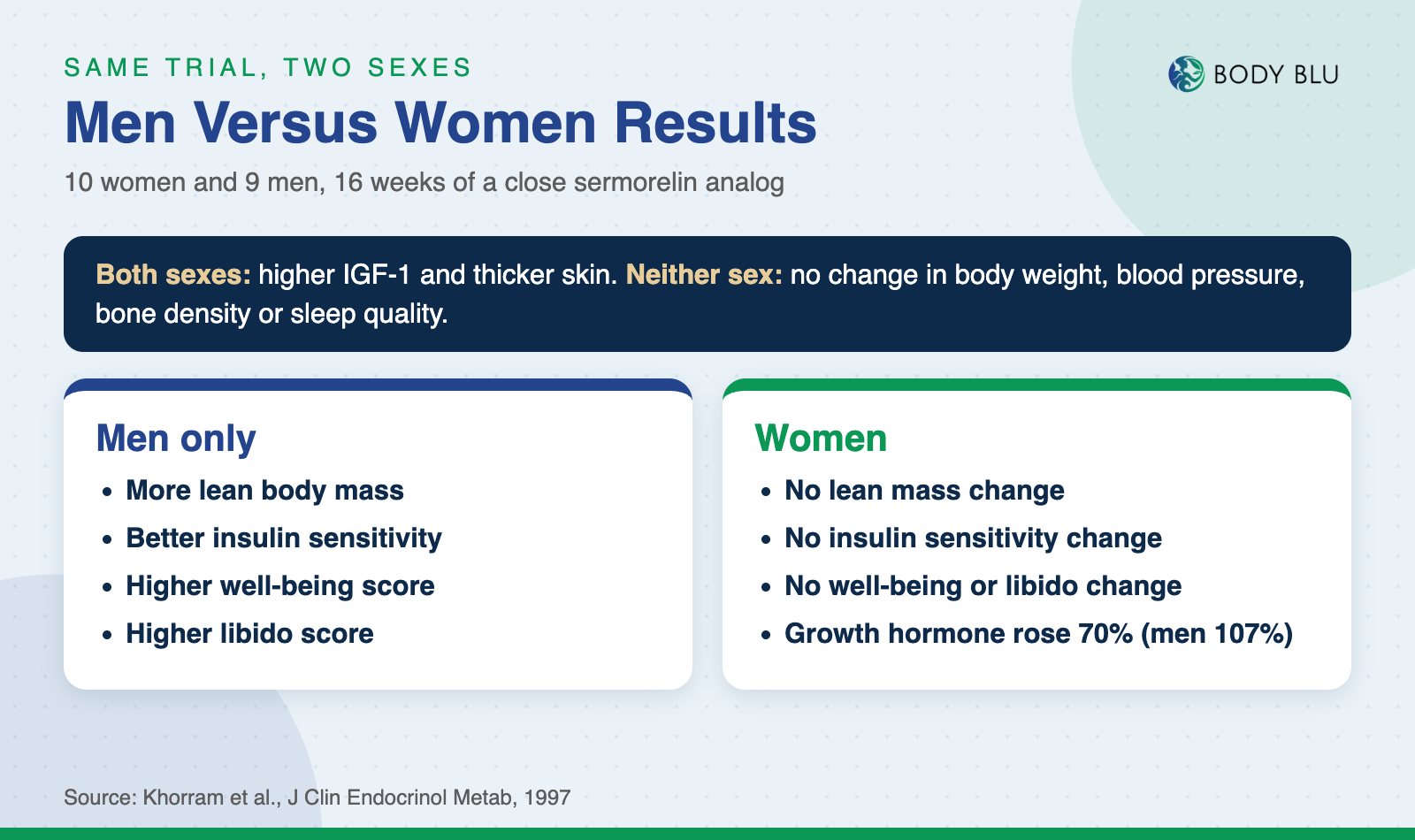
The authors concluded that the analog had anabolic effects favoring men over women. Evidence on sermorelin before and after women rests on 10 women in one trial, so results cannot be promised. Hormone shifts at midlife add other variables, which a provider reviews during menopause evaluation.
Reports of sermorelin men before and after changes are no stronger. Sigalos and colleagues studied men already using testosterone, so the IGF-1 rise cannot be credited to sermorelin alone. Men with symptoms of low testosterone need a testosterone evaluation before any peptide discussion.
Can Sermorelin Change Your Face and Skin?
Sermorelin can raise skin thickness slightly, and caliper-measured skin thickness is the only skin finding in the human trial data reviewed here. The Khorram team measured 4 sites on the hands and forearms. Skin thickness rose in both sexes after 16 weeks, with a significance level of P below 0.05.
No trial photographed faces or counted wrinkles. Searches for sermorelin before and after face turn up clinic photos, yet those images are not study data. A photo labeled sermorelin skin before and after cannot show the lighting, diet, sleep or other treatments behind the change.
Skin thickness also differs from visible smoothness. A thicker skin measurement does not prove fewer lines. Realistic expectations therefore stop at a small measured change after about 16 weeks of nightly use, not a new face.
Does Sermorelin Cause Weight Loss or Hair Growth?
Sermorelin has no proven weight loss or hair growth effect in the human trials found. Body weight stayed the same in the 16-week Khorram trial. Weight, body mass index, waist-to-hip ratio and scan-measured fat were also unchanged in the 6-week Vittone trial.
Claims for sermorelin before and after weight loss therefore outrun the data. Fat did not drop within 6 or 16 weeks in these trials, which answers how quickly sermorelin burns fat. Clinic timelines of 2 to 3 months for fat loss are not backed by these studies.
Hair claims have even less support. A PubMed search on October 31, 2026 for sermorelin together with hair or alopecia returned 0 records. Posts on sermorelin before and after hair therefore rest on opinion, not trial data. Programs with published weight outcomes work differently, such as the GLP-1 therapy program at Body Blu.
What Are the Side Effects and Risks of Sermorelin?
The side effects of sermorelin in trials were minor: temporary high blood fats in one trial and no significant effects in another. Khorram and colleagues reported transient hyperlipidemia that resolved by the end of the study. Vittone and colleagues observed no significant adverse effects.
The evidence has clear limits. The trials enrolled 11 to 19 healthy volunteers and lasted 6 to 20 weeks. A 2018 review by Sigalos and Pastuszak found few long-term, rigorously controlled studies of growth hormone secretagogues. The same review noted some concern for higher blood glucose from lower insulin sensitivity.
Blood sugar matters most for people already managing pre-diabetes screening. Cancer incidence and long-term safety also need study, according to the review. Compounded products add another unknown, since FDA does not check their quality before sale. A provider should review personal health history before any peptide is considered.
What Else Should You Know About Sermorelin?
Is Sermorelin the Same as Human Growth Hormone?
Sermorelin is not human growth hormone, because it prompts the pituitary gland to make its own. Injected growth hormone enters the blood directly. A 2006 editorial by Walker describes sermorelin release as episodic and controlled by the feedback hormone somatostatin.
Sigalos and Pastuszak describe the same idea in their review. Secretagogues promote pulsatile release that stays subject to negative feedback. Strict FDA criteria govern the use of injected growth hormone.
Will You Gain Weight on Sermorelin?
Sermorelin showed no change in body weight in either trial. Khorram reported unaffected body weight after 16 weeks. Vittone reported unchanged weight and body mass index after 6 weeks.
Where Does Sermorelin Fit Among Other Peptides?
Sermorelin sits among 12 peptides that a 2026 Sports Medicine review sorted into approved and unapproved groups. The review lists BPC-157, CJC-1295, ipamorelin and tesamorelin (Egrifta) beside it. Mendias and Awan found that rigorous human safety data for unapproved peptides are scarce.
For comparison, our article on glutathione research weighs benefits and risks of an injectable we do list.
How Should You Judge Sermorelin Results Before and After Photos?
Sermorelin results before and after photos deserve the same scrutiny as any unverified claim. The 2026 review discusses the placebo effect as a mediator of peptide results and notes that social media amplifies it. A fair comparison needs 4 matching conditions, listed below.
- Same lighting and camera angle in both photos.
- Same time of day, hydration and posture.
- A stated time gap of at least 16 weeks.
- Disclosure of diet, exercise and other treatments used.
Even matched photos cannot prove sermorelin caused the change. Lab values such as IGF-1 and a provider's exam give firmer evidence than any image. A peptide eligibility review with a provider is the right place to ask about sermorelin.
How Does Body Blu Help With Peptide Questions?
Body Blu helps by reviewing symptoms, labs and goals before any peptide discussion. We do not list sermorelin or promise results from it. Our peptide counseling covers which options fit a person's history, and which do not. A provider also reviews sleep, stress, nutrition and lab results before any peptide decision, because those factors change how a person feels.
Dr. Joseph Scarpuzzi, ND, focuses on endocrine health, including thyroid, adrenal and sex hormones. Evaluation of hormone imbalance treatment starts with a history and targeted blood work.
Anyone weighing these claims can bring the studies above to a visit with our providers. Questions about fatigue, sleep or body composition also fit that conversation. The care team reviews each concern in the context of the whole person.
Peptide decisions should follow a full review of symptoms, history and lab results by a licensed provider. Anyone ready to talk can contact Body Blu Naturopathic to start that review.


Resources
From Our Blog
Naturopathic insights, wellness tips, and updates from the Body Blu team.

Treatments
What Is BPC-157 Peptide and What Does BPC-157 Peptide Do?
BPC-157 peptide is a lab-made chain of 15 amino acids that the FDA has not approved for any use. Evidence comes mainly from animal studies, and only 3 small human studies exist.

Treatments
BPC 157 Side Effects and BPC 157 Peptide Side Effects for Women
BPC 157 side effects reported by users include injection-site pain, fatigue and anxiety, but only 3 small human studies exist. The FDA has not approved BPC-157, so risks remain unknown.
Treatments
Sermorelin Before and After Results for Face, Women and Men
Sermorelin before and after changes in studies are small, slow and measured in blood tests. Trials of 11 to 19 adults found higher IGF-1 within 2 weeks, but no change in body weight.