


What Is BPC-157 Peptide and What Does BPC-157 Peptide Do?


BPC-157 peptide is a lab-made chain of 15 amino acids that the FDA has not approved as a drug for any condition. Scientists based it on a protein in human gastric juice and tested it mainly in animals. Only 3 small human studies exist, so healing claims remain unproven. This guide covers how the peptide works, its safety record and its legal status in 2026.
Key Takeaways
- BPC-157 is a synthetic peptide of 15 amino acids, and the FDA has not approved it for human use.
- A systematic review found 36 studies through June 2024, with 35 preclinical studies and 1 clinical study.
- HHS published a draft enforcement policy on October 30, 2026 that eases action against compounded BPC-157 but does not approve it.
- No universal guidance sets how much to take, how often or for how long.
- Gray-market peptides may contain 5% to 75% of the labeled amount, according to a UVA Health physician.
What Is BPC-157 Peptide?
BPC-157 peptide is a synthetic chain of 15 amino acids based on a protein in human gastric juice. Cleveland Clinic describes it as a short chain of amino acids created in a lab. The name stands for Body Protection Compound 157. Researchers also call it a pentadecapeptide, which means 15 amino acids.
The short answer to "what is BPC 157" starts in Croatia. Predrag Sikiric first reported the compound in 1993, according to a 2025 review by McGuire and colleagues. His group describes the peptide as stable in human gastric juice.
Education like this guide helps patients prepare for a conversation about peptide treatment, which Body Blu reviews case by case. A provider can explain which peptides have approval and which remain experimental. The next question is how the compound is thought to work.
How Does BPC-157 Work in the Body?
BPC-157 works in animals by switching on blood vessel growth and tissue repair signals, according to preclinical studies. McGuire and colleagues report that it raises activity of the VEGFR2 receptor and nitric oxide production through the Akt-eNOS pathway. These steps promote angiogenesis, which is the growth of new blood vessels.
Research on how BPC 157 works centers on poorly supplied tissue. Tendons and ligaments receive little blood, so better vessel growth could speed repair. The same review reports lower levels of tumor necrosis factor-alpha, interleukin-6 and interferon-gamma in animal models. These three signals drive inflammation.
The peptide has a half-life of under 30 minutes, which is the time for half of a dose to leave the blood. Animal studies still report effects lasting weeks to months. The review proposes that early gene signals trigger repair that continues on its own. Animal results like these shape what BPC-157 is claimed to do.
What Does BPC-157 Do According to Research?
BPC-157 speeds tendon, muscle, ligament and bone healing in animal studies, but no large human trial has confirmed those effects. A systematic review in an orthopaedic journal identified 544 articles and included 36 studies. Of those, 35 were preclinical and 1 was clinical.
Evidence on what BPC 157 does in people is thin. The table below pairs each common claim with the animal finding and the human evidence.
| Claimed Use | Animal Finding | Human Evidence |
|---|---|---|
| Tendon, muscle and bone repair | Faster healing in rodent models | One small knee-pain study with no control group |
| Gut lining and colitis | Protected gut lining in animals | FDA briefing found the studies too small to show safety or effect |
| Safety and tolerance | One 2020 study found no toxic or lethal dose | An intravenous pilot in 2 healthy adults was well tolerated |
| Brain health and mood | Changes in brain chemical signals in animals | Untested in humans, according to Cleveland Clinic |
The table shows one pattern. Every row has an animal finding, and none has a controlled human trial. McGuire and colleagues found only 3 published human studies, covering knee pain, interstitial cystitis and intravenous safety.
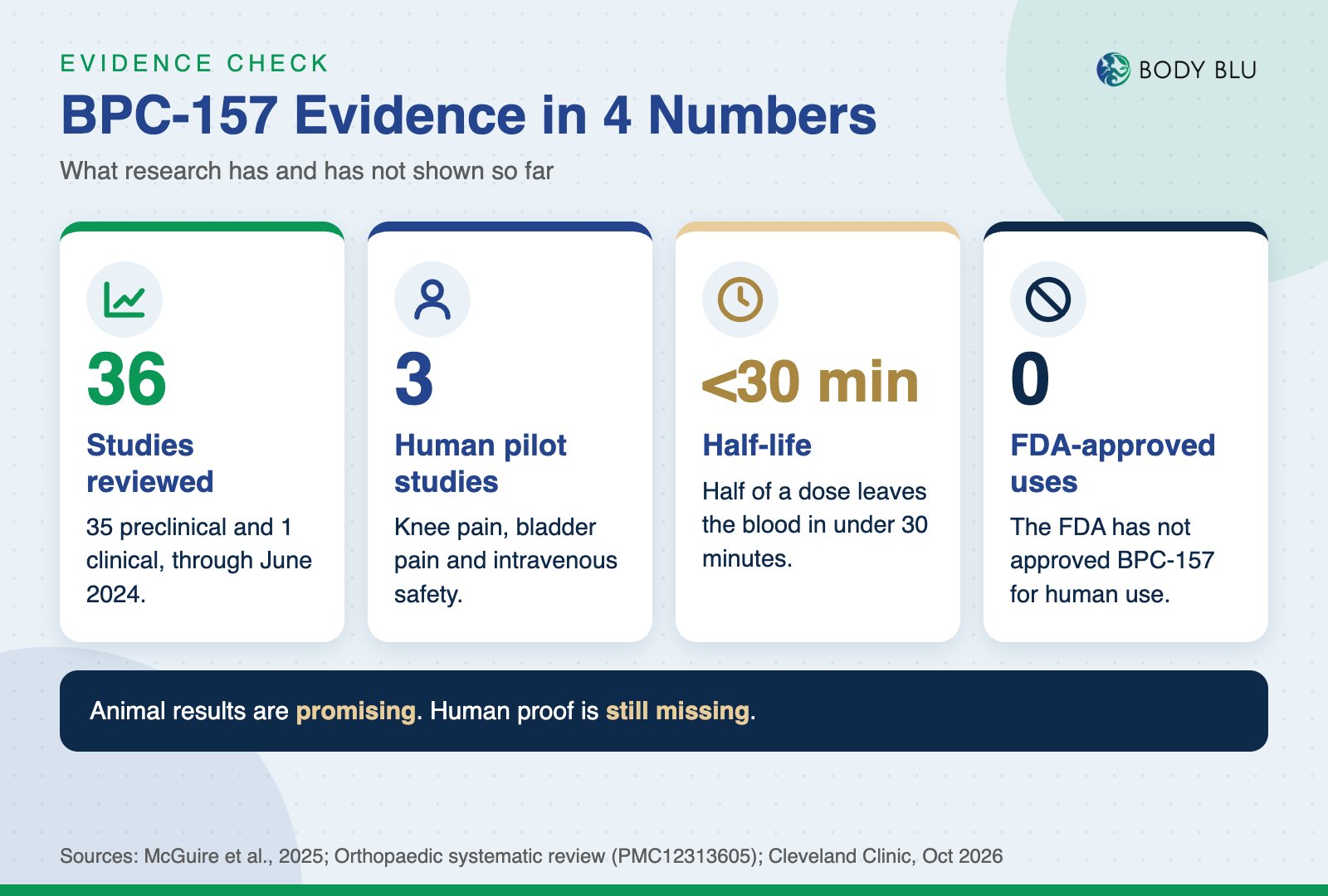
The graphic above summarizes the evidence in four numbers. The authors also note that every published study reports a positive result, which suggests possible publication bias. Inflammation and gut claims need a closer look next.
Does BPC-157 Help With Inflammation and IBS?
BPC-157 for inflammation and irritable bowel syndrome (IBS) has animal support but no confirmed human benefit. Animal studies show lower inflammatory messengers and a protected gut lining. Those findings explain why BPC 157 for inflammation appears in so many claims.
The FDA reviewed BPC-157 at a July 23, 2026 advisory meeting, and the listed use was ulcerative colitis. Ulcerative colitis is a form of inflammatory bowel disease, and IBS is a different condition. FDA briefing materials found that available studies, including 5 on BPC-157, were short, small and insufficient to establish safety or effectiveness.
Searches for BPC 157 for IBS therefore lack a human trial to cite. Gut symptoms such as bloating and loose stools have causes a provider can test first. Small intestinal bacterial overgrowth, or SIBO, is one example. Safety is the next concern.
Is BPC-157 Safe to Use?
BPC-157 safety is unproven in humans, because no large trial has measured side effects. The 3 small human studies reported no adverse effects. The orthopaedic review, however, found no clinical safety data at all.
Cleveland Clinic lists the main risks of buying BPC-157 now. The list below follows its warnings, plus a supply concern raised in the American Journal of Managed Care (AJMC).
- Product quality: a vial may fall below standards or carry contaminants such as lead or arsenic.
- Injection problems: self-injection carries risks that need professional guidance.
- Drug interactions: large trials have not tested BPC-157 with other medicines.
- Cancer concern: blood vessel growth could theoretically help tumors grow, and research has not ruled this out.
Catherine Varney, DO, of UVA Health told AJMC that gray-market peptides may contain 5% to 75% of the labeled amount. The FDA adverse event reporting system has logged 10 serious reports tied to BPC-157 since 2021, with 8 in 2026. Such reports do not establish that the peptide caused the events.
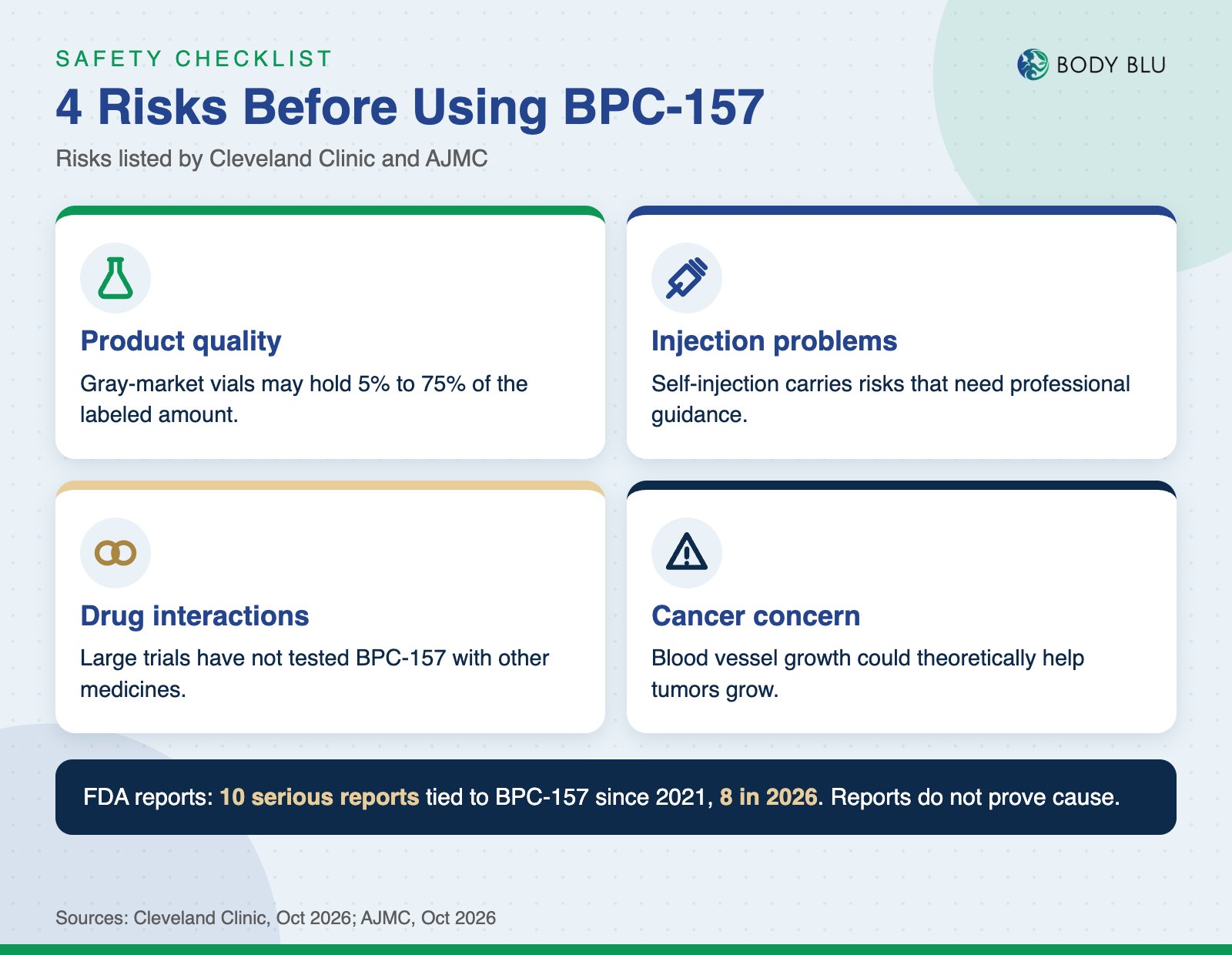
The checklist above shows why a provider should hear about any peptide use. Cleveland Clinic physician Layth Tumah, MD, advises healthy eating, regular exercise and other basics before experimental therapies. Our root-cause care starts with those basics. Legal status adds another layer.
What Is the Current FDA Status of BPC-157?
The current FDA status of BPC-157 is not approved for any use, as of October 31, 2026. Cleveland Clinic calls it an experimental compound that the FDA has not approved for use in humans. Four events between 2023 and 2026 shaped the rules around it.
- September 2023: the FDA placed BPC-157 in category 2, a list of bulk drug substances with possible significant safety risks.
- April 22, 2026: the FDA compounding page lists BPC-157 among substances previously in category 2 and withdrawn by their nominators.
- July 23, 2026: an FDA panel voted 8 to 6, with 1 abstention, to recommend BPC-157 for the 503A bulks list.
- October 30, 2026: HHS published a draft enforcement discretion policy in the Federal Register.
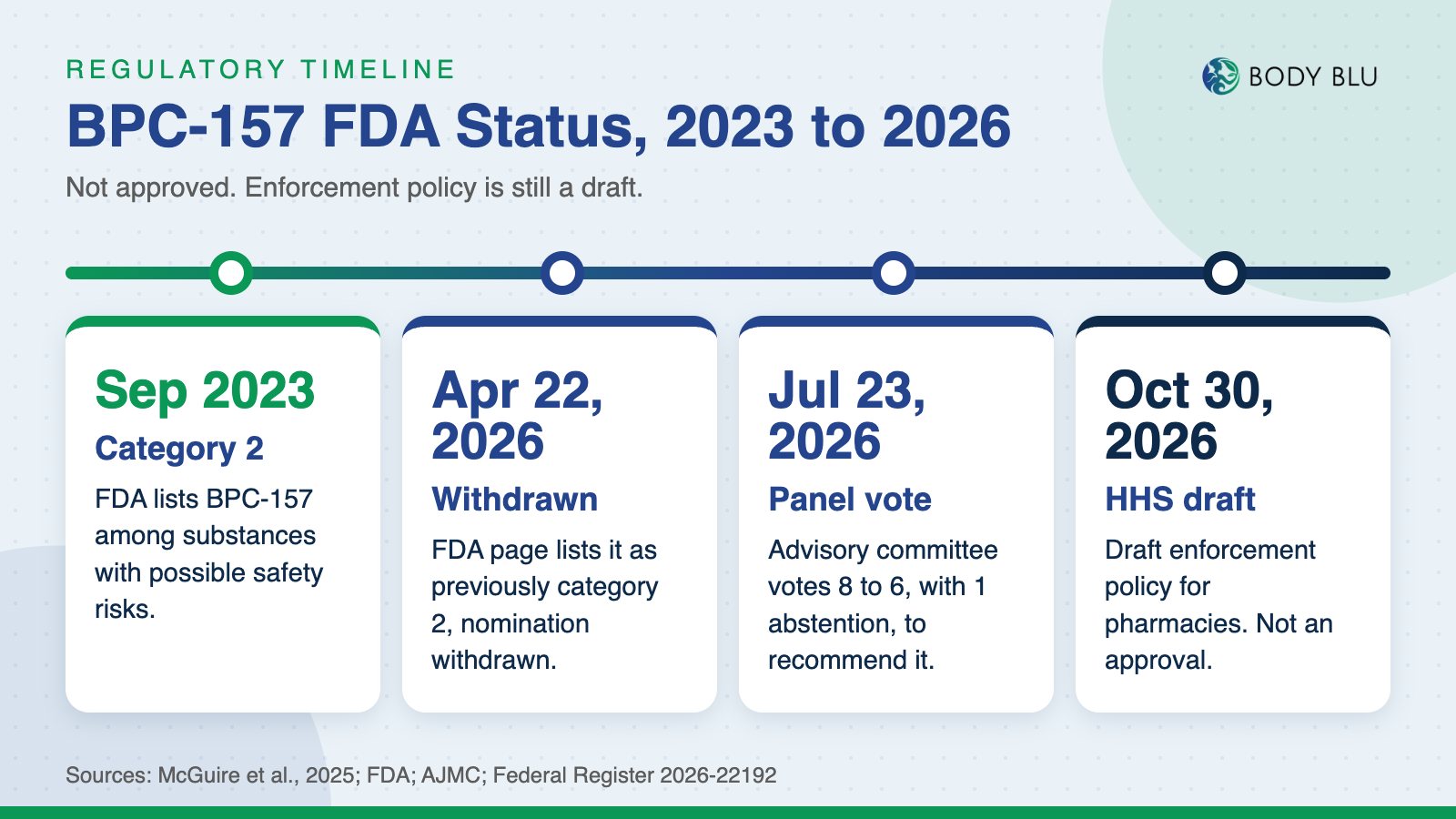
The timeline above ends with a draft policy, not an approval. HHS states that it does not intend to take enforcement action against a state-licensed pharmacy or physician compounding BPC-157. The policy sets conditions. AJMC reports 10 conditions, including an FDA-registered manufacturer, a certificate of analysis and a patient-specific prescription.
The notice also states that compounded drugs are not FDA-approved, so the FDA does not review their safety, effectiveness or quality. The policy is a draft, it is not binding, and HHS may revisit it if a safety signal appears. AJMC notes that formal rulemaking can take 12 to 24 months. That status decides whether a doctor can supply the peptide.
Can You Get BPC-157 From a Doctor?
Doctors can supply compounded BPC-157 only with a patient-specific prescription under the draft HHS policy. The policy offers enforcement discretion, not approval. The compounder must also meet its conditions.
Vials sold online "for research purposes only" are a different matter. Cleveland Clinic places them in the gray market and notes that sourcing is a major concern. Guidance on BPC-157 injections is also missing. Cleveland Clinic states that no universal direction exists on how much to take, how often or for how long.
Disclosure matters for any patient who uses a peptide. Cleveland Clinic explains that a provider needs to account for the compound when interpreting test results. Baseline laboratory testing gives that provider a reference point for later comparison.
Peptide decisions also depend on history, medicines and goals, so a short written list of current supplements and drugs helps. A licensed clinician can review that list with you during a peptide consult. The consult covers risks, evidence and legal status.
What Else Should You Know About BPC-157?
How Does BPC-157 Compare With Sermorelin?
BPC 157 and sermorelin differ in target and regulatory history. Sermorelin acts on the growth hormone cells of the pituitary gland, while BPC-157 research centers on blood vessel growth and tissue repair. The FDA once approved sermorelin acetate, sold as Geref, for children with growth failure from growth hormone deficiency. A 2013 Federal Register notice confirms this. BPC-157 has never received an FDA approval.
Is BPC-157 Banned in Sports?
BPC-157 is banned in sports under the World Anti-Doping Agency (WADA) rules. WADA listed it in 2022 under the S0 category of unapproved substances. Cleveland Clinic advises competitive athletes to be open with their provider about any use.
Does BPC-157 Help With Sleep, Diabetes or Hair?
BPC-157 has no human trial behind claims about sleep, diabetes or hair. None of the 3 published human studies tested those outcomes. Blood sugar concerns call for measured data, and we test fasting insulin and glucose together when checking for insulin resistance.
Frequently Asked Questions About BPC-157
Is It Safe to Take BPC-157 Every Day?
No daily schedule has been shown safe, because no large human trial tested one. Cleveland Clinic reports that no universal guidance exists on how often to take the peptide.
Is BPC-157 Hard on the Kidneys?
The reviews cited report no human data on kidney effects. The orthopaedic review reports that the liver metabolizes BPC-157 and the kidneys clear it, and it found no clinical safety data.
Can BPC-157 Help With Degenerative Disc Disease?
The reviews cited found no human evidence that BPC-157 helps degenerative disc disease. The 3 published human studies covered knee pain, interstitial cystitis and intravenous safety.
Can Peptides Help With Injury Recovery?
BPC-157 has not been proven to speed injury recovery in people. BPC-157 shows faster tendon and muscle healing in animals. The 2025 review concludes that it should not be recommended for clinical use until human trials are published.
How Does Body Blu Help With Peptide Questions?
Body Blu helps by reviewing peptide questions with a naturopathic doctor in a consult. We go through symptoms, history and goals, then explain which options fit and which do not. BPC-157 is not on our service list.
Each peptide review happens case by case in a consult. The peptide therapy page names GLP-1 and glutathione, and BPC-157 is not on it. We explain the evidence, the risks and the legal status before any decision.
Our review of glutathione evidence shows how we weigh research before recommending anything. That review states the benefits, the risks and the limits of the evidence, so patients see both sides. We apply the same standard to every peptide question.
Patients who want to compare other options can ask about NAD+ therapy during the same visit. Anyone considering BPC-157 peptide therapy should talk with a licensed provider first, because the research is early and the rules are changing.
Patients can visit the Body Blu office in Cardiff or Carlsbad to start that conversation.


Resources
From Our Blog
Naturopathic insights, wellness tips, and updates from the Body Blu team.
Treatments
What Is BPC-157 Peptide and What Does BPC-157 Peptide Do?
BPC-157 peptide is a lab-made chain of 15 amino acids that the FDA has not approved for any use. Evidence comes mainly from animal studies, and only 3 small human studies exist.

Treatments
BPC 157 Side Effects and BPC 157 Peptide Side Effects for Women
BPC 157 side effects reported by users include injection-site pain, fatigue and anxiety, but only 3 small human studies exist. The FDA has not approved BPC-157, so risks remain unknown.

Treatments
Sermorelin Before and After Results for Face, Women and Men
Sermorelin before and after changes in studies are small, slow and measured in blood tests. Trials of 11 to 19 adults found higher IGF-1 within 2 weeks, but no change in body weight.