


Signs of Insulin Resistance and How Do You Know If You Have It


Signs of insulin resistance include extra weight around the waist, tiredness after meals, strong sugar cravings and dark, velvety skin patches. The CDC reports that 115.2 million US adults have prediabetes, and 8 in 10 do not know it. This guide explains each sign, how the signs differ in women and men, and the tests that confirm insulin resistance.
Key Takeaways
- NIDDK reports that insulin resistance and prediabetes usually cause no symptoms.
- A waist over 40 inches in men or 35 inches in women is a measurable warning sign.
- Acanthosis nigricans (dark, velvety patches) and skin tags are the 2 visible skin changes.
- No routine test confirms insulin resistance, so providers combine waist, blood pressure, glucose, A1C and lipid results.
- The Diabetes Prevention Program lowered type 2 diabetes risk by 58% with lifestyle change.
What Are the Signs of Insulin Resistance?
The early signs of insulin resistance are a mix of waist, energy, appetite and skin changes that build gradually. Bupa Blua groups 10 subtle signs, and the 6 below are the ones you can see or feel.
- Weight gain around the waist
- Difficulty losing weight despite diet and activity changes
- Tiredness after meals
- Increased hunger or sugar cravings
- Dark, thick patches of skin
- Skin tags
The graphic below sorts these 6 signs by body area, from waist and energy to appetite and skin.
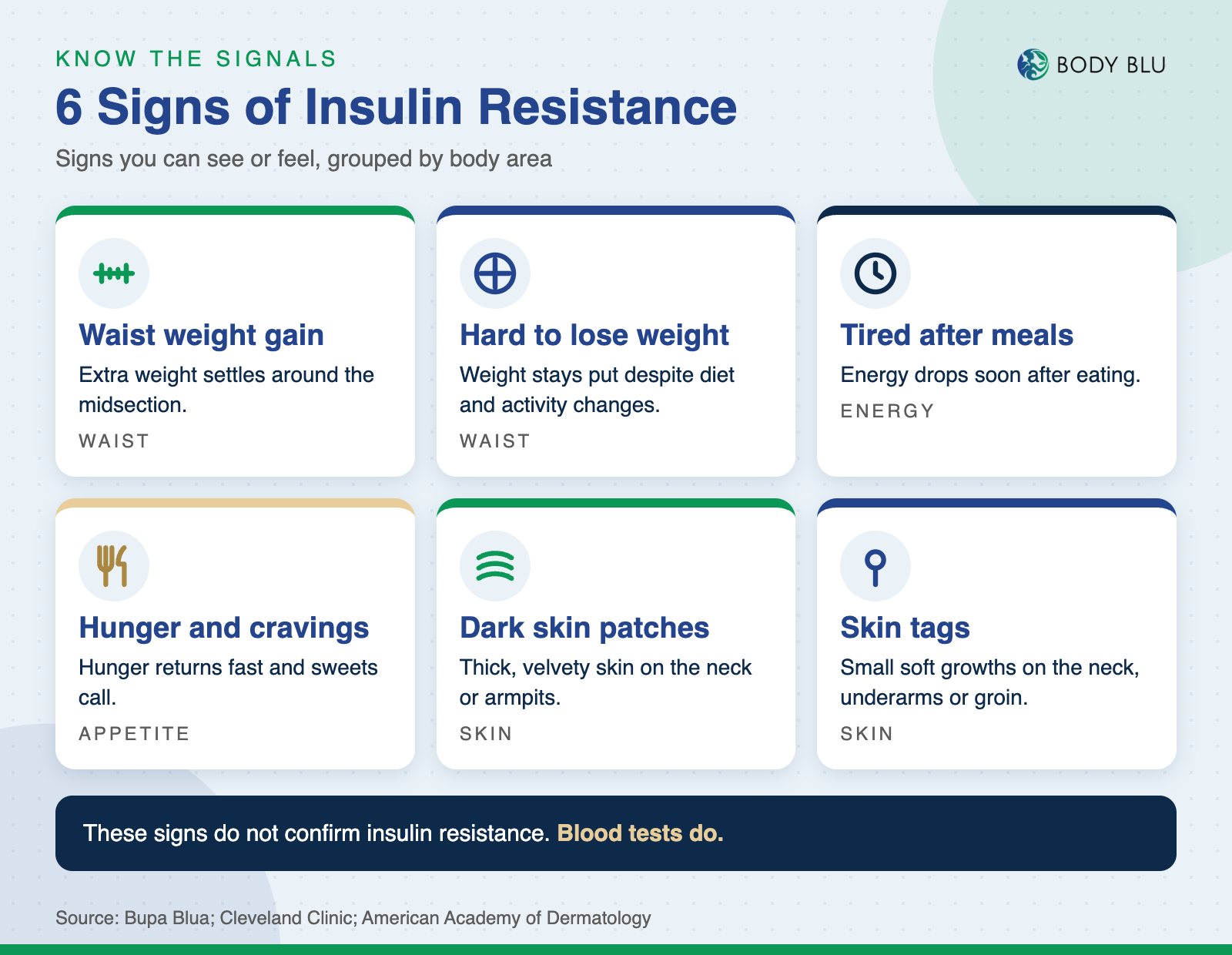
Each sign has other possible causes. Bupa Blua states that signs alone cannot diagnose insulin resistance and that blood tests are needed. We review these signs next to lab results as part of insulin resistance evaluation. That pairing separates insulin resistance from other conditions with the same complaints.
The lack of early signs complicates detection, because insulin resistance can exist with no signs at all.
Can You Have Insulin Resistance Without Symptoms?
Yes, you can have insulin resistance without any symptoms, because the pancreas hides the problem by making extra insulin. Cleveland Clinic explains that cells in muscle, fat and liver respond poorly to insulin. The pancreas then makes more insulin, which is called hyperinsulinemia.
Blood sugar stays in range while the pancreas keeps up, so no symptoms appear. NIDDK reports that people with insulin resistance and prediabetes usually have no symptoms. Cleveland Clinic adds that people can have no symptoms of prediabetes for years.
Awareness data show the gap clearly. The CDC finds that 8 in 10 adults with prediabetes do not know they have it. Symptoms of high blood sugar appear only after the pancreas can no longer keep up, according to Cleveland Clinic.
Cleveland Clinic ties symptoms to high blood sugar rather than to high insulin alone. Those blood sugar symptoms are the ones people describe when they ask what insulin resistance feels like.
What Does Insulin Resistance Feel Like?
Insulin resistance feels like tiredness after meals, hunger soon after eating and cravings for sweet foods, as Bupa Blua describes. Bupa Blua links post-meal tiredness to glucose that cells cannot use efficiently. Hunger returns when meals leave you unsatisfied despite eating enough.
Brain fog and energy highs and lows also appear on the Bupa Blua list. Bupa Blua adds that these 2 signs are not specific to insulin resistance and have many causes. Symptoms of insulin resistance are subtle, and WebMD states that you cannot tell by how you feel.
Blood sugar symptoms feel different. Consistently high blood sugar causes 7 symptoms, according to Cleveland Clinic. The symptoms are unexplained weight loss, fatigue, thirst, frequent urination, hunger, blurred vision and yeast infections.
Such symptoms mean the pancreas is falling behind, so they call for a provider visit. Skin changes work differently, because a provider can see them directly.
What Are the Skin Signs of Insulin Resistance?
Dark, velvety patches called acanthosis nigricans and soft skin tags are the 2 skin changes linked to insulin resistance. The American Academy of Dermatology says acanthosis nigricans darkens and thickens skin, and the skin feels like velvet. Cleveland Clinic places the patches in the armpit and on the back and sides of the neck.
A 2020 study of 320 adults aged 40 to 60 found acanthosis nigricans in 46.3% of participants. The study reported specificity for insulin resistance of 85% in adults with normal glucose and 90% in adults with prediabetes or diabetes. Specificity measures how rarely a sign appears in people without the condition.
A 2022 pediatric review names obesity as the most common cause of acanthosis nigricans. The table below compares the skin signs and the evidence behind each one.
| Skin sign | Where it appears | What the evidence says |
|---|---|---|
| Acanthosis nigricans | Neck, armpits and groin | Dark, thick, velvety skin that studies link to insulin resistance |
| Skin tags | Neck, underarms and groin | Small growths that a 2012 study associated with insulin resistance |
| Medicine-related patches | Varies by person | Some medicines cause acanthosis nigricans, so a dermatologist checks the cause |
The American Academy of Dermatology advises seeing a dermatologist for any area of darker, thicker skin. Scrubbing will not remove acanthosis nigricans. A provider can also remove skin tags through cosmetic lesion removal, but removal does not change insulin sensitivity.
Skin is not the only visible area, because waist size also gives a measurable clue.
Is Belly Fat a Sign of Insulin Resistance?
Yes, belly fat is linked to insulin resistance. Cleveland Clinic names excess body fat around the belly as 1 of 2 main contributing factors. Physical inactivity is the second factor on the Cleveland Clinic list. Belly fat therefore works as both a sign and a driver.
NHLBI defines abdominal obesity as a waist over 40 inches in men and over 35 inches in women. Providers may use different cutoffs by race and ethnicity. Bupa Blua adds that waist circumference can be a better risk indicator than weight alone.
Difficulty losing weight is the paired sign. Some people find weight loss harder despite diet and activity changes, according to Bupa Blua. Supervised medical weight loss programs can track waist size alongside lab follow-up.
Waist size matters for women and men, but the other signs differ between the sexes.
What Are the Signs of Insulin Resistance in Women?
The signs in women match the core list, with NHLBI thresholds of a waist over 35 inches and HDL under 50 mg/dL. Blood pressure of 130/85 mmHg or higher and triglycerides over 150 mg/dL apply to both sexes. HDL (high-density lipoprotein) is the "good" cholesterol, according to NHLBI.
Polycystic ovary syndrome (PCOS) adds a hormonal clue. NIDDK lists PCOS among the conditions that raise the chance of insulin resistance. A 2019 meta-analysis of 27 studies found 3.35 times higher odds of metabolic syndrome in women with PCOS.
Metabolic syndrome is a cluster of waist, blood pressure, glucose, HDL and triglyceride findings. Women with PCOS can have these markers reviewed together in polycystic ovary syndrome. The same thresholds then guide follow-up testing.
Men reach the same markers at different cutoffs, and men have 1 extra clue.
What Are the Signs of Insulin Resistance in Men?
The signs in men match the core list, with NHLBI thresholds of a waist over 40 inches and HDL under 40 mg/dL. Blood pressure and triglyceride thresholds match those for women. Waist size is the easiest of these markers to check at home.
Sexual health can carry a signal. A 2023 meta-analysis linked metabolic syndrome to up to a fourfold higher risk of erectile dysfunction. The same review linked metabolic syndrome to low testosterone.
Fully adjusted data in that review showed that other conditions explained more of the erectile dysfunction risk than the syndrome label itself. A provider can review testosterone and glucose together in low testosterone care. That review separates hormone causes from metabolic ones.
No single sign settles the question, so the next step is how providers confirm insulin resistance.
How Do You Know If You Have Insulin Resistance?
You know whether you have insulin resistance through a provider's review of history, exam and blood tests, because no routine test exists. Cleveland Clinic states that insulin resistance is hard to diagnose for this reason. NIDDK adds that the direct test is primarily used in research studies.
Providers therefore use markers that point to insulin resistance. The 5 steps below organize that process.
- Write down signs such as tiredness after meals, cravings and new skin changes.
- Measure your waist and compare it with 40 inches for men or 35 inches for women.
- Check blood pressure against the 130/85 mmHg threshold.
- Ask for a fasting glucose, an A1C and a lipid panel.
- Ask whether fasting insulin adds information to those results.
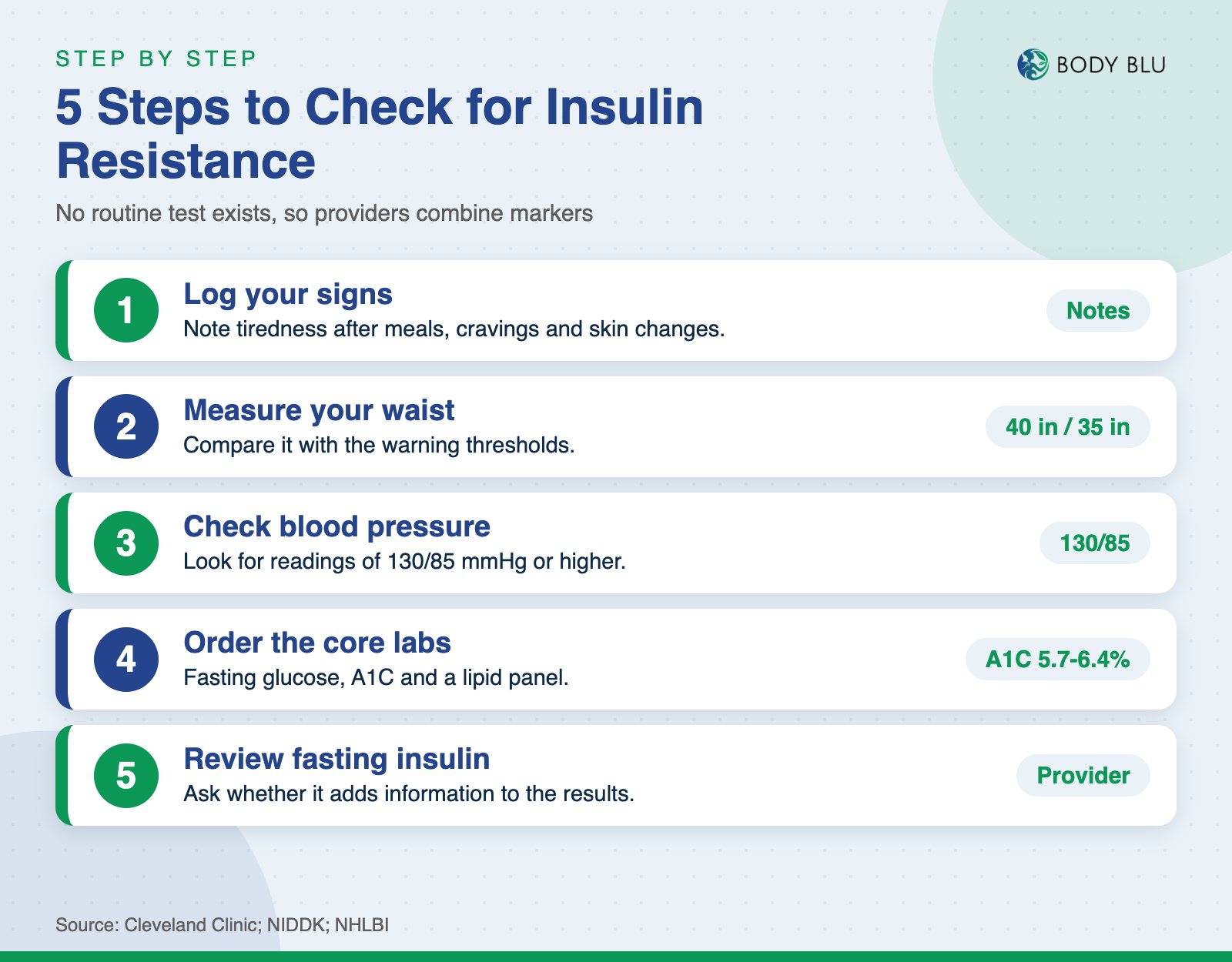
The table below lists the blood test cutoffs that providers use as warning markers.
| Test | Warning range | Source |
|---|---|---|
| A1C | 5.7% to 6.4% | NIDDK |
| Fasting plasma glucose | 100 to 125 mg/dL | NIDDK |
| Oral glucose tolerance test | 140 to 199 mg/dL | NIDDK |
| Triglycerides | Over 150 mg/dL | NHLBI |
| HDL cholesterol | Under 40 mg/dL (men) or 50 mg/dL (women) | NHLBI |
NIDDK states that adults with risk factors and normal tests may be retested at least every 3 years. Adults with prediabetes should be tested for type 2 diabetes every year. Adults can request insulin resistance testing after a high waist reading or a new skin change.
The triglyceride-glucose (TyG) index estimates insulin resistance from fasting triglycerides and fasting glucose. A systematic review of 15 studies and 69,922 participants found that TyG cutoffs varied between studies. TyG results therefore need careful interpretation.
We test fasting insulin and glucose together through metabolic lab work. That pairing shows how much insulin the body needs to hold glucose steady. Providers may order tests at age 35 or older, or with overweight and other risk factors, according to NIDDK.
Risk factors decide who should ask for these tests first.
Who Is More Likely to Have Insulin Resistance?
People with excess belly fat, low activity or a family history of diabetes are more likely to have insulin resistance. NIDDK lists 9 risk factors, and Cleveland Clinic names the same main ones.
- Overweight, obesity or a large waist size
- Age 35 or older
- A family history of diabetes
- African American, American Indian, Asian American, Hispanic, Latino or Pacific Islander background
- Low physical activity
- Smoking, including e-cigarettes and secondhand smoke
- A history of gestational diabetes
- PCOS, Cushing's syndrome, acromegaly, sleep apnea or COVID-19
- Glucocorticoids, some antipsychotics and some HIV medicines
Cleveland Clinic names 3 hormonal disorders that can cause insulin resistance: Cushing's syndrome, acromegaly and hypothyroidism. A provider can screen for these disorders through hormone testing. NIDDK states that researchers do not fully understand what causes insulin resistance.
Risk factors raise the chance but do not decide the outcome. Weight, activity and sleep can change, which is why the signs can also improve.
What Are the Signs Insulin Resistance Is Reversing?
The signs insulin resistance is reversing are a smaller waist and improving lab markers that a provider confirms with repeat testing. Providers re-check the same 6 markers that flagged the problem. The markers are waist size, blood pressure, triglycerides, HDL cholesterol, fasting glucose and A1C.
Evidence supports improvement more firmly than full reversal. WebMD quotes endocrinologist Janine Suarez, MD, who says complete reversal is hard to confirm but lifestyle changes can improve insulin resistance greatly. NIDDK states that healthy living may help prevent or reverse insulin resistance and prediabetes.
The Diabetes Prevention Program enrolled 3,234 adults at high risk of type 2 diabetes. Its lifestyle program lowered the chance of type 2 diabetes by 58% over about 3 years compared with placebo. Participants aimed for 7% weight loss and 150 minutes of activity per week.
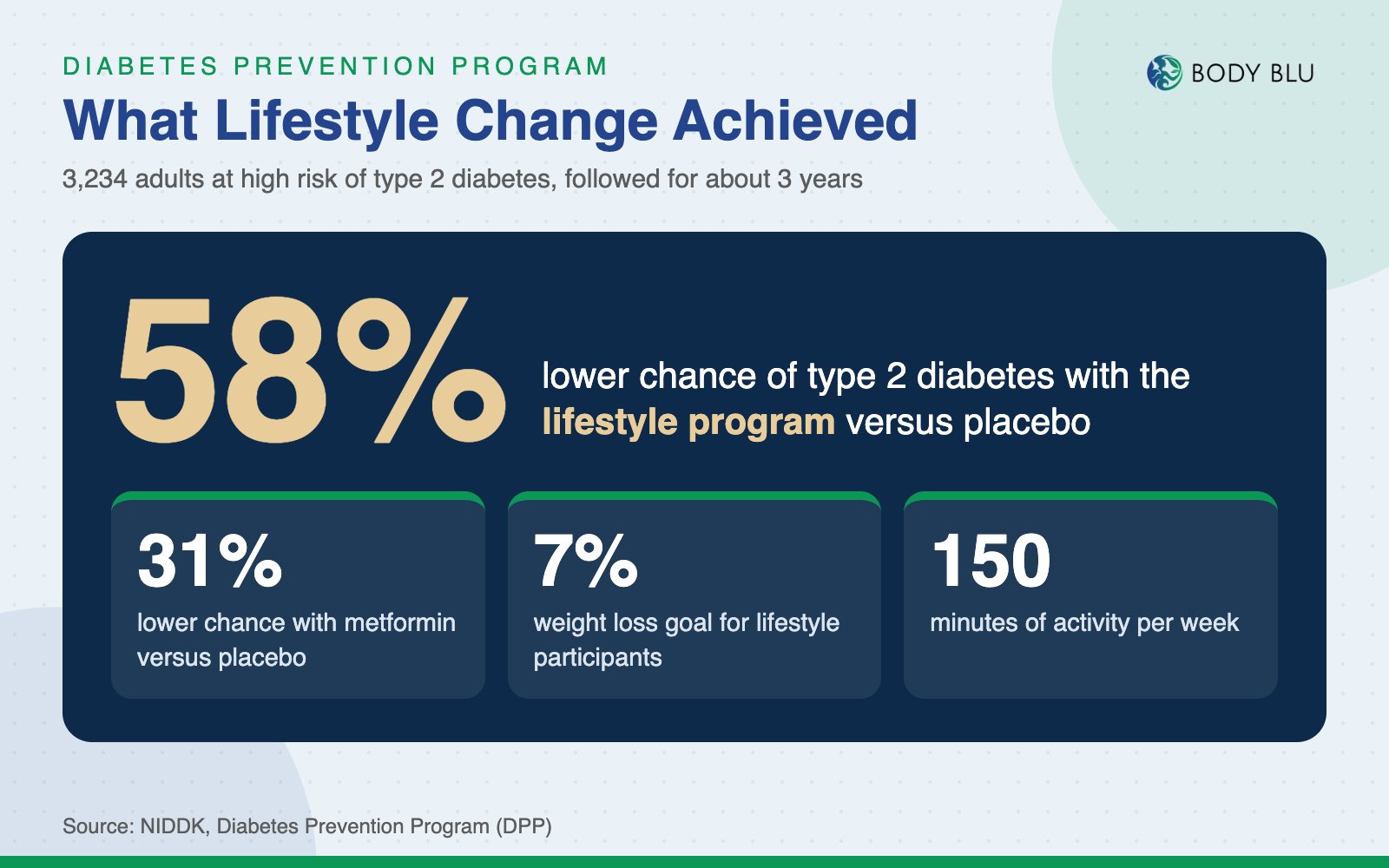
The graphic above shows the program results, including the 31% reduction seen with metformin. A provider decides whether medicine fits, and blood sugar support can combine nutrition, activity and lab follow-up. NIDDK reports that losing 5% to 7% of starting weight reduced the chance of developing diabetes.
Several side questions about insulin resistance signs remain.
What Else Should You Know About Insulin Resistance Signs?
Is Insulin Resistance the Same as Diabetes?
No, insulin resistance is not the same as diabetes, because blood sugar can stay normal while cells resist insulin, as WebMD explains. Prediabetes means glucose runs above normal but below the diabetes range. NIDDK reports a high chance of type 2 diabetes within 5 to 10 years in people with prediabetes.
Progression is not certain. Cleveland Clinic states that some people have mild insulin resistance that never turns into prediabetes or type 2 diabetes.
Can You Check for Insulin Resistance at Home?
No, you cannot confirm insulin resistance at home, but you can collect clues to bring to a provider. A tape measure gives a waist number to compare with the 40-inch and 35-inch thresholds. A home blood pressure cuff shows readings to compare with 130/85 mmHg.
A glucose meter measures glucose, not insulin. WebMD notes that blood sugar can remain normal in insulin resistance. A normal meter reading therefore does not rule out the condition.
What Are the Symptoms of Brain Insulin Resistance?
Brain insulin resistance symptoms are not yet defined by a confirmed checklist, because research on the condition is still early. A 2024 systematic review of 17 studies linked brain insulin resistance to neurodegenerative disease such as Alzheimer's disease. The review focused on those diseases, so brain fog alone cannot confirm it.
Persistent mental sluggishness has many causes. A provider can look at blood sugar, sleep and other causes together, including through brain fog support programs.
Does Sleep Apnea Affect Insulin Resistance?
Yes, sleep apnea is linked to insulin resistance, and NIDDK lists it among the conditions that raise the chance. A 2015 meta-analysis of randomized trials found that people treated with continuous positive airway pressure (CPAP) had a lower HOMA-IR score. The difference was 0.43 points compared with untreated participants.
HOMA-IR is a score calculated from fasting glucose and fasting insulin. Researchers use that score to estimate insulin resistance in studies.
When Should You See a Provider About These Signs?
You should see a provider when signs persist for several weeks or appear together, according to Bupa Blua. Bupa Blua also lists reasons to ask for testing. Reasons include a family history of type 2 diabetes, excess weight, high blood pressure and abnormal cholesterol.
A clinic that reads labs and signs together can turn that conversation into a plan.
How Can Body Blu Help With Insulin Resistance?
Body Blu helps with insulin resistance by reviewing signs, risk factors and fasting insulin and glucose labs together. Our approach follows naturopathic medicine principles under Dr. Joseph Scarpuzzi, ND. Plans combine personalized nutrition, lifestyle changes and lab-guided strategies.
This guide offers general education and does not diagnose any condition. Anyone who notices several signs of insulin resistance can request a discovery call to start. Bring notes on waist size, blood pressure readings and any lab results from the past year.
Appointments are available at our Cardiff and Carlsbad locations. The Body Blu team follows a root-cause approach to every plan review.


Resources
From Our Blog
Naturopathic insights, wellness tips, and updates from the Body Blu team.

Treatments
What Is BPC-157 Peptide and What Does BPC-157 Peptide Do?
BPC-157 peptide is a lab-made chain of 15 amino acids that the FDA has not approved for any use. Evidence comes mainly from animal studies, and only 3 small human studies exist.

Treatments
BPC 157 Side Effects and BPC 157 Peptide Side Effects for Women
BPC 157 side effects reported by users include injection-site pain, fatigue and anxiety, but only 3 small human studies exist. The FDA has not approved BPC-157, so risks remain unknown.

Treatments
Sermorelin Before and After Results for Face, Women and Men
Sermorelin before and after changes in studies are small, slow and measured in blood tests. Trials of 11 to 19 adults found higher IGF-1 within 2 weeks, but no change in body weight.