


What Are Symptoms of Perimenopause and Early Signs at Age 40


Perimenopause symptoms start with irregular periods, then add hot flashes, night sweats, poor sleep, mood changes and vaginal dryness. The short answer to "what are symptoms of perimenopause" begins in the 40s, per Mayo Clinic. A cycle that shifts by 7 days or more marks the early stage. Frequent hot flashes lasted a median of 7.4 years in the SWAN study.
Key Takeaways
- Irregular periods are the first sign, and a cycle that shifts by 7 days or more marks early perimenopause.
- Hot flashes, night sweats, sleep problems, mood changes and vaginal dryness follow as estrogen falls.
- Frequent hot flashes lasted a median of 7.4 years among 1,449 women in the SWAN study.
- Hormone tests are not needed to diagnose perimenopause, because levels swing too much.
- A provider should review very heavy bleeding, or bleeding after 12 months without a period.
What Are Symptoms of Perimenopause?
Symptoms of perimenopause are changes in periods, body temperature, sleep, mood and vaginal health that follow shifting hormones. Mayo Clinic names estrogen and progesterone as the 2 hormones behind the transition. Estrogen rises and falls during these years, and lower estrogen drives many of the changes.
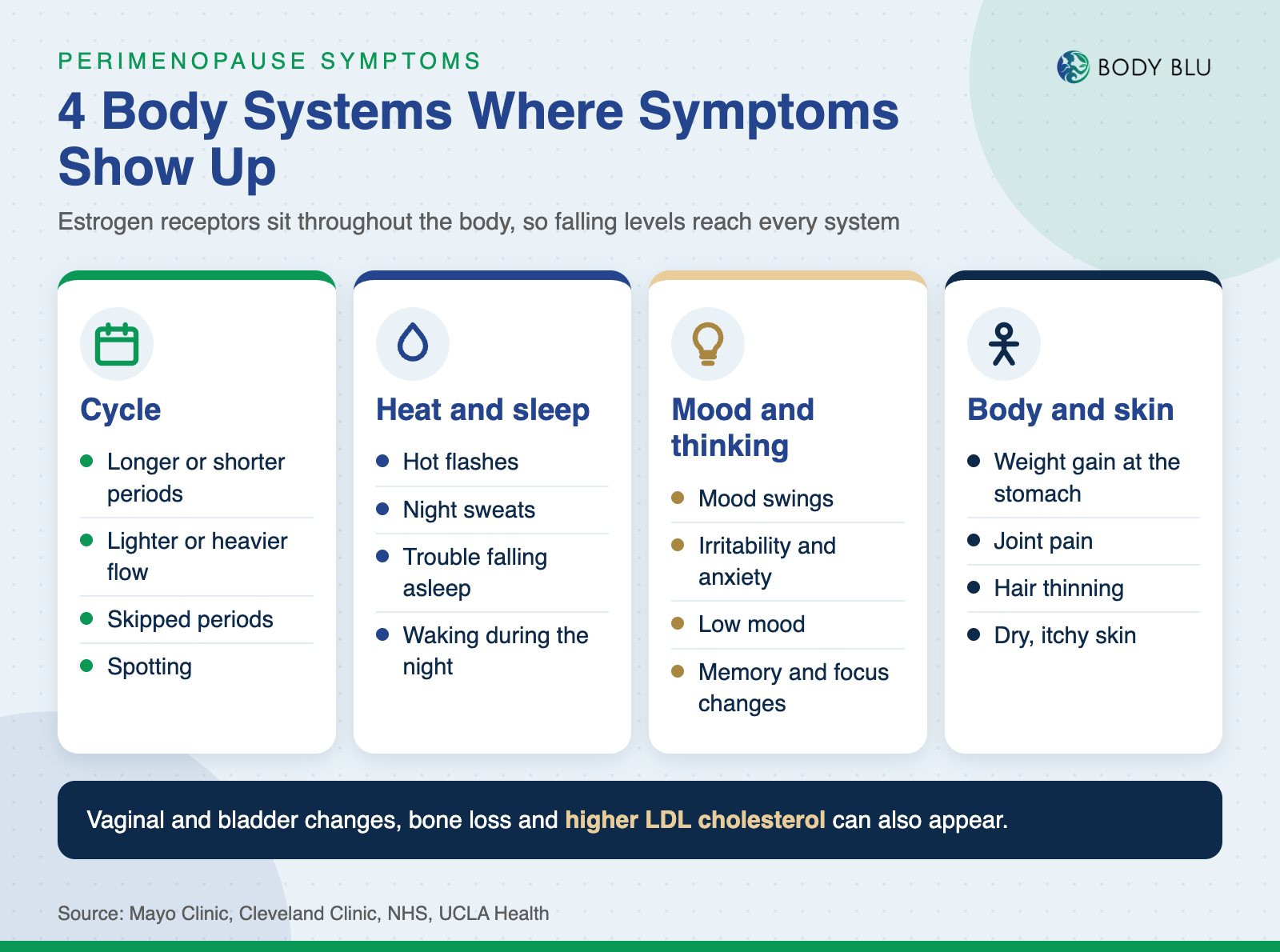
The list of perimenopause symptoms runs wider than hot flashes. Cleveland Clinic names irregular periods, heavier or lighter bleeding, mood changes, vaginal dryness, urinary urgency and sleep problems. The NHS adds weight gain, palpitations, headaches, joint pain, hair thinning, dry skin and sensitive teeth. Symptoms vary between women, and some notice only skipped periods.
The table below groups these symptoms by body system. Body Blu reviews each system during perimenopause care before any lab work is ordered.
| Body system | Symptoms | Source |
|---|---|---|
| Cycle | Longer, shorter, lighter, heavier or skipped periods; spotting | Mayo Clinic, Cleveland Clinic |
| Heat and sleep | Hot flashes, night sweats, trouble falling or staying asleep | Mayo Clinic, NHS |
| Mood and thinking | Mood swings, irritability, anxiety, low mood, memory and focus changes | Cleveland Clinic, NHS, Office on Women's Health |
| Vagina and bladder | Dryness, pain during sex, urgency, more urinary tract infections | Mayo Clinic, NHS |
| Body and skin | Weight gain around the stomach, joint pain, hair thinning, dry and itchy skin, palpitations | NHS, UCLA Health |
| Long-term markers | Faster bone loss and higher LDL cholesterol | Mayo Clinic |
UCLA Health explains that estrogen receptors sit throughout the body, so falling levels can cause symptoms in every row above. The cycle row usually changes first. Those cycle changes are the early signs, and they look different at age 40.
What Are the Early Signs of Perimenopause at Age 40?
The early signs of perimenopause at age 40 are a cycle that changes length, plus stronger PMS and lighter sleep. Cleveland Clinic calls irregular periods the first sign of perimenopause. Mayo Clinic adds that a cycle length consistently 7 days or more different from your usual points to early perimenopause. The checklist graphic below shows these early symptoms of perimenopause to track:
- A cycle that runs 7 or more days longer or shorter than your usual length.
- Periods that turn heavier or lighter.
- Stronger PMS, mood symptoms and fatigue before a period, according to UCLA Health.
- Sleep that changes even without night sweats, according to Mayo Clinic.
- New hot flashes or vaginal dryness, which Cleveland Clinic says many people notice early.

Symptoms of perimenopause at 40 sit earlier than the typical window. Cleveland Clinic places the usual start in the mid-40s. The National Institute on Aging says most women begin the transition between ages 45 and 55. Mayo Clinic and UCLA Health both report that signs can appear in the 30s.
Several factors move the start earlier. Mayo Clinic lists smoking, which brings menopause 1 to 2 years sooner, plus family history, cancer treatment and autoimmune disease. Thyroid disease is also on that list, so Body Blu checks conditions such as Hashimoto's thyroiditis alongside hormone symptoms. Menopause before age 40 is called premature menopause by Cleveland Clinic and needs medical review.
Hormonal birth control complicates the picture. UCLA Health states that hormonal birth control masks perimenopause, because it controls the cycle. The early signs also shift as the transition moves from early to late perimenopause.
How Do Perimenopause Symptoms Change From Early to Late Perimenopause?
Perimenopause symptoms change from cycle shifts in early perimenopause to hot flashes and long gaps between periods in late perimenopause. Mayo Clinic marks early perimenopause by a cycle that differs by 7 days or more. The same source marks late perimenopause by 60 days or more between periods. The table below compares the stages.
| Stage | Cycle pattern | Symptoms to expect | Source |
|---|---|---|---|
| Early perimenopause | Cycle length differs by 7 days or more | PMS changes, sleep shifts, mood changes | Mayo Clinic, UCLA Health |
| Late perimenopause | 60 days or more between periods | Hot flashes, night sweats, vaginal dryness | Mayo Clinic, Gold 2006 |
| Menopause | 12 months with no period | Symptoms can continue; bone and heart changes | Mayo Clinic, NIA |
Late perimenopause carries the strongest link to hot flashes. Gold and colleagues followed 3,198 women in the SWAN study. Late perimenopause showed an adjusted odds ratio of 6.64 for hot flashes. Researchers who wrote the 2012 STRAW+10 staging consensus also split the transition into early and late stages. These hormone shifts raise a practical question about their cause.
What Causes Perimenopause Symptoms?
What causes perimenopause symptoms is the rise and fall of estrogen and progesterone as the ovaries slow down. Mayo Clinic says lower estrogen causes many of the changes. Cleveland Clinic adds that falling estrogen throws off the balance with progesterone, the second ovarian hormone. Ovulation becomes unpredictable, and the cycle follows.
What Are Low Progesterone Symptoms in Perimenopause?
Low progesterone symptoms in perimenopause are irregular periods plus mood changes, anxiety or depression, according to Cleveland Clinic. The same page says low progesterone lets estrogen dominate. Progesterone levels also change across the cycle, so a provider reads any result against cycle timing.
Body Blu sees this pattern as one piece of a wider hormonal imbalance picture. Cleveland Clinic states that hormone testing is not necessary to diagnose perimenopause. Hormone levels fluctuate so much that single tests can mislead, which is why a symptom history carries more weight.
How Does Perimenopause Affect Mood and Brain Function?
Perimenopause affects mood and thinking through hormone swings linked with low mood and slower learning. Freeman and colleagues followed women with no history of depression. High depressive-symptom scores were more than 4 times as likely in the transition, and depressive disorder was 2.5 times as likely.
Perimenopause brain fog symptoms have measured support. Greendale and colleagues tested 2,362 women over 4 years in the SWAN study. Delayed recall scores did not improve during early or late perimenopause, and scores rebounded after menopause. The Office on Women's Health says these memory changes often improve after menopause. Body Blu reviews cognitive issues alongside hormone patterns.
Anxiety also tracks with the transition. Gold and colleagues linked baseline anxiety symptoms to hot flashes, with an adjusted odds ratio of 3.10. Body Blu offers naturopathic anxiety care for people whose worry rises during the transition. Greendale and colleagues described these memory changes as possibly time-limited, and the next section gives the timeline.
How Long Do Perimenopause Symptoms Last?
Perimenopause symptoms last about 4 years on average, and frequent hot flashes last a median of 7.4 years. Cleveland Clinic gives the 4-year average for perimenopause, with a range up to 8 years. The NHS says symptoms usually last 7 to 9 years. Avis and colleagues measured the median hot flash duration in 1,449 SWAN women.
Timing varies by starting point and background. Women who were premenopausal or in early perimenopause at their first frequent hot flashes had a median above 11.8 years. African American women had a median of 10.1 years. Frequent hot flashes persisted a median of 4.5 years after the final period.
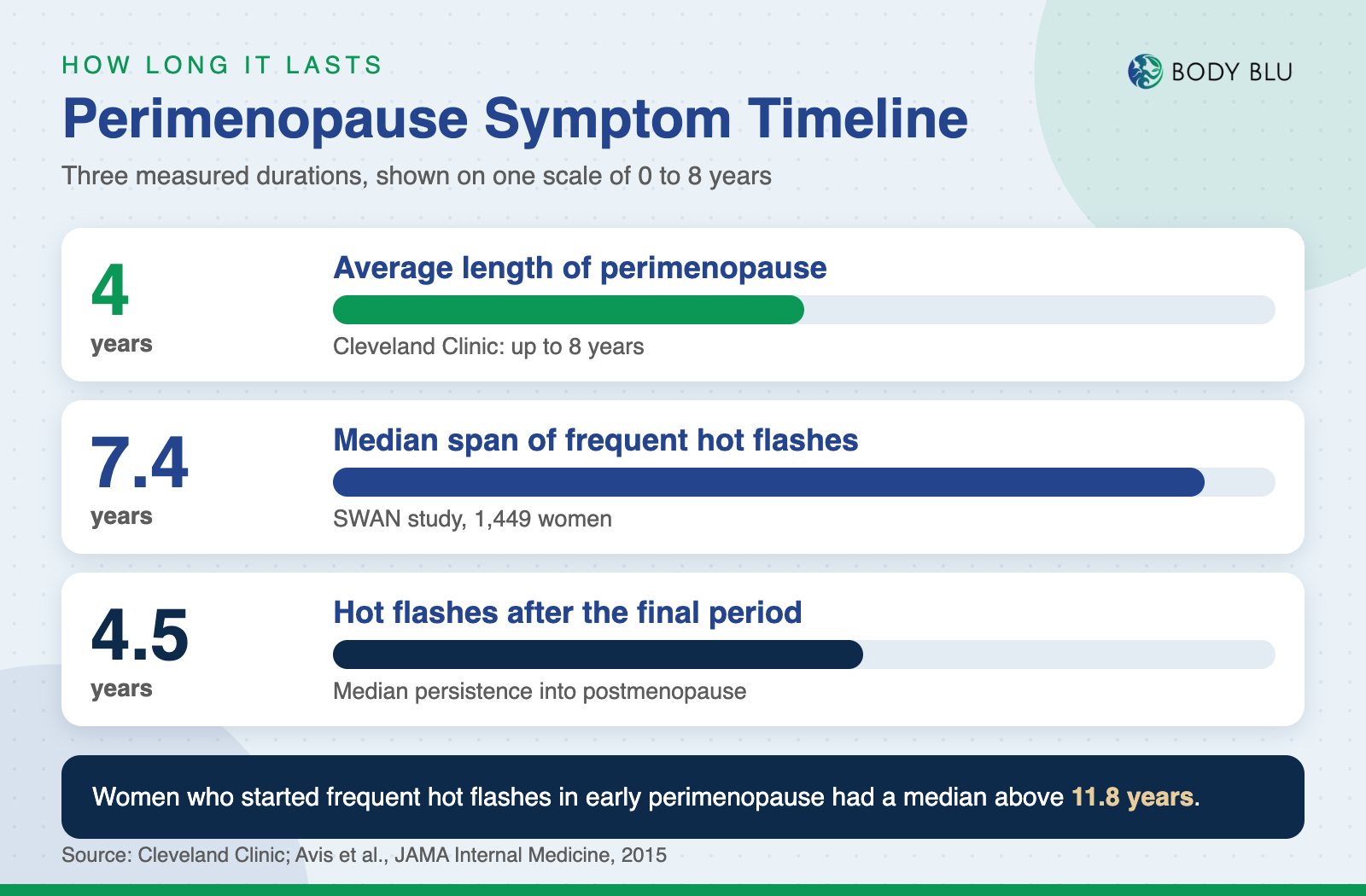
The graphic above lines up those 3 durations. Duration alone does not show whether symptoms come from perimenopause. A provider confirms that with a short review.
How Do You Know If Your Symptoms Are From Perimenopause?
You know symptoms are from perimenopause when a provider reviews your age, symptom pattern, cycle history and other possible causes. Cleveland Clinic says a physical exam, symptoms, age and medical history can support the conclusion. Mayo Clinic notes that symptoms can develop slowly, so some people do not link them to perimenopause at first.
Follicle-stimulating hormone (FSH) is the hormone that labs measure to look for the transition. UCLA Health says a level over 25 raises suspicion. A level of 50 or more makes perimenopause most likely, though no definitive test exists. Cleveland Clinic cautions that FSH swings can mislead. Body Blu uses hormone lab work to rule out thyroid, nutrient and other causes of similar symptoms.
A symptom log gives the provider the most useful record. Cleveland Clinic and UCLA Health both advise keeping a journal. Follow these steps for 2 to 3 cycles:
- Record the start date, stop date and flow of each period.
- Note hot flashes, night sweats and wake-ups each day.
- Rate mood, focus and energy on a 1 to 5 scale.
- List medicines, supplements and any hormonal birth control.
- Bring the log and your questions to the appointment.
Some patterns need prompt review rather than a log. Mayo Clinic and Cleveland Clinic list these bleeding patterns that call for a provider visit:
- Very heavy bleeding or large blood clots.
- Changing pads or tampons every 1 to 2 hours.
- Bleeding that lasts longer than 7 days.
- Spotting or bleeding between periods.
- Periods less than 21 days apart.
- Any bleeding after 12 months without a period.
Pregnancy remains possible during this time. The NHS advises contraception for 2 years after the final period at ages 40 to 49. A confirmed pattern then leads to the options for relief.
What Helps With Perimenopause Symptoms?
What helps with perimenopause symptoms is a plan matched to the symptom, from lifestyle changes to hormone therapy. Cleveland Clinic says many people need no medication, while others find relief with medicine. The table below lists the main perimenopause symptoms and treatment options, with the evidence source.
| Option | Main target | Source |
|---|---|---|
| Lifestyle changes | Hot flashes, sleep, weight and mood | Cleveland Clinic |
| Hormone therapy | Hot flashes, vaginal dryness, bone loss | FDA |
| Birth control pills | Cycle control and symptom relief | Cleveland Clinic |
| Nonhormonal medicines | Hot flashes, mood and anxiety | UCLA Health, Cleveland Clinic |
| Vaginal estrogen and creams | Dryness, pain during sex, urinary symptoms | Office on Women's Health |
| Talk therapy and mindfulness | Depression and anxiety | Office on Women's Health |
Cleveland Clinic recommends these lifestyle steps for how to help perimenopause symptoms:
- Eat fruits, vegetables, whole grains, lean protein and healthy fats.
- Do weight-bearing exercise such as walking or strength training.
- Dress in layers and keep the room cool.
- Limit alcohol and caffeine.
- Practice stress management and avoid tobacco.
Hormone therapy has a recent label update. On February 12, 2026, the FDA approved label changes for 6 hormone therapy products. Statements on cardiovascular disease, breast cancer and probable dementia were removed from the boxed warning. The FDA reported about 41 million US women aged 45 to 64 in 2020. Only about 2 million women aged 46 to 65 held a hormone therapy prescription.
Individual risk still differs, so the choice belongs with your provider. The Office on Women's Health states that hormone therapy is not used for brain fog or memory problems alone. Body Blu explains the label change in its guide to bioidentical hormone therapy. These options leave several smaller questions that women ask next.
What Else Should You Know About Perimenopause Symptoms?
Are Perimenopause Symptoms Worse During Period?
Perimenopause symptoms can be worse in the days before a period. Cleveland Clinic says some people notice PMS symptoms get worse. UCLA Health explains that sensitivity to the drop in estrogen before a period increases. Mood symptoms, PMS and fatigue then rise at that point in the cycle.
When Are Perimenopause Symptoms the Worst?
Perimenopause symptoms are the worst in late perimenopause, according to hot flash data from the SWAN study. Gold and colleagues found women reported hot flashes most often in late perimenopause and nearly as often after menopause. Hot flashes then persisted a median of 4.5 years after the final period.
Does Perimenopause Cause Weight Gain?
Perimenopause is linked with weight gain around the stomach and upper body, according to the NHS. The National Institute on Aging adds that the body begins to use energy differently and fat distribution changes. Cleveland Clinic states that low progesterone alone is not usually a cause of weight gain. Body Blu supports sustainable weight management after a hormone review.
Can Perimenopause Cause Hair Loss and Itchy Skin?
Perimenopause can cause hair thinning, hair loss and dry, itchy skin, according to the NHS list of other symptoms. UCLA Health explains that lower estrogen can affect the skin and hair. Persistent itching or rash deserves a skin exam, because other conditions share these signs.
Can Stress Change Perimenopause Symptoms?
Stress is linked with longer-lasting hot flashes in the SWAN study. Avis and colleagues found that greater perceived stress, anxiety and depressive symptoms at first report related to longer duration. SWAN is an observational study, so it shows an association rather than a cause. Body Blu reviews stress hormones through adrenal support when stress runs high.
Do Perimenopause Symptoms Differ by Ethnicity?
Perimenopause symptoms can differ by ethnic background, according to the NHS. The NHS says Black women are more likely to have hot flushes that are severe and last longer. SWAN supports this with a median hot flash duration of 10.1 years for African American women, against 7.4 years overall.
How Does Body Blu Help With Perimenopause Symptoms?
Body Blu helps with perimenopause symptoms through a root-cause review of your cycle history, symptoms and labs. A licensed naturopathic doctor leads the review. Our team starts with your log and your own answer to "what are symptoms of perimenopause" for your body. We then explain the options in plain language, from lifestyle changes to hormone therapy discussions.
That review sits inside our whole-body care approach. Our doctor coordinates with your gynecologist or primary provider on bleeding changes and prescriptions. Follow-up visits track how symptoms change over the months.
Patients who want ongoing guidance through each stage can book menopause support. Each plan starts from your own log, your history and your goals.
We do not diagnose perimenopause from a blog post, and nothing here replaces medical advice. Talk to your provider about heavy bleeding or bleeding after menopause. Call or text 988 for thoughts of self-harm. Visit Body Blu practice in Cardiff to start a conversation about your symptoms.


Resources
From Our Blog
Naturopathic insights, wellness tips, and updates from the Body Blu team.

Treatments
What Is BPC-157 Peptide and What Does BPC-157 Peptide Do?
BPC-157 peptide is a lab-made chain of 15 amino acids that the FDA has not approved for any use. Evidence comes mainly from animal studies, and only 3 small human studies exist.

Treatments
BPC 157 Side Effects and BPC 157 Peptide Side Effects for Women
BPC 157 side effects reported by users include injection-site pain, fatigue and anxiety, but only 3 small human studies exist. The FDA has not approved BPC-157, so risks remain unknown.

Treatments
Sermorelin Before and After Results for Face, Women and Men
Sermorelin before and after changes in studies are small, slow and measured in blood tests. Trials of 11 to 19 adults found higher IGF-1 within 2 weeks, but no change in body weight.