


What Is Insulin Resistance and What Does Insulin Resistance Mean?


Insulin resistance is a condition in which muscle, fat and liver cells respond poorly to insulin. The pancreas then makes extra insulin to hold blood sugar steady. The CDC reports that 115.2 million US adults had prediabetes in 2023, a condition that insulin resistance sets the stage for. This guide covers what is insulin resistance, how providers test for it and how to improve it.
Key Takeaways
- Insulin resistance means cells respond poorly to insulin, and the pancreas compensates with extra insulin.
- NIDDK states that people with insulin resistance and prediabetes usually have no symptoms.
- Prediabetes starts at an A1C of 5.7% or a fasting glucose of 100 mg/dL.
- Losing 5% to 7% of starting weight lowered diabetes risk in the Diabetes Prevention Program.
- No medication is approved specifically for insulin resistance, so lifestyle changes come first.
What Is Insulin Resistance and What Does Insulin Resistance Mean?
Insulin resistance is a condition in which muscle, fat and liver cells respond poorly to insulin. Cleveland Clinic also calls it impaired insulin sensitivity. Insulin is a hormone that the pancreas makes. The hormone moves glucose, the body's main sugar, from the blood into cells for energy.
The meaning of insulin resistance is a signaling problem, not a shortage of insulin. Cells stop answering the hormone's signal, so glucose stays in the blood longer. The pancreas then releases more insulin. Blood sugar stays in a healthy range for as long as the pancreas keeps up, Cleveland Clinic explains.
Insulin resistance can affect anyone, and a person does not need diabetes to have it. The condition can be temporary, such as during a short course of steroid medicine, or chronic. Cleveland Clinic names excess belly fat and physical inactivity as the 2 main contributors.
Body Blu reviews insulin and glucose together as part of insulin resistance care. That review supports a primary care evaluation and does not replace it. The next section explains how the process unfolds.
How Does Insulin Resistance Develop Step by Step?
Insulin resistance develops in 4 steps that start with a rise in blood sugar, based on the CDC's description. The steps below follow that sequence in order.
- Food breaks down into sugars, and blood sugar rises.
- The pancreas releases high levels of insulin to move that sugar into cells.
- Cells respond less to insulin over time, so blood sugar stays high and the pancreas keeps releasing more.
- The pancreas eventually cannot keep up, and blood sugar keeps climbing.
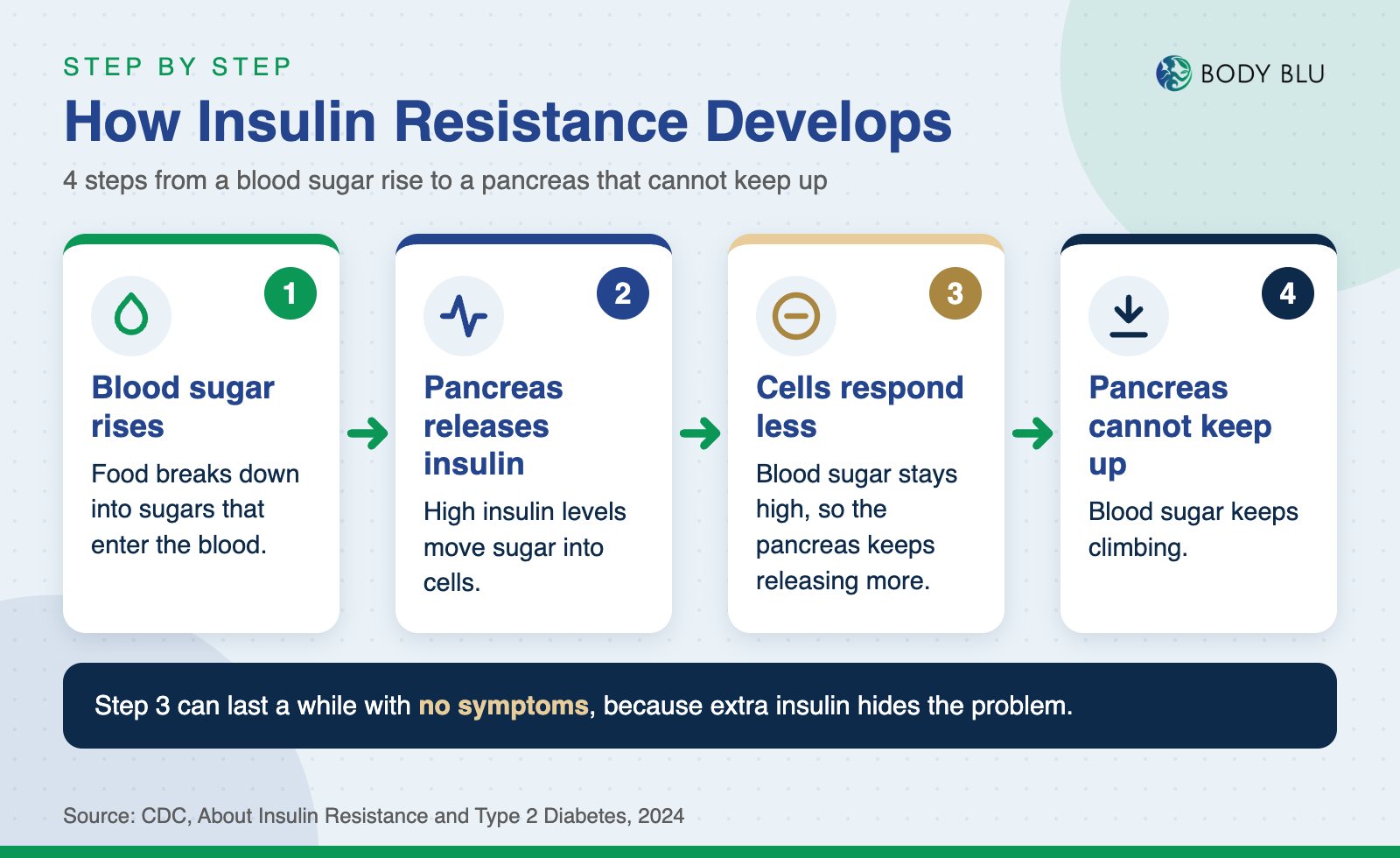
The graphic above shows the same 4 steps as a flow. High blood sugar also causes harm, so the body stores the extra sugar in the liver and muscles. The CDC adds that the liver sends the remaining sugar to be stored as body fat once those stores are full. That storage step explains the weight gain linked to the condition.
The pancreas masks the problem in the early stage. Masking explains why the signs of insulin resistance are easy to miss.
What Are the Signs of Insulin Resistance?
The signs of insulin resistance are usually absent, according to NIDDK. The pancreas hides the problem by making extra insulin, Cleveland Clinic explains. Visible signs can appear once prediabetes develops.
Cleveland Clinic lists 3 signs that some people with prediabetes may notice:
- Darkened skin in the armpit or on the back and sides of the neck, called acanthosis nigricans
- Skin tags
- Eye changes that can lead to diabetes-related retinopathy
Skin tags are small growths of extra skin. Providers can remove them cosmetically through skin tag removal, but removal does not treat the underlying cause. A provider should check blood sugar when new skin changes appear.
Consistently high blood sugar causes a different set of symptoms. Cleveland Clinic lists fatigue, increased thirst, frequent urination, increased hunger, blurred vision and yeast infections. Those symptoms point to rising blood sugar, so a provider visit is the next step. The causes behind the condition shape who develops it.
What Causes Insulin Resistance?
Insulin resistance has several contributing causes, and researchers do not fully understand how they interact, according to NIDDK. Cleveland Clinic groups the causes into acquired, hormonal and genetic types.
- Excess body fat, especially visceral fat around the belly and organs
- Physical inactivity
- A diet high in highly processed foods, carbohydrates and saturated fats
- Certain medicines, including steroids, some blood pressure medicines and HIV treatments
- Hormone disorders such as Cushing's syndrome, acromegaly and hypothyroidism
- Inherited conditions, including the rare Type A insulin resistance syndrome
Hormone disorders alter how cells use insulin, so Body Blu also checks thyroid and related patterns during hormone imbalance care. Medicines and hormones are causes a provider can review together.
Some risk factors cannot change. NIDDK lists age 35 or older and a family history of diabetes. NIDDK also lists certain ancestries, including African American, Asian American and Hispanic or Latino. Weight, activity and smoking can change. Because causes differ from person to person, providers rely on lab results.
How to Get Tested for Insulin Resistance
Get tested for insulin resistance by asking a provider for fasting glucose, A1C and lipid blood tests. NIDDK says health care professionals may not test for insulin resistance directly. The direct test is primarily used for research studies.
Providers therefore read blood sugar markers and blood fats to judge risk. The table below lists the common tests and the NIDDK prediabetes ranges.
| Test | What it shows | Prediabetes range |
|---|---|---|
| A1C | Average blood sugar over the past 3 months | 5.7% to 6.4% |
| Fasting plasma glucose | Blood sugar after an 8-hour fast | 100 to 125 mg/dL |
| Oral glucose tolerance test | Blood sugar 2 hours after a sugary drink | 140 to 199 mg/dL |
| Lipid panel | Cholesterol and triglyceride levels | No range set for prediabetes |
The A1C test and the fasting glucose test overlap, but they measure different time frames. A1C reflects 3 months, while fasting glucose reflects a single moment. Lipid results add context, since insulin resistance can raise fats in the blood.
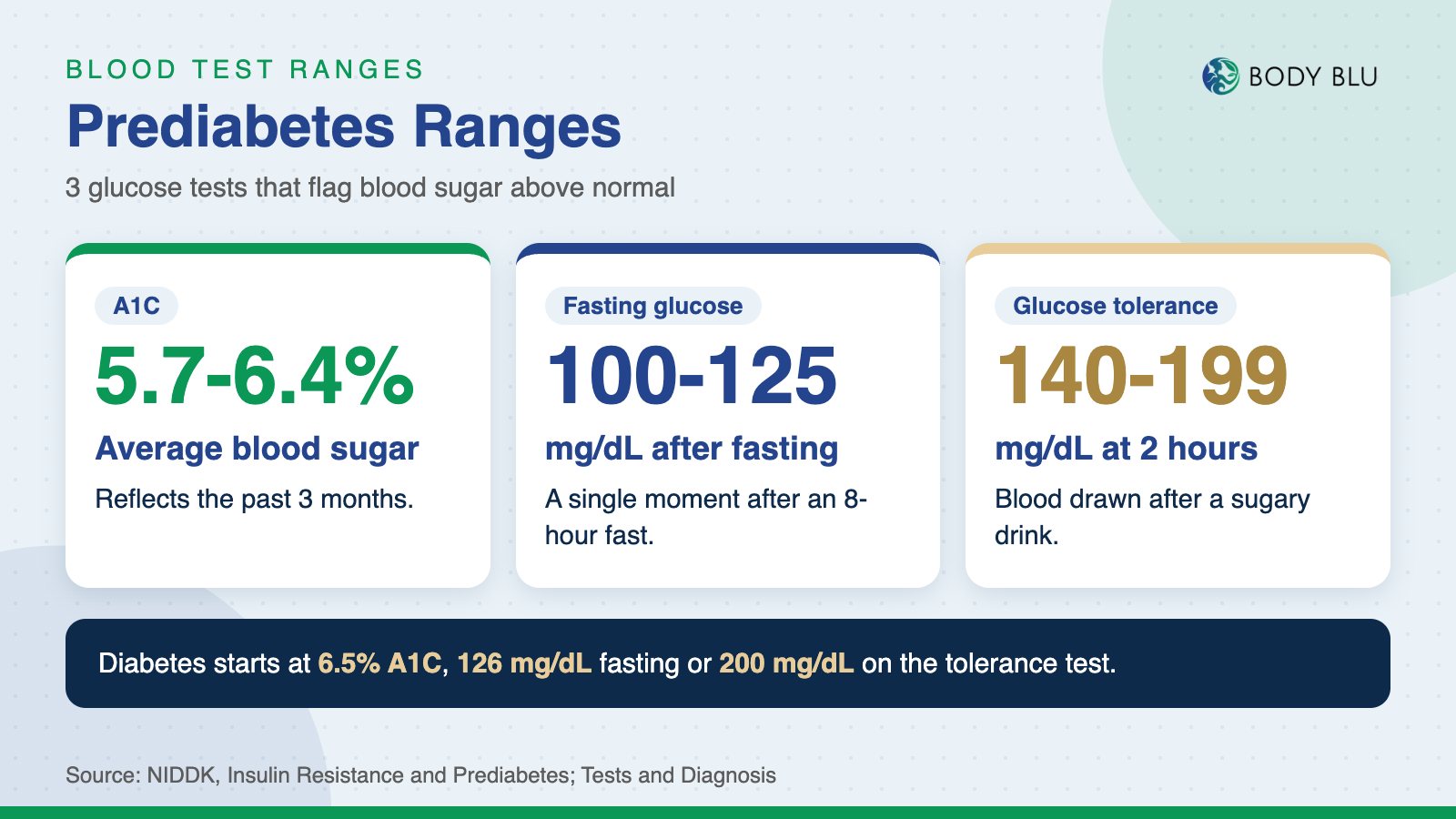
The figure above summarizes the 3 glucose ranges. Body Blu runs functional laboratory testing that pairs fasting insulin with glucose. Researchers also use a calculation called HOMA-IR. The formula multiplies fasting insulin in uIU/mL by fasting glucose in mg/dL, then divides by 405.
A 2025 study of men used a HOMA-IR of 2.7 or more as its cutoff. Providers interpret that number alongside symptoms and the rest of the lab panel.
Can You Have Insulin Resistance With a Normal A1C?
Insulin resistance with normal A1C is possible because the pancreas can offset resistance with extra insulin. Cleveland Clinic explains that blood sugar stays in a healthy range as long as the pancreas makes enough insulin. A1C therefore stays normal while insulin runs high.
NIDDK adds that A1C can miss prediabetes in people with certain health conditions. A provider may order additional labs when symptoms or risk factors persist. A normal A1C therefore does not close the question, and the link to diabetes deserves a closer look.
Is Insulin Resistance the Same as Diabetes?
Insulin resistance is not the same as diabetes, but insulin resistance and diabetes are closely linked. The CDC states that insulin resistance sets the stage for prediabetes and type 2 diabetes. The table below separates the conditions.
| Condition | Main problem | Key marker |
|---|---|---|
| Insulin resistance | Cells respond poorly to insulin | No routine test, used in research |
| Prediabetes | Blood sugar above normal but below diabetes | A1C 5.7% to 6.4% |
| Type 2 diabetes | Blood sugar in the diabetes range | A1C 6.5% or above |
| Type 1 diabetes | Body makes little or no insulin | Autoimmune cause |
Type 1 diabetes differs from insulin resistance, according to the CDC. An autoimmune reaction drives type 1, and the body makes little or no insulin. Insulin resistance involves cells that ignore insulin that is present.
Insulin resistance and prediabetes overlap closely. Cleveland Clinic says people with prediabetes or type 2 diabetes usually have insulin resistance. The scale of the overlap is large. The CDC estimates 115.2 million US adults had prediabetes in 2023.

The timeline above shows how the stages connect. NIDDK states that people with prediabetes have a high chance of developing type 2 diabetes within 5 to 10 years. The CDC counted 40.1 million people with diabetes in 2023, and 27.6% of adults with diabetes were undiagnosed. Prediabetes can still be reversed, which leads to a practical question.
Can You Have Insulin Resistance Without Diabetes?
A person can have insulin resistance without diabetes, and Cleveland Clinic confirms that diabetes is not required. The condition can also stay mild. Cleveland Clinic notes that mild insulin resistance may never progress to prediabetes or type 2 diabetes.
Can Insulin Resistance Be Reversed?
Insulin resistance can be reversed in some people through lifestyle changes, but Cleveland Clinic notes that not every cause is reversible. NIDDK lists 4 habits that may prevent or reverse insulin resistance and prediabetes:
- Consuming healthy foods and drinks
- Being physically active
- Managing weight
- Getting enough sleep
Weight loss carries measurable results. In the Diabetes Prevention Program, high-risk adults lost 5% to 7% of their starting weight. That loss reduced their chance of developing diabetes. Follow-up data showed that lifestyle changes or metformin prevented or delayed type 2 diabetes for at least 15 years. Body Blu offers medical weight loss programs for adults who want clinical support.
Exercise works through 2 routes, according to the American Diabetes Association. Active muscle absorbs blood sugar, and activity opens a second gateway for glucose that does not need insulin. The ADA also states that no medication is approved specifically for insulin resistance. Providers may prescribe metformin to manage blood sugar and prevent type 2 diabetes.
Cleveland Clinic advises people to talk with a provider before making extreme changes to eating patterns. NIDDK suggests starting with small changes. Several related questions about hair, hormones and sleep come next.
What Else Should You Know About Insulin Resistance?
Is Insulin Resistance Linked to Hair Loss?
Insulin resistance is linked to early-onset hair loss in men in some studies, but the evidence is mixed. A 2025 case-control study compared 100 men with early-onset androgenetic alopecia against 100 matched controls. Insulin resistance, defined as a HOMA-IR of 2.7 or more, appeared in 18% of the hair loss group and 4% of controls.
A 2019 study of 50 men found 10% against 4%, and that difference was not statistically significant. Research on insulin resistance and hair loss therefore shows an association and does not prove cause. Hair loss has several causes, so a provider should review it.
How Does PCOS Relate to Insulin Resistance?
Polycystic ovary syndrome (PCOS) relates to insulin resistance, according to the Office on Women's Health. The office says many women with PCOS have insulin resistance. The agency links the pattern to overweight, low activity, eating habits and a family history of diabetes.
The link between insulin resistance and polycystic ovary syndrome matters for long-term planning. Ovulation problems, obesity, insulin resistance and diabetes all raise endometrial cancer risk, the agency adds. Body Blu supports patients with PCOS care that looks at insulin alongside hormones.
Does Metabolic Syndrome Involve Insulin Resistance?
Metabolic syndrome involves insulin resistance, and NHLBI also calls it insulin resistance syndrome. A provider diagnoses metabolic syndrome when 3 or more of 5 conditions are present:
- A waist larger than 40 inches in men or 35 inches in women
- Blood pressure of 130/85 mmHg or higher
- Fasting blood sugar of 100 mg/dL or higher
- Triglycerides above 150 mg/dL
- HDL cholesterol below 40 mg/dL in men or below 50 mg/dL in women
The tie between insulin resistance and metabolic syndrome explains why providers check blood pressure and blood fats together with blood sugar. Sleep is another factor that changes these numbers.
How Does Sleep Affect Insulin Resistance?
Sleep affects insulin resistance because short sleep impaired insulin sensitivity in a 2024 trial. In that Diabetes Care study, 38 women slept 6.2 hours per night for 6 weeks. Fasting insulin and HOMA-IR rose compared with adequate sleep, independent of body fat changes.
The trial links insulin resistance and sleep in women without cardiometabolic disease. The authors call insufficient sleep a modifiable risk factor. The FAQ below covers food and home testing.
Frequently Asked Questions About Insulin Resistance
Which Foods Help With Insulin Resistance?
Foods that help with insulin resistance are low glycemic index foods, which raise blood sugar more steadily. Cleveland Clinic lists beans and legumes, apples and berries, non-starchy vegetables, nuts, dairy, fish and meat.
What Foods Are Bad for Insulin Resistance?
Foods that are bad for insulin resistance are high glycemic index foods and sugary drinks. Cleveland Clinic names regular soda, juice, white bread, potatoes, breakfast cereals, cakes, cookies, watermelon and dates.
Can You Check Insulin Resistance at Home?
No home method can confirm insulin resistance, because the direct test is primarily used for research, according to NIDDK. A glucose meter reads blood sugar only. A provider can order blood tests that show how the body handles sugar.
Does Insulin Resistance Make You Tired?
Insulin resistance itself causes no symptoms while the pancreas keeps up, Cleveland Clinic states. Fatigue appears among the symptoms of consistently high blood sugar. A provider can check the cause of ongoing tiredness.
How Does Body Blu Help With Insulin Resistance?
Body Blu helps by testing fasting insulin and glucose together and reviewing the results with a licensed naturopathic doctor. The clinic's endocrine and metabolic care is led by Dr. Scarpuzzi, who holds a California naturopathic license. We answer what is insulin resistance for each patient with lab data rather than guesses.
This guide is educational only and does not replace advice from a primary care provider. A patient's plan reflects labs, symptoms and goals. Our functional medicine approach looks at sleep, stress, food and hormones together.
Baseline labs guide the next steps for each patient. Test results, symptoms and personal goals all shape the plan, and no 2 plans look the same. Patients whose results show prediabetes can start prediabetes care with a plan built around those numbers. The plan covers food, movement, sleep and follow-up testing.
Prior A1C or glucose results are useful to bring, since earlier numbers show trends over time. Patients can contact our clinic to schedule a visit and discuss which labs fit their history.
The clinic has 2 locations in North County San Diego, so scheduling a visit is simple. Patients can reach Body Blu in Cardiff and Carlsbad.


Resources
From Our Blog
Naturopathic insights, wellness tips, and updates from the Body Blu team.

Treatments
What Is BPC-157 Peptide and What Does BPC-157 Peptide Do?
BPC-157 peptide is a lab-made chain of 15 amino acids that the FDA has not approved for any use. Evidence comes mainly from animal studies, and only 3 small human studies exist.

Treatments
BPC 157 Side Effects and BPC 157 Peptide Side Effects for Women
BPC 157 side effects reported by users include injection-site pain, fatigue and anxiety, but only 3 small human studies exist. The FDA has not approved BPC-157, so risks remain unknown.

Treatments
Sermorelin Before and After Results for Face, Women and Men
Sermorelin before and after changes in studies are small, slow and measured in blood tests. Trials of 11 to 19 adults found higher IGF-1 within 2 weeks, but no change in body weight.