


What Is Mast Cell Activation Syndrome (MCAS) and Who Gets It?


Mast cell activation syndrome (MCAS) is a rare condition in which mast cells release chemical mediators too easily. The result is repeated symptoms that affect 2 or more organ systems. No confirmed prevalence figure exists, and experts diagnose MCAS only when 3 consensus criteria are met. This guide covers the types, who gets MCAS, symptoms and testing.
Key Takeaways
- MCAS requires all 3 consensus criteria: matching symptoms, a mediator rise and a drug response.
- Primary, secondary and idiopathic are the 3 recognized types.
- Self-reported mast cell symptoms reached about 46% in patients' relatives, against about 17% in the general German population.
- A tryptase rise of at least 20% plus 2 ng/mL within 4 hours of an episode meets the lab criterion.
- A provider with mast cell experience should confirm the diagnosis and guide treatment.
What Is Mast Cell Activation Syndrome (MCAS)?
Mast cell activation syndrome is an immune condition in which mast cells release chemical mediators repeatedly and inappropriately. Cleveland Clinic calls mast cells the body's alarm system. These cells form in bone marrow and settle in the airways, lungs and gastrointestinal tract, and around blood vessels and nerves. Their granules store histamine, tryptase, cytokines and heparin.
Histamine opens blood vessels, fills tissues with fluid and tightens airway and gut muscle, according to Cleveland Clinic. Fluid and muscle tightening explain why flushing, swelling, wheezing and cramping can appear together. Experts therefore define MCAS by criteria rather than by symptoms alone.
Allergy offers a useful contrast. In a typical allergy, the antibody IgE latches onto mast cells. Contact with the allergen then switches those cells on, as Cleveland Clinic explains. MCAS involves repeated episodes of allergy-like symptoms, sometimes without a known trigger. Mast cell mediators include proteases such as tryptase and chymase, which are the markers that labs measure.
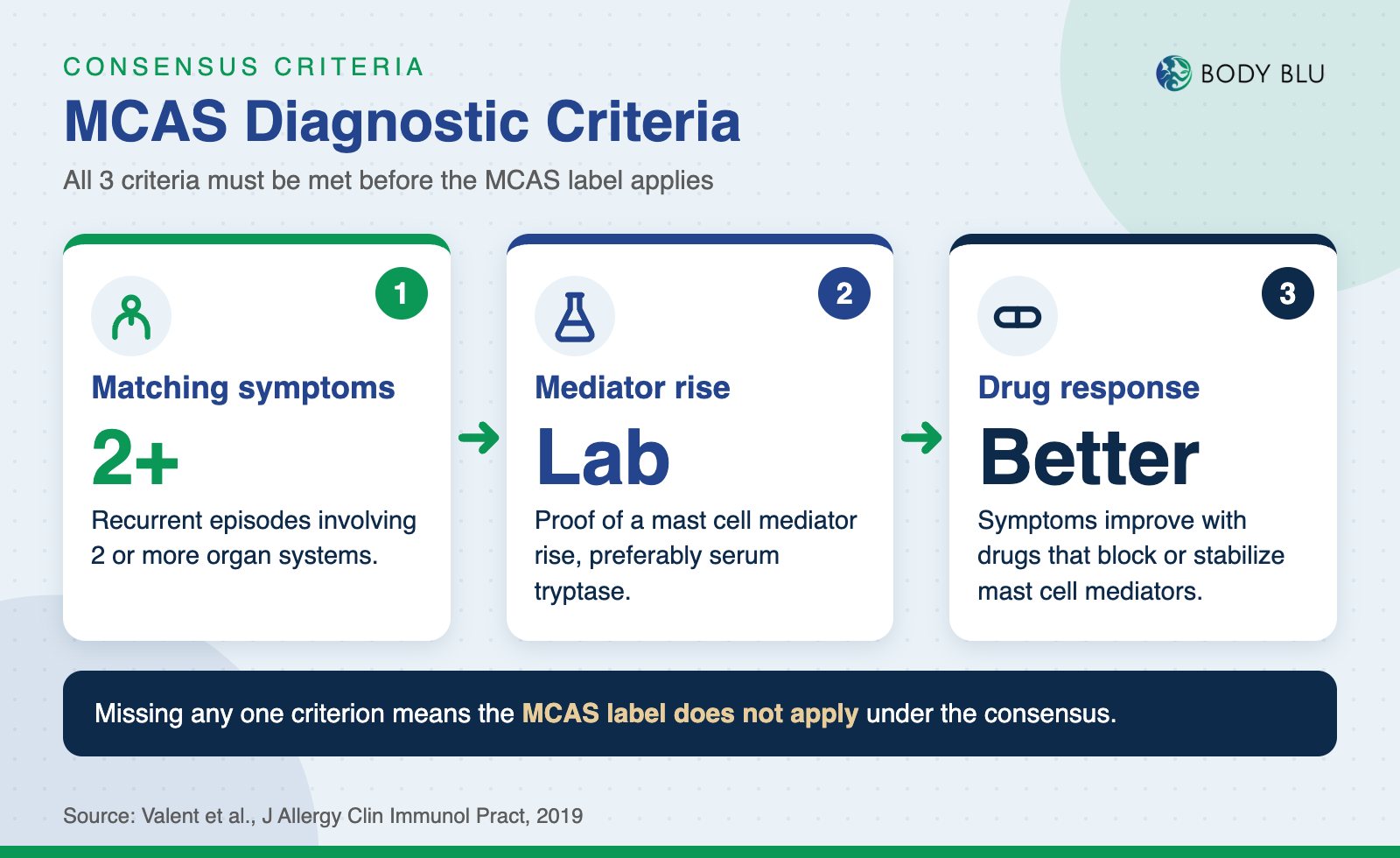
The 2019 diagnostic algorithm in the Journal of Allergy and Clinical Immunology: In Practice requires all 3 criteria below. Missing any one of them rules out the MCAS label under that consensus.
- Typical symptoms occur in episodes and involve 2 or more organ systems.
- Lab tests show a mast cell mediator rise, preferably serum tryptase.
- Symptoms improve with drugs that block or stabilize mast cell mediators.
Body Blu reviews symptom patterns, triggers, mold exposure and gut dysfunction as part of MCAS care. That review supports an allergy or immunology work-up and does not replace it. The criteria above also sort patients into 3 types of MCAS.
What Are the Types of MCAS?
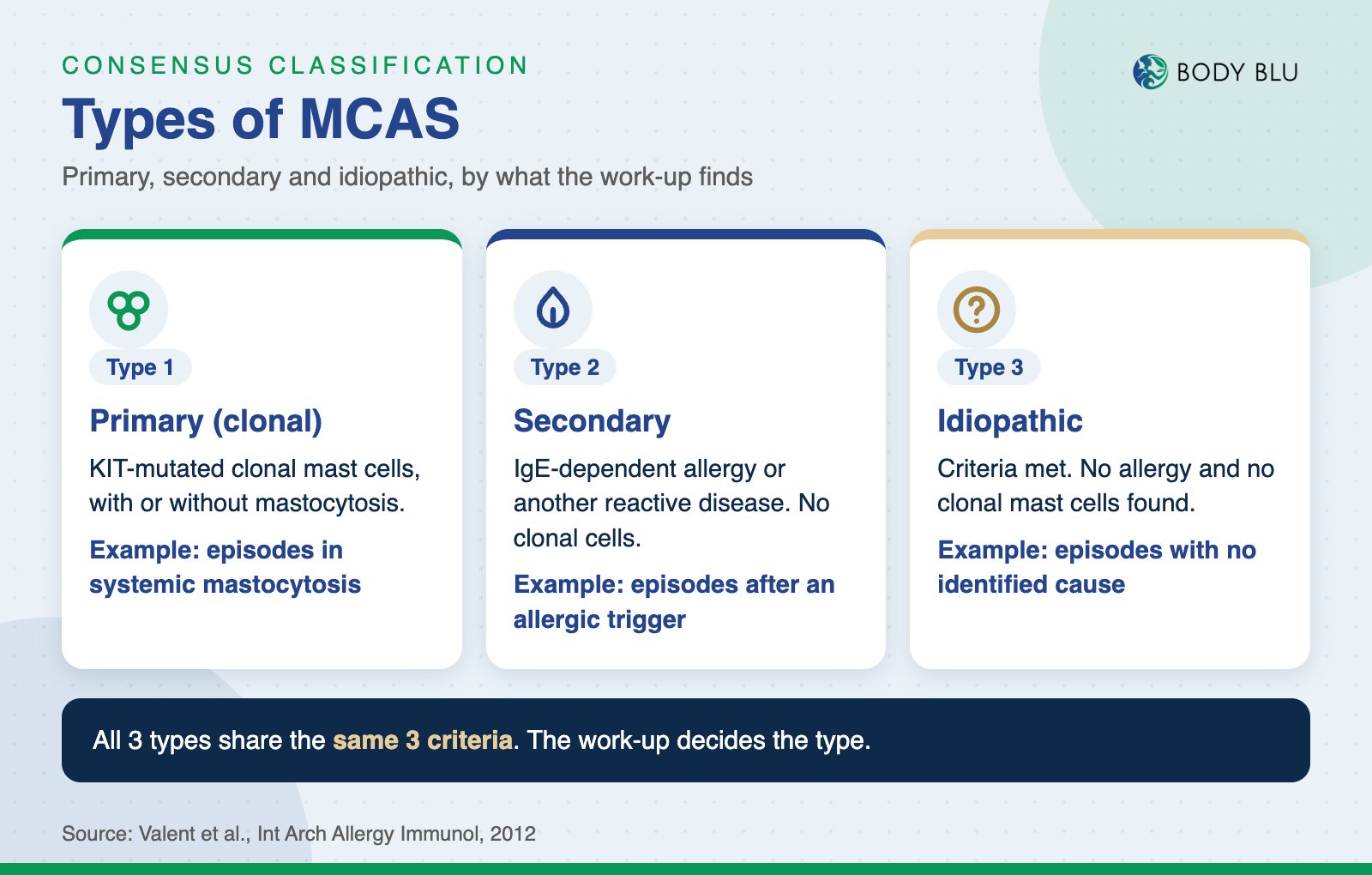
The types of MCAS are primary, secondary and idiopathic, based on what the work-up finds. Valent and colleagues defined these 3 types in a 2012 consensus paper. The table below compares them.
| Type | What the work-up finds | Example |
|---|---|---|
| Primary (clonal) | KIT-mutated clonal mast cells, with or without mastocytosis | Episodes in systemic mastocytosis |
| Secondary | IgE-dependent allergy or another reactive disease, no clonal cells | Episodes after an allergic trigger |
| Idiopathic | Criteria met, with no allergy and no clonal mast cells found | Episodes with no identified cause |
Primary MCAS differs from secondary MCAS by the presence of clonal cells, while idiopathic MCAS is a diagnosis of exclusion. Akin reported in 2018 that 10-20% of people with an IgE-dependent allergy have events that meet MCAS criteria. The same table lists 10-20% for systemic mastocytosis and 1-3% for acute infections.
Mast cell activation syndrome allergies need their own work-up, because the 2019 algorithm names IgE-dependent allergy as the most frequent underlying cause. Genetic testing finds the KIT D816V mutation in 90-95% of systemic mastocytosis patients, according to Mastocytosis Society Canada. The algorithm also lists autoimmune disorders and infections as associated conditions. Patients with autoimmune conditions therefore need both questions reviewed together.
Two related conditions share symptoms with MCAS. Mastocytosis is a condition in which too many mast cells build up in the body, according to Cleveland Clinic. Hereditary alpha-tryptasemia is a genetic condition with extra copies of the TPSAB1 gene. Mastocytosis Society Canada reports that most patients have serum tryptase above 8 ng/mL. These distinctions shape who gets each diagnosis.
Who Gets MCAS and How Common Is It?
Who gets MCAS depends on the type, and no confirmed prevalence figure exists. Cleveland Clinic lists MCAS among the rare mast cell disorders. Valent and colleagues state that the prevalence of MCAS in children is unknown. Children with mast cell disease most commonly have cutaneous mastocytosis, a skin form.
Family history is the link with the clearest data. Molderings and colleagues reported in 2013 that about 46% of patients' first-degree relatives had suspected mast cell activation disease by self-report. The same study put the general German population at about 17%. Self-report is not a confirmed diagnosis, so the 17% figure does not describe diagnosed MCAS.
Genetics adds a second link. Lyons and colleagues reported in 2016 that elevated basal serum tryptase is present in 4-6% of the general population. Hereditary alpha-tryptasemia, an inherited cause of high tryptase, is a separate condition from MCAS. Tryptase level alone therefore does not identify MCAS.
Overdiagnosis is a documented concern. Akin wrote in 2018 that referrals of patients labeled MCAS have increased dramatically. Referral centers frequently find that these patients do not meet the definition. The groups below have a documented link to mast cell activation.
- First-degree relatives of patients with mast cell activation disease.
- People with an IgE-dependent allergy or drug hypersensitivity.
- People with mastocytosis, either cutaneous or systemic.
- People with hereditary alpha-tryptasemia, which is inherited in an autosomal dominant pattern.
Membership in a group does not mean a person has MCAS. The next question is which symptoms point toward it.
What Are the Symptoms of MCAS?
MCAS symptoms are recurrent episodes that involve 2 or more organ systems. Akin lists typical symptoms such as hives, angioedema, flushing, itching, nausea, vomiting, diarrhea, cramping, fainting, rapid heart rate and wheezing. The groups below sort these symptoms by system.
- Skin: hives, swelling (angioedema), flushing and itching.
- Gut: nausea, vomiting, diarrhea and abdominal cramping.
- Heart and circulation: rapid heart rate and fainting from low blood pressure.
- Airway and nose: wheezing, hoarseness and nasal congestion.
- Head and eyes: headache and red eyes.
Mastocytosis Society Canada also lists fatigue and neuropsychiatric disturbances among mast cell mediator symptoms. Some patients describe these as brain fog. No single symptom is specific to MCAS, and the 2012 consensus members agreed on this by a 100% vote.
Episodes wax and wane. Symptoms can resolve between flares, which is why timing matters for testing and why a diary helps. A single visit during a symptom-free period may show normal labs. Repeated documentation across several episodes gives a provider more to work with.
Severity matters for the label. Valent and colleagues describe mast cell activation symptoms as usually mild and transient. The 2019 algorithm reserves the MCAS label for severe, recurrent episodes, so it defines no mild mast cell activation syndrome category.
Anaphylaxis is the emergency end of mast cell activation. The NHS describes anaphylaxis as a life-threatening allergic reaction that usually starts within minutes of contact with a trigger. NHS guidance says to use an adrenaline auto-injector if one is prescribed and to call emergency services. Triggers are the next piece of the pattern.
What Triggers MCAS Episodes?
MCAS episodes follow triggers that differ by person and by type. The 2019 algorithm links mast cell activation to IgE-dependent allergy, mastocytosis, autoimmune disease, infections and intoxications. Akin's table adds acute drug hypersensitivity, where 10-20% of affected people meet MCAS criteria.
The same algorithm names Helicobacter pylori gastritis and skin infections among infectious associations. Gut inflammation therefore belongs in the review. Body Blu also checks mold illness exposure as a possible contributor. The consensus papers do not name mold as a proven cause.
Cleveland Clinic describes MCAS as repeated allergy-like episodes without a known trigger. Many patients therefore keep a symptom diary. A diary records the date, time, food, medicine, activity and symptoms for each episode. Patterns then appear that a single visit misses.
Trigger patterns guide the testing plan. Testing also requires careful timing, as the next section explains.
How to Get Tested for Mast Cell Activation Syndrome?
Get tested by seeing a provider with mast cell disorder experience and timing blood work to an episode. A mast cell activation syndrome doctor should confirm all 3 criteria rather than rely on symptoms alone. Mast Cell Action, a UK charity, explains that mediators may be raised only during an episode and then return to normal.
- Record each episode with its date, time, symptoms and suspected triggers.
- Bring the record to an allergist, immunologist or other provider with mast cell experience.
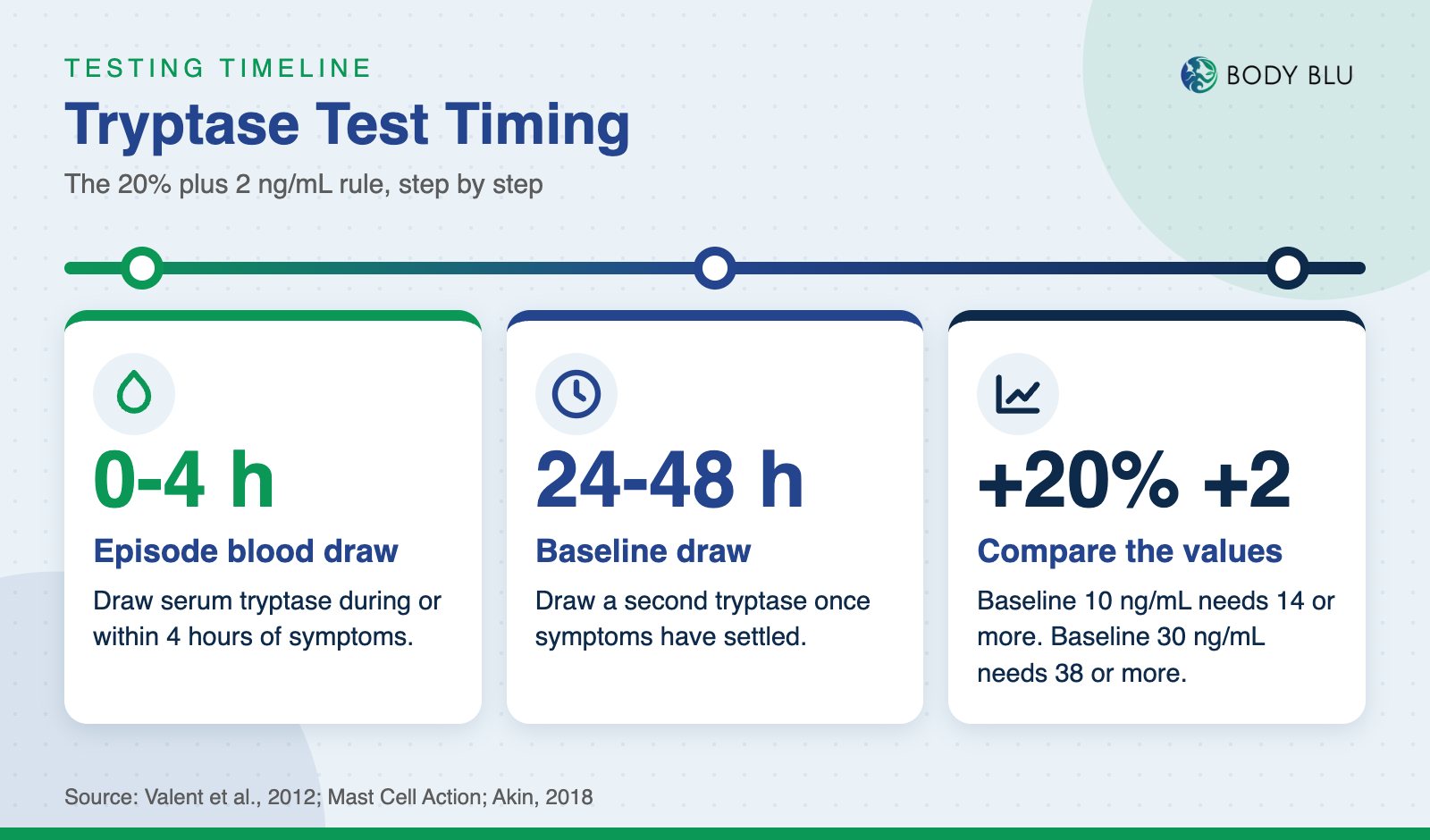
- Draw serum tryptase during an episode, within 4 hours of symptom onset.
- Draw a baseline tryptase 24-48 hours later, when symptoms have settled.
- Compare the two values against the consensus rule of a 20% rise plus 2 ng/mL.
- Add other tests the provider chooses, such as urine mediators, allergy tests or bone marrow studies.
The 20% plus 2 ng/mL rule works as simple arithmetic. A baseline of 10 ng/mL needs an episode value of at least 14 ng/mL. A baseline of 30 ng/mL needs at least 38 ng/mL. The infographic below shows the timing.
Normal results do not close the question. Mast Cell Action states that serum tryptase stays in the normal range in most people with MCAS. Urinary N-methylhistamine and prostaglandin tests are other markers, and Cleveland Clinic lists urine, blood, bone marrow and skin as sample sources.
Preparation improves the visit. Bring the diary, a list of medicines and supplements, past test results and any family history of mast cell disease. The provider can then check each consensus criterion against real records. Mastocytosis Society Canada reports that many patients with mast cell disease decline for up to 10 years or longer before diagnosis.
Body Blu offers functional lab testing that adds nutrient, gut and hormone context. Those labs do not confirm MCAS on their own. A confirmed picture leads to the question of management.
Can MCAS Be Managed or Reversed?
MCAS can be managed, and avoiding known triggers and blocking mediators are the core strategies. Reversal depends on the underlying cause, because secondary MCAS follows an allergy or other reactive disease. Cleveland Clinic lists the main treatment groups for mast cell disorders.
- Trigger avoidance when a trigger is known.
- Antihistamines, acid reducers and leukotriene-modifying medications such as montelukast.
- Mast cell stabilizers, which prevent mast cells from releasing their granules.
- Epinephrine and omalizumab for anaphylactic episodes.
A provider chooses and doses these medicines, and this article gives no dosing advice. The third consensus criterion depends on a clear symptom response to such drugs. Valent and colleagues add that an identified IgE-dependent allergy needs its own management plan.
Supportive care sits beside medical care. Body Blu builds a plan around triggers, gut health and related conditions, and we describe that as functional medicine support. Plans stay in step with each patient's allergist or immunologist. Several side questions remain.
What Else Should You Know About MCAS?
Is MCAS the Same as Histamine Intolerance?
Mast cell activation syndrome and histamine intolerance are different conditions with overlapping symptoms. Histamine intolerance is an impaired ability to metabolize ingested histamine, according to a 2020 review by Comas-Baste and colleagues. MCAS instead involves mast cells releasing mediators. The review states that more evidence is still needed to define, diagnose and manage histamine intolerance.
Can MCAS Cause Anxiety?
MCAS and anxiety share symptoms, but the consensus criteria do not list anxiety as a mast cell symptom. Rapid heart rate is on the consensus list and also occurs in panic. A provider should therefore evaluate both possibilities. Body Blu offers anxiety support alongside that evaluation.
Can MCAS Cause Weight Gain?
MCAS has no weight criterion, so weight gain is not part of the diagnosis. Cleveland Clinic lists swelling as a histamine effect, because histamine fills tissues with fluid. Fluid is not body fat, and a provider can sort out the cause of a weight change.
Does Alcohol Trigger MCAS Episodes?
No consensus paper lists alcohol as a proven MCAS trigger. A symptom diary shows whether alcohol precedes an episode. Providers can then weigh that pattern with the rest of the history.
When Should You See a Provider About Possible MCAS?
See a provider when repeated episodes affect 2 or more organ systems, such as skin and gut together. Swelling, trouble breathing or fainting calls for urgent care, and the NHS advises calling emergency services for anaphylaxis. A provider can then check for allergy, mastocytosis and other explanations. Early records of each episode shorten that process.
Is Long COVID Linked to MCAS?
The proposed link between lingering post-viral symptoms and MCAS is a hypothesis. Body Blu follows this question in long COVID care. Batiha and colleagues proposed in a 2022 critical review that post-COVID syndrome may progress in association with MCAS. That paper is a review and not a trial, so the evidence stays limited.
How Does Body Blu Help With MCAS?
Body Blu helps people with MCAS through a root-cause review of symptoms, triggers and related conditions, led by a licensed naturopathic doctor. We coordinate with your allergist or immunologist, because mast cell activation syndrome needs the 3 consensus criteria confirmed. Our MCAS treatment plan focuses on gut health, mold exposure and symptom tracking.
We do not diagnose MCAS from a blog post, and nothing here replaces medical advice. Talk to your provider about any episode with swelling, trouble breathing or fainting. Call emergency services for anaphylaxis. The Body Blu clinic in Cardiff can start a conversation about your symptom pattern.


Resources
From Our Blog
Naturopathic insights, wellness tips, and updates from the Body Blu team.

Treatments
What Is BPC-157 Peptide and What Does BPC-157 Peptide Do?
BPC-157 peptide is a lab-made chain of 15 amino acids that the FDA has not approved for any use. Evidence comes mainly from animal studies, and only 3 small human studies exist.

Treatments
BPC 157 Side Effects and BPC 157 Peptide Side Effects for Women
BPC 157 side effects reported by users include injection-site pain, fatigue and anxiety, but only 3 small human studies exist. The FDA has not approved BPC-157, so risks remain unknown.

Treatments
Sermorelin Before and After Results for Face, Women and Men
Sermorelin before and after changes in studies are small, slow and measured in blood tests. Trials of 11 to 19 adults found higher IGF-1 within 2 weeks, but no change in body weight.