


BPC-157 Peptide Benefits and BPC-157 Benefits for Men and Women


BPC-157 peptide benefits come mainly from animal studies, and the FDA has not approved the peptide for any use. Only 3 small human studies exist, covering knee pain, bladder pain and an intravenous safety check. The 2 pain studies had no control group. This guide compares the claimed benefits for men and women with what the published evidence supports.
Key Takeaways
- Cleveland Clinic lists 5 alleged BPC-157 benefits and says no proof shows it can treat or prevent any health condition.
- A systematic review included 36 studies through June 2024, and 35 of them were preclinical.
- The knee-pain study reported relief in 14 of 16 patients, and the bladder pilot enrolled 12 women, both without a control group.
- No published human study was designed to test BPC-157 in men or to compare men with women.
- A draft enforcement policy from HHS, dated October 30, 2026, eases action against compounded BPC-157 but does not approve it.
What Are the BPC-157 Peptide Benefits People Claim?
BPC-157 peptide benefits that people claim include faster healing of tendons, muscles, ligaments and nerves after injury. Cleveland Clinic lists 5 alleged benefits. These include injury healing, joint pain relief and brain protection. The list also covers inflammatory bowel disease (IBD) symptoms and mental illness symptoms. The clinic adds that no proof shows BPC-157 can treat or prevent any health condition.
BPC-157 is a synthetic chain of 15 amino acids based on a protein in human gastric juice. Online searches for what are the benefits of BPC 157 return the same short list. Skin repair, gut comfort, joint relief and sharper thinking appear on seller pages again and again.
Every item on that list needs a source, and the source is rarely a human trial. Education like this helps patients prepare for a consult about peptide guidance, which Body Blu reviews case by case. The next question is what research actually sits behind each claim.
What Does the Evidence Behind BPC-157 Benefits Show?
The evidence behind BPC-157 benefits comes from rodent injury models, not controlled human trials. A systematic review in an orthopaedic journal screened 544 articles and included 36 studies. Preclinical work made up 35 of those studies, and 1 study was clinical.
The animal results look strong on paper. In a 2003 rat study, BPC-157 improved the load a cut Achilles tendon could bear, compared with saline over 14 days. In a 2019 rat study, one dose given 10 minutes after spinal cord injury improved tail movement, tracked up to 360 days.
McGuire and colleagues describe the proposed mechanism in a 2025 review. BPC-157 raises VEGFR2 activity and nitric oxide production through the Akt-eNOS pathway, which promotes angiogenesis. Angiogenesis means the growth of new blood vessels, and tendons have a poor blood supply. The review also reports more growth hormone receptors on tendon fibroblasts in cell studies.
The table below pairs each claimed benefit with the animal finding and the human evidence.
| Claimed Benefit | Animal Finding | Human Evidence |
|---|---|---|
| Tendon and ligament repair | Better strength and function in cut rat Achilles tendons | No tendon study in people |
| Muscle recovery and sports performance | Faster recovery in rat injury models | No direct study of speed or strength in athletes |
| Nerve and spinal cord repair | Better tail movement in rats for up to 360 days | No study in people |
| Gut lining and colitis | Healing in rat colitis models | None among the 3 published human studies |
| Joint and bladder pain | Not the focus of the animal studies cited here | 2 small studies with no control group |
The table shows one pattern. Every claimed benefit has an animal finding, and none has a controlled human trial. McGuire and colleagues also note that all published BPC-157 studies report positive results, which suggests publication bias.
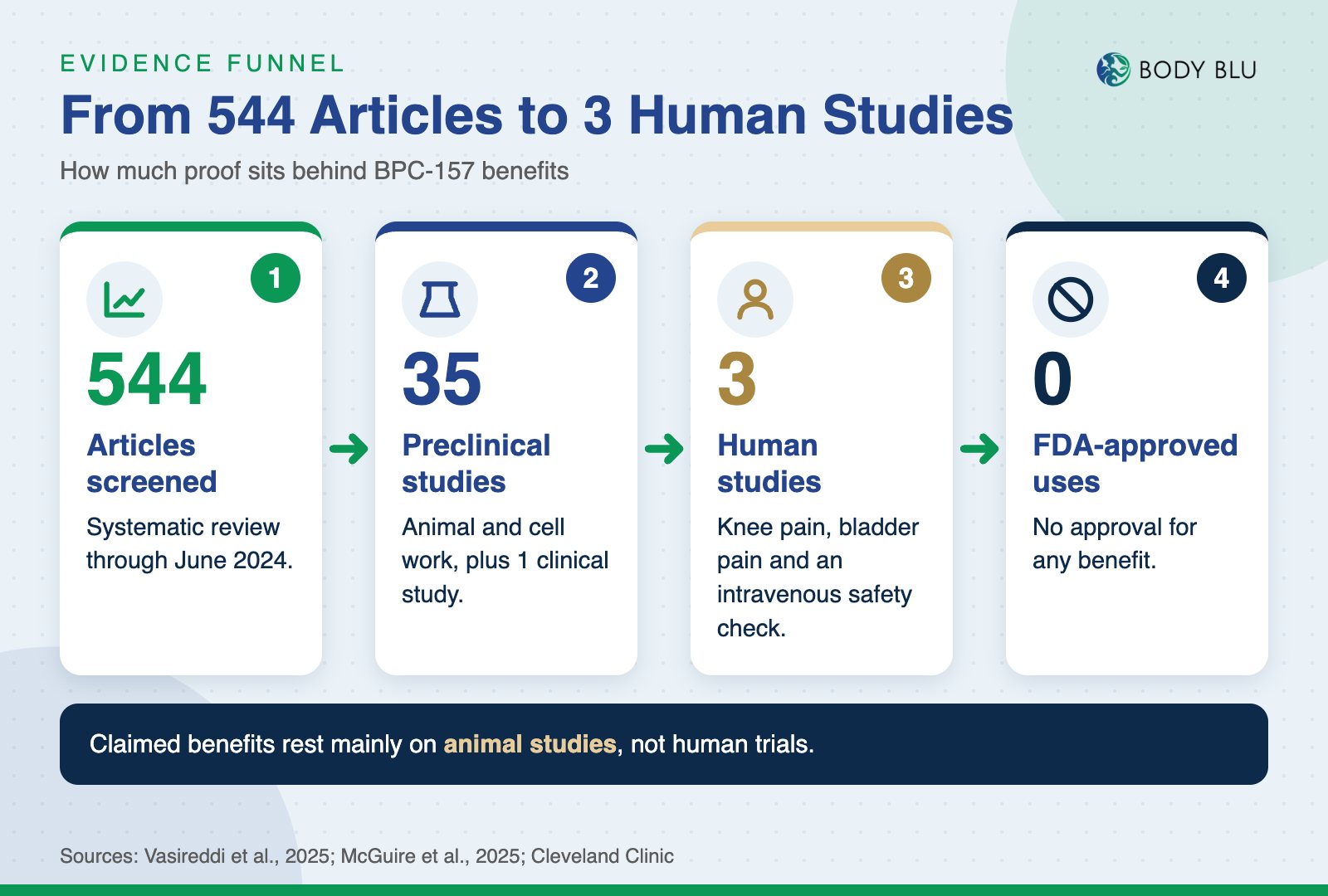
The graphic above shows how few human studies sit behind the claims. The three human studies are the next place to look.
What Do the 3 Human Studies on BPC-157 Show?
The 3 human studies on BPC-157 show small signals of relief and no reported side effects in 30 participants. McGuire and colleagues found only 3 published studies, and each one had major limits. The list below gives the key numbers for each study.
- Knee pain, 2021: A Florida clinic reviewed charts for 17 patients and reached 16 by phone. Of those, 14 (87.5%) reported relief after injections of BPC-157 alone or with thymosin beta-4 (TB4).
- Bladder pain, 2024: Twelve women with interstitial cystitis received a single 10 mg injection around the inflamed bladder area. Ten rated their improvement at 100%, 2 rated it at 80%, and none reported an adverse event.
- Intravenous safety pilot, 2025: Two healthy adults received up to 20 mg intravenously. Researchers reported no adverse events, and blood levels returned to baseline within 24 hours.
Each result carries a caution. The knee study was retrospective, had no control group and used no tool to measure function or quality of life. The bladder pilot also had no control group, and the participants rated their own improvement.
Healthline reported on a September 2026 preprint that adds real-world context. The preprint reviewed more than 15 million records and found 1,039 people with documented BPC-157 use. Of those, 27% reported improvement, but the study has not been peer reviewed and counted self-reports only.
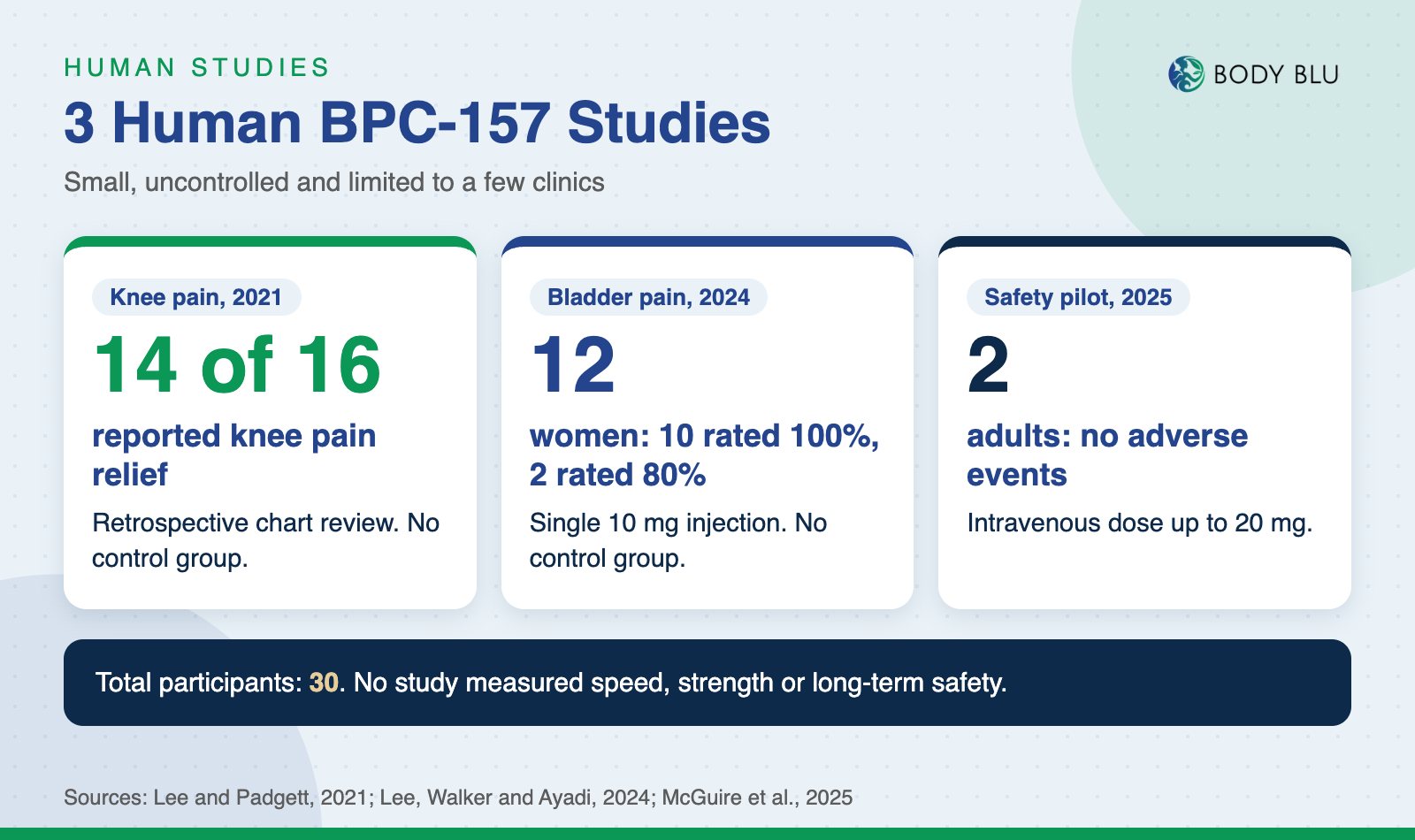
The graphic above lists the three studies side by side. Because the bladder pilot enrolled only women, the question of sex-specific benefit starts there.
What Are the BPC-157 Benefits for Women?
The evidence for women is one small bladder-pain pilot of 12 women, and no study covers other claimed uses. The women were 39 to 76 years old, with a mean age of 58.3 years. All 12 had moderate to severe interstitial cystitis that had not responded to pentosan polysulfate, the only FDA-approved treatment for that condition.
Claims about skin, hair, periods, fertility and hormone balance have no human study among the 3 published trials. BPC-157 raised growth hormone receptor levels in tendon cells, but no study shows a change in a woman's own hormone levels. Women in perimenopause who link joint aches or skin changes to hormones need a review of midlife hormones first.
Pregnancy and breastfeeding data are also missing. A rat study found no differences in fetuses after 3 intramuscular injections, according to Vasireddi and colleagues. The same review found no human pregnancy data, so a provider should be told about any peptide use.
What Are the BPC-157 Benefits for Men?
The evidence for men is absent, because no published human study was designed around men. The knee and intravenous studies did not test men as a group or compare the sexes. Claims about muscle gain, testosterone or libido therefore have no human trial behind them.
Interest among men is rising anyway. The September 2026 preprint found that men made up 57% of newly documented BPC-157 users in 2020 and 70% in 2026. Pain relief was the leading reported benefit, in 183 patients, while 4% of patients reported using it for performance.
Athletes face a separate rule. McGuire and colleagues report no direct human study of speed or strength. The World Anti-Doping Agency (WADA) bans BPC-157 in and out of competition. Men who suspect hormones lie behind low energy or slow recovery need lab-based andropause support rather than an unapproved peptide.

The graphic above summarizes the evidence gap for both sexes. The next question is how fast any benefit could appear.
How Long Does BPC-157 Take to Work?
BPC-157 has no proven time to work in humans, because no study measured it. Online timelines of 1 to 2 weeks for early effects have no controlled trial behind them. The studies that exist used very different follow-up periods.
- Rat Achilles tendon study: assessed on days 1, 4, 7, 10 and 14.
- Rat spinal cord study: assessed up to 360 days after injury.
- Human knee survey: patients were contacted 6 months to 1 year after the injection.
- Human bladder pilot: results were reported 6 weeks after treatment.
The list shows that follow-up ranged from 14 days in rats to a year in people. BPC-157 has a half-life under 30 minutes, which is the time for half of a dose to leave the blood. Animal effects still lasted weeks to months, according to McGuire and colleagues.
A person who feels better after an injection cannot tell whether the peptide, the placebo effect or natural healing caused the change. A provider in a functional medicine visit can review that question alongside proven options for the same complaint. The next question is whether the benefits justify the risks.
Do BPC-157 Benefits Outweigh the Risks?
The risks of BPC-157 cannot be weighed against its benefits yet, because human safety data is nearly empty. The systematic review of 36 studies found no clinical safety data. Preclinical studies found no acute toxic dose, but none assessed adverse events beyond 6 weeks.
Cleveland Clinic names a theoretical concern. BPC-157 promotes blood vessel growth, and researchers worry it could also promote cancer growth. The clinic calls this a theoretical risk that needs more research. Our guide to BPC-157 side effects covers the reported problems in detail.
Product quality adds a second risk. A UVA Health physician says gray-market peptides may hold 5% to 75% of the labeled amount. The FDA adverse event system logged 10 serious reports tied to BPC-157 since 2021, with 8 in 2026. These reports do not prove cause.
A provider can also order baseline blood work before any experimental compound enters a plan. Baseline numbers help a provider spot changes later. The FDA status of BPC-157 shapes every one of these choices.
What Else Should You Know About BPC-157 Benefits?
Is BPC-157 FDA Approved for Any Benefit?
No, the FDA has not approved BPC-157 for any benefit. The FDA advisory committee voted 8-6 with 1 abstention on July 23, 2026 to recommend BPC-157 for the compounding bulks list. The use FDA evaluated was ulcerative colitis. HHS then published a draft enforcement policy on October 30, 2026 that is not binding. Our BPC-157 overview explains that timeline in full.
Do BPC 157 Skin Benefits and Brain Benefits Have Evidence?
BPC 157 skin benefits have only animal and cell evidence, such as a study of alkali-burn wound healing. No human trial tested skin repair, wrinkles or hair. The bpc 157 brain benefits that Cleveland Clinic lists, such as protection from Alzheimer's disease, also lack human testing.
Does BPC-157 Help Gut Health?
BPC-157 for gut health has animal support but no confirmed human result. The peptide came from gastric juice, which explains the interest in bpc 157 gut benefits. Rat studies reported healing in colitis models, yet the 3 human studies covered knee pain, bladder pain and safety only. Patients with ongoing digestive symptoms need an evaluation for causes such as gut lining problems instead of a self-treatment guess.
Are BPC 157 Injection Benefits Different From Oral Use?
BPC 157 injection benefits are the only route with human data, and that data is small. The knee study used joint injections. The bladder pilot used injections around the inflamed bladder area, and the safety pilot used an intravenous dose. No human study tested oral use, so oral claims have no trial behind them. Compounded drugs are not FDA-approved, and the FDA does not verify their quality before sale. Patients can review those limits through peptide education before any decision.
How Can Body Blu Help You Weigh Peptide Claims?
Body Blu does not list BPC-157 among its services, and we share only education on it. Our team explains approval status, evidence limits and risks in plain language. A peptide evaluation covers which peptide options fit a person's history, case by case in a consult. The goal is a clear view of evidence, approval status and risk before any decision.
Our clinic director, Dr. Joseph Scarpuzzi, ND, reviews symptoms, labs and medications together. A patient who asks about benefits of BPC-157 peptide products leaves with a plan built on proven options.
Patients can start that conversation with the Body Blu naturopathy team. The visit covers symptoms, goals, medications and the evidence behind each option.


Resources
From Our Blog
Naturopathic insights, wellness tips, and updates from the Body Blu team.
Treatments
BPC-157 Peptide Benefits and BPC-157 Benefits for Men and Women
BPC-157 peptide benefits come mainly from animal studies, and the FDA has not approved it for any use. Only 3 small human studies exist, and none was designed around men.

Wellness
What Causes Insulin Resistance and Does It Cause Weight Gain
What causes insulin resistance is a mix of excess belly fat, inactivity, family history, short sleep and some medicines. Insulin resistance and weight gain feed each other, but research shows the link does not run only one way.
Nutrition
Diet for Insulin Resistance and Best Foods for Insulin Resistance
A diet for insulin resistance centers on nonstarchy vegetables, fiber-rich whole foods, beans, fish and nuts, with fewer sugary drinks and ultra-processed foods. The ADA says no single eating plan fits everyone with prediabetes.