


What Causes Insulin Resistance and Does It Cause Weight Gain


What causes insulin resistance is a mix of excess belly fat, low physical activity, family history, short sleep and certain medical conditions. Prediabetes affects 115.2 million US adults, and 8 in 10 do not know it, according to the CDC. This guide explains each cause, how the causes differ in women and men, and whether insulin resistance causes weight gain.
Key Takeaways
- Cleveland Clinic names excess body fat, especially around the belly, and a lack of physical activity as the 2 main factors.
- Researchers do not fully understand what causes insulin resistance, NIDDK states.
- A 6-week sleep trial in 38 women raised insulin resistance by cutting sleep to 6.2 hours a night.
- Insulin resistance and weight gain feed each other, but a 1991 study found the link does not run only one way.
- Steroid medicines, Cushing's syndrome, PCOS and sleep apnea are medical causes that a provider can check.
What Causes Insulin Resistance?
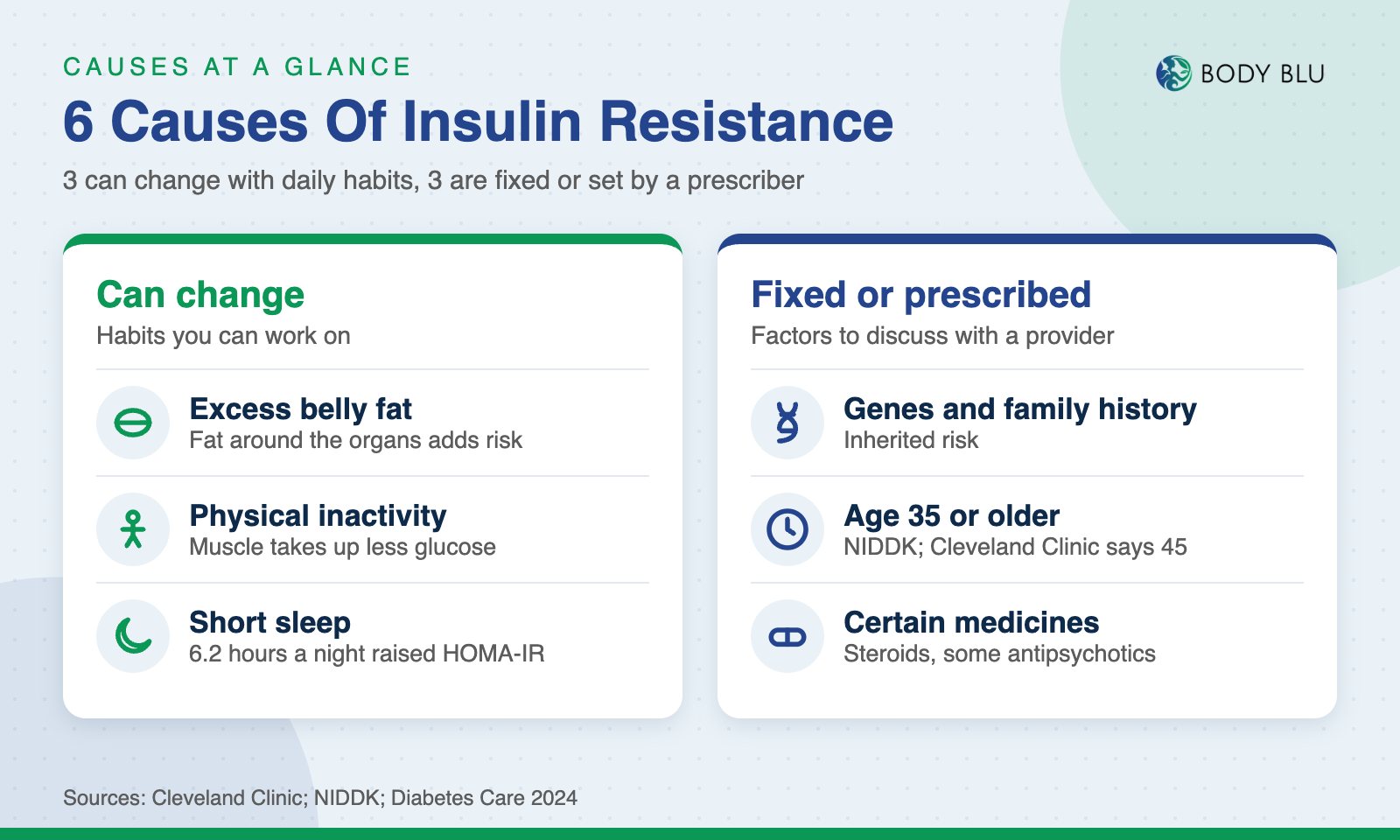
The causes of insulin resistance are excess body fat, physical inactivity, genetics, age, certain conditions and medicines, and they act together. Cleveland Clinic reports that excess body fat and a lack of physical activity are the 2 main factors. Fat around the belly and organs, called visceral fat, especially raises the risk.
Insulin resistance means that cells in muscle, fat and liver respond poorly to insulin. Insulin is the hormone that moves glucose out of the blood, so the pancreas makes extra insulin to compensate. We review these drivers together in a cause-focused insulin resistance program, because no single trigger explains every case.
The American Diabetes Association adds that specific genes make a person more or less likely to develop insulin resistance. The risk also rises with age.
- Excess body fat, especially visceral fat
- Physical inactivity
- Family history and inherited genes
- Age of 35 years or older (NIDDK) or 45 years or older (Cleveland Clinic)
- Short or disrupted sleep and sleep apnea
- Smoking
- Hormonal conditions and medicines such as glucocorticoids
The graphic below groups these drivers by the ones you can change and the ones you cannot. Fat is the first driver on the list, so the mechanism of fat comes next.
How Does Excess Body Fat Cause Insulin Resistance?
Excess body fat causes insulin resistance when fat spills into the liver and muscle and blocks the insulin signal. A 2021 review in Diabetes & Metabolism Journal explains that stored liver and muscle fat can cause severe insulin resistance. The effect occurs even without much visceral fat. The American Diabetes Association (ADA) states that scientists do not yet know exactly why fat has this effect.
Researchers theorize that extra fat tissue triggers inflammation or other cell stress. Fat tissue may also release a hormone-like signal that tells the body to resist insulin. Such theories make belly fat a leading candidate for the root cause of insulin resistance. Proof of a single root is still missing.
The same review describes selective insulin resistance. In the liver, insulin stops suppressing glucose output but still stimulates fat production. Insulin levels stay high, so fat production continues while blood sugar rises.
That fat production leads to a second group of drivers, because movement and rest change how muscle handles glucose.
Can Stress Cause Insulin Resistance, and Do Sleep and Inactivity Matter?
Yes, chronic stress, poor sleep and inactivity can all raise insulin resistance within days to weeks. Cleveland Clinic explains that movement makes the body more sensitive to insulin and builds muscle that absorbs glucose. A lack of activity removes that effect.
Bed rest studies show how fast the change happens. Three combined studies of 26 young men found that 9 days of bed rest raised HOMA-IR by 27%. HOMA-IR is a lab score for insulin resistance. Muscle that stops working stops taking up glucose well.
Sleep has a measured effect as well. A 2024 randomized trial in Diabetes Care cut sleep by 1.5 hours a night in 38 women for 6 weeks. Sleep fell to 6.2 hours a night. Fasting insulin rose by 6.8 pmol/L and HOMA-IR rose by 0.30. Body fat did not explain the change.
The graphic below summarizes the trial numbers.
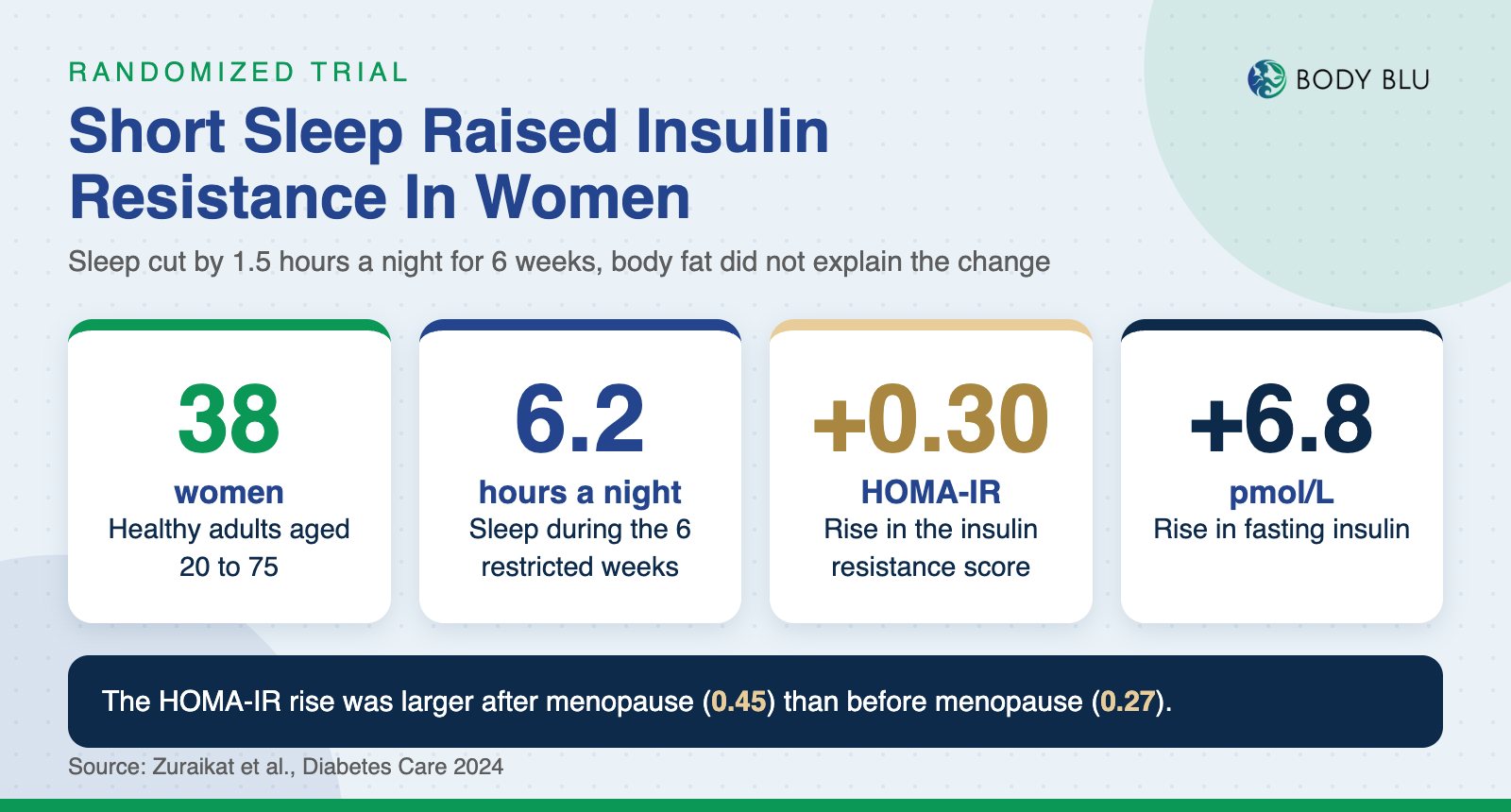
The same trial found a larger HOMA-IR rise in postmenopausal women (0.45) than in premenopausal women (0.27). Stony Brook Medicine lists chronic stress and poor sleep among its causes. Cortisol, the stress hormone, counteracts insulin when levels stay high, as Cleveland Clinic explains for Cushing's syndrome.
Stress, sleep and activity overlap, so a provider reviews them together. We look at stress hormones through HPA axis support when symptoms suggest they play a part. Food is the next driver to examine.
Does Sugar Cause Insulin Resistance?
Sugar alone is not proven to cause insulin resistance, but sugary drinks link to a 26% higher risk of type 2 diabetes. A 2010 meta-analysis in Diabetes Care pooled 11 studies and 310,819 people. People who drank 1 to 2 servings a day had a relative risk of 1.26 compared with people who drank almost none.
That study measured diabetes, not insulin resistance directly. Sugary drinks also add calories, and extra calories add body fat. Body fat is the stronger and better documented driver.
Ultra-processed food shows a similar pattern. A 2017 review found that 4 of 5 studies linked higher intake to overweight or obesity. The review states that it remains unclear whether processing or nutrient content explains the link. Cleveland Clinic ties a diet high in processed foods, carbohydrates and saturated fats to insulin resistance.
A high fat diet follows the same logic. The evidence points to the overall eating pattern, not to one nutrient. The ADA notes that some evidence suggests low-fat, high-carbohydrate diets can worsen insulin resistance. Medical conditions and medicines work differently from food, so they form their own group of causes.
What Medical Conditions and Medicines Cause Insulin Resistance?
Hormone conditions and medicines cause insulin resistance, and Cushing's syndrome, acromegaly and hypothyroidism are the 3 hormone disorders Cleveland Clinic names. Cushing's syndrome means extra cortisol in the body. Acromegaly means high growth hormone, and hypothyroidism means an underactive thyroid.
NIDDK adds polycystic ovary syndrome (PCOS), sleep apnea and viral illness such as COVID-19 to the list. A 2019 meta-analysis found that women with PCOS had 3.35 times the odds of metabolic syndrome. Women with PCOS need a closer look through PCOS evaluation alongside insulin testing.
Some medicines act on insulin directly. NIDDK lists glucocorticoids, some antipsychotics and some HIV medicines. Cleveland Clinic notes that a brief course of steroids can cause temporary insulin resistance.
Rare inherited conditions such as Type A insulin resistance syndrome and Donohue syndrome also cause it. Never stop a prescribed medicine on your own, because only the prescriber can weigh the risks. These shared causes affect women and men differently, which the next section compares.
What Causes Insulin Resistance in Women and Men?
The main causes are the same in women and men, but PCOS, pregnancy and menopause add causes that apply only to women. The table below compares the shared and sex-specific drivers.
| Cause | Women | Men | Source |
|---|---|---|---|
| Excess belly fat | Waist over 35 inches | Waist over 40 inches | NHLBI |
| Hormone condition | PCOS and menopause, plus shared disorders | Cushing's syndrome and hypothyroidism (shared) | NIDDK, Cleveland Clinic |
| Pregnancy history | Gestational diabetes | Not applicable | Cleveland Clinic |
| Sleep | Short sleep (trial in women) | Sleep apnea and short sleep (both sexes) | Diabetes Care 2024, NIDDK |
Women face 3 added drivers: PCOS, a history of gestational diabetes and the menopause transition. A 2021 review explains that estrogen loss adds visceral fat, and that fat releases free fatty acids that cause insulin resistance. Our menopause transition guidance covers these shifts. The answer to what causes insulin resistance in women therefore includes hormone changes across life.
Men share the belly fat, inactivity and sleep apnea drivers. What causes insulin resistance in men follows the same list. A provider can check hormone status through testosterone levels when symptoms point there.
Both groups confirm the cause with the same blood work, which a provider orders after reviewing history and symptoms.
Some of these drivers raise body weight, so the weight link needs its own answer.
Does Insulin Resistance Cause Weight Gain?
Insulin resistance and weight gain are linked in a two-way cycle. The evidence does not show that insulin resistance alone causes weight gain. NIDDK states that insulin resistance can lead to higher blood glucose and weight gain.
Insulin normally suppresses fat breakdown in fat tissue, according to the 2021 review. Fat cells that still respond to high insulin therefore favor fat storage. Researchers have not proven this mechanism in people.
The cycle runs in 4 steps:
- Excess belly fat and inactivity make cells resist insulin.
- The pancreas makes extra insulin to compensate.
- High insulin favors fat storage in cells that still respond.
- Added weight deepens the resistance, and the cycle repeats.
The graphic below shows the 4 steps of the cycle and the 1991 study result.
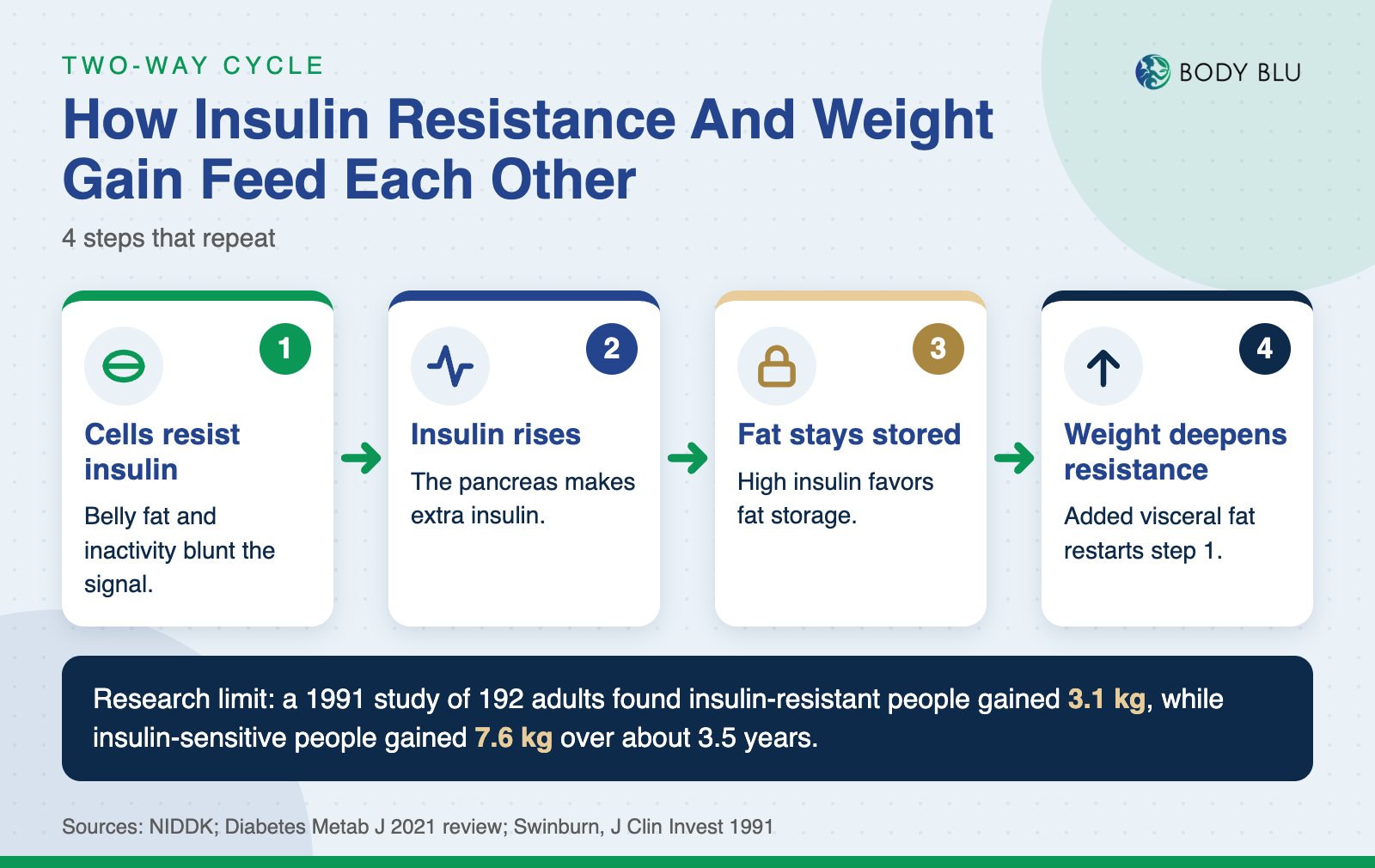
The evidence has limits. A 1991 study followed 192 adults without diabetes for about 3.5 years. Insulin-resistant adults gained 3.1 kg, while insulin-sensitive adults gained 7.6 kg.
That finding shows insulin resistance does not make weight gain certain. Weight gain that did occur raised resistance. We use the cycle as a working model, not a proven one-way rule. Our weight loss support starts with the cause and not the scale alone.
How Does Insulin Resistance Cause Weight Gain?
Insulin resistance causes weight gain mainly through higher insulin levels that favor fat storage. Insulin turns off fat release in fat tissue. Cells that resist insulin signals in muscle and liver leave more insulin in the blood.
The 2021 review calls this a working model and not a proven rule. Weight gain then adds visceral fat, and that fat drives insulin resistance up further. A root cause evaluation separates which side of the cycle started first.
Why Does Insulin Resistance Cause Weight Gain Around the Belly?
Insulin resistance links to belly weight because visceral fat is the fat type Cleveland Clinic ties to higher risk. Cleveland Clinic states that fat around the belly and organs especially raises risk. A waist over 40 inches in men or 35 inches in women meets the NHLBI metabolic syndrome threshold.
Whether insulin resistance causes belly fat or belly fat causes insulin resistance is not settled. The cycle explains why the 2 move together. We therefore address both sides of the cycle together.
What Else Should You Know About the Causes of Insulin Resistance?
Can You Get Insulin Resistance Without Being Overweight?
Yes, a person can get insulin resistance without excess weight through genes, short sleep, inactivity, medicines or hormone conditions. The 2021 review notes that stored fat in the liver and muscle can cause severe resistance without visceral fat. The Diabetes Care sleep trial found that sleep loss raised HOMA-IR independent of body fat. Our insulin resistance signs guide lists the clues that prompt testing.
Which Causes of Insulin Resistance Can You Change?
You can change activity, sleep, smoking and body weight, but you cannot change age, family history or genes. NIDDK states that people can lower some risk factors by reaching a healthy weight, being active and stopping smoking. The Diabetes Prevention Program found that 5% to 7% weight loss lowered diabetes chance. Our insulin resistance basics post explains how the numbers fit together.
Is Insulin Resistance Temporary?
Insulin resistance can be temporary when a short-term cause such as a steroid course ends. Cleveland Clinic states that a brief course of steroid medication causes temporary insulin resistance. Chronic causes such as sleep loss and excess belly fat keep it going.
What Deficiency Causes Insulin Resistance?
No single nutrient deficiency is a proven primary cause, and hypothyroidism is the deficiency-type cause that Cleveland Clinic lists. Hypothyroidism means too little thyroid hormone, which slows metabolism. A provider can test thyroid and nutrient status before any supplement choice.
How Does Body Blu Help Find the Cause of Insulin Resistance?
Body Blu helps by testing fasting insulin and glucose together and then matching the result to your own drivers. We order fasting insulin testing and review sleep, activity, medicines and hormones in one visit.
Dr. Scarpuzzi explains each result in plain language. The plan then follows your own causes, from thyroid and cortisol to sex hormones when they apply. Each plan starts with a full history review at the Body Blu center.
Ask your provider before changing any medicine, because only a prescriber can weigh the risks of stopping or switching a drug. We review results with every patient before a plan begins. You can request an appointment to review your own causes.


Resources
From Our Blog
Naturopathic insights, wellness tips, and updates from the Body Blu team.
Wellness
What Causes Insulin Resistance and Does It Cause Weight Gain
What causes insulin resistance is a mix of excess belly fat, inactivity, family history, short sleep and some medicines. Insulin resistance and weight gain feed each other, but research shows the link does not run only one way.
Nutrition
Diet for Insulin Resistance and Best Foods for Insulin Resistance
A diet for insulin resistance centers on nonstarchy vegetables, fiber-rich whole foods, beans, fish and nuts, with fewer sugary drinks and ultra-processed foods. The ADA says no single eating plan fits everyone with prediabetes.

Treatments
What Is Sermorelin Peptide and What Does Sermorelin Do?
Sermorelin is a lab-made peptide that copies the first 29 amino acids of GHRH and prompts the pituitary gland to release growth hormone. FDA withdrew approval of the brand drug in 2009.