


How to Test for Insulin Resistance and the Blood Test to Ask For

Testing for insulin resistance starts with a fasting blood draw, held for at least 8 hours, that measures insulin and glucose together. A provider then calculates HOMA-IR from the two results. NIDDK states that providers may not test for insulin resistance, so A1C and lipids add context. This guide explains how to test for insulin resistance and which blood test to ask for.
Key Takeaways
- Ask first for a fasting insulin level and a fasting glucose, drawn after a fast of at least 8 hours.
- HOMA-IR equals fasting insulin times fasting glucose divided by 405, and published cutoffs range from 1.85 to 3.46.
- A1C and fasting glucose measure blood sugar, not insulin, so each result needs context.
- A triglyceride to HDL ratio of 3.0 identified insulin resistance with 64% sensitivity in one Stanford study.
- NIDDK states that providers may order prediabetes tests from age 35, with repeat tests at least every 3 years.
How to Test for Insulin Resistance and Which Test Comes First?
The first test is one blood draw that measures fasting insulin and fasting glucose together. Mayo Clinic Laboratories requires an 8-hour fast before its serum insulin test. A provider then multiplies the two results and divides by 405 to get HOMA-IR, short for homeostasis model assessment of insulin resistance.
Matthews and colleagues introduced the HOMA model in 1985. Their estimate matched the euglycemic clamp, a research method, with a correlation of 0.88. Providers use the fasting values as a practical stand-in for that research method.
NIDDK states that health care professionals may not test for insulin resistance, because the test is primarily used in research studies. Cleveland Clinic agrees that no routine test exists. We run insulin lab testing that draws insulin and glucose together, and the next section lists the exact tests to request.
What Blood Test for Insulin Resistance Should You Ask For?
The blood test for insulin resistance to ask for is a fasting insulin level paired with a fasting glucose. Ask for a lipid panel and an A1C at the same visit. Those 4 labs give a provider both insulin data and blood sugar data.
Request the labs below at one visit, in this order.
- Fasting insulin, drawn after a fast of at least 8 hours.
- Fasting plasma glucose from the same draw.
- Hemoglobin A1C, which needs no fast.
- Lipid panel, which reports triglycerides and HDL cholesterol.
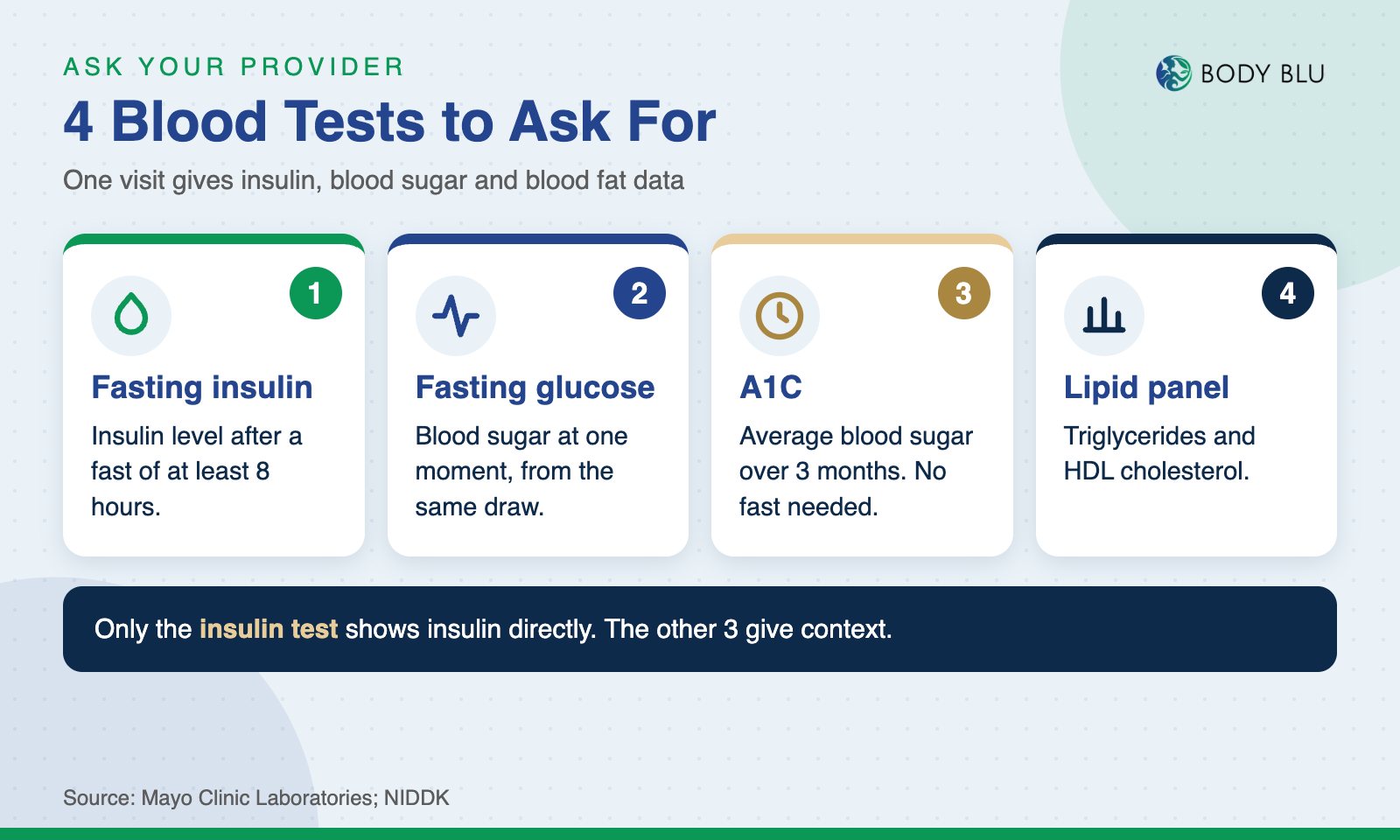
The graphic above shows the 4 labs and what each one measures. A provider can add an oral glucose tolerance test (OGTT) for borderline results. A functional lab panel at Body Blu pairs fasting insulin with glucose in a single draw.
The table below compares each test by what it measures and whether it shows insulin.
| Test | What it measures | Fasting rule | Shows insulin? |
|---|---|---|---|
| Fasting insulin | Insulin in the blood | At least 8 hours (Mayo Clinic Laboratories) | Yes |
| Fasting plasma glucose | Blood glucose at one moment | At least 8 hours (NIDDK) | No |
| A1C | Average blood glucose over 3 months | No fast (NIDDK) | No |
| OGTT | Blood glucose 2 hours after a sugary drink | At least 8 hours (NIDDK) | No, unless insulin is added |
| Lipid panel | Triglycerides and HDL cholesterol | Follow the lab's instructions | No |
Only the insulin test shows insulin directly, so the other 4 rows need that result for context.
What Is a Normal Insulin Resistance Test Range?
A normal insulin resistance test range is not one official number, because each laboratory publishes its own insulin reference interval. Mayo Clinic Laboratories lists serum insulin at 2.6-24.9 mcIU/mL. A result inside that interval does not rule out insulin resistance.
A Stanford study tested 258 nondiabetic, overweight adults. An insulin cut-point of 109 pmol/L showed 57% sensitivity and 85% specificity. Sensitivity is the share of insulin-resistant adults that a marker catches, and the authors noted that no standardized insulin assay exists.
Our earlier guide covers the insulin resistance meaning and why the pancreas makes extra insulin. The table below collects ranges from 5 named sources.
| Test | Value | What the value means | Named source |
|---|---|---|---|
| Fasting serum insulin | 2.6-24.9 mcIU/mL | Laboratory reference interval | Mayo Clinic Laboratories |
| Fasting insulin cut-point | 109 pmol/L | Research marker in overweight adults | McLaughlin, Ann Intern Med 2003 |
| Fasting plasma glucose | 100-125 mg/dL | Prediabetes range | NIDDK |
| A1C | 5.7% to 6.4% | Prediabetes range | NIDDK |
| OGTT at 2 hours | 140-199 mg/dL | Prediabetes range | NIDDK |
| Triglycerides | Over 150 mg/dL | Metabolic syndrome criterion | NHLBI |
| HDL cholesterol | Under 40 mg/dL (men), under 50 mg/dL (women) | Metabolic syndrome criterion | NHLBI |
| Triglyceride to HDL ratio | 3.0 (mg/dL units) | Research cut-point in overweight adults | McLaughlin, Ann Intern Med 2003 |
| HOMA-IR | 1.85 to 3.46 | Range of cutoffs in one population study | Gayoso-Diz, BMC Endocr Disord 2013 |
Ranges from different sources answer different questions, so each row names its source. The HOMA-IR row shows the widest spread, which the next section explains.
How Can You Calculate Insulin Resistance From Lab Results?
Calculate insulin resistance from lab results with HOMA-IR, which equals fasting insulin times fasting glucose, divided by 405. The formula uses insulin in uIU/mL and glucose in mg/dL. Both numbers must come from the same fasting draw.
The steps below use US lab units.
- Read the fasting insulin value in uIU/mL from the lab report.
- Multiply that value by the fasting glucose in mg/dL.
- Divide the product by 405.
- Compare the score with the cutoff that your provider or a study uses.
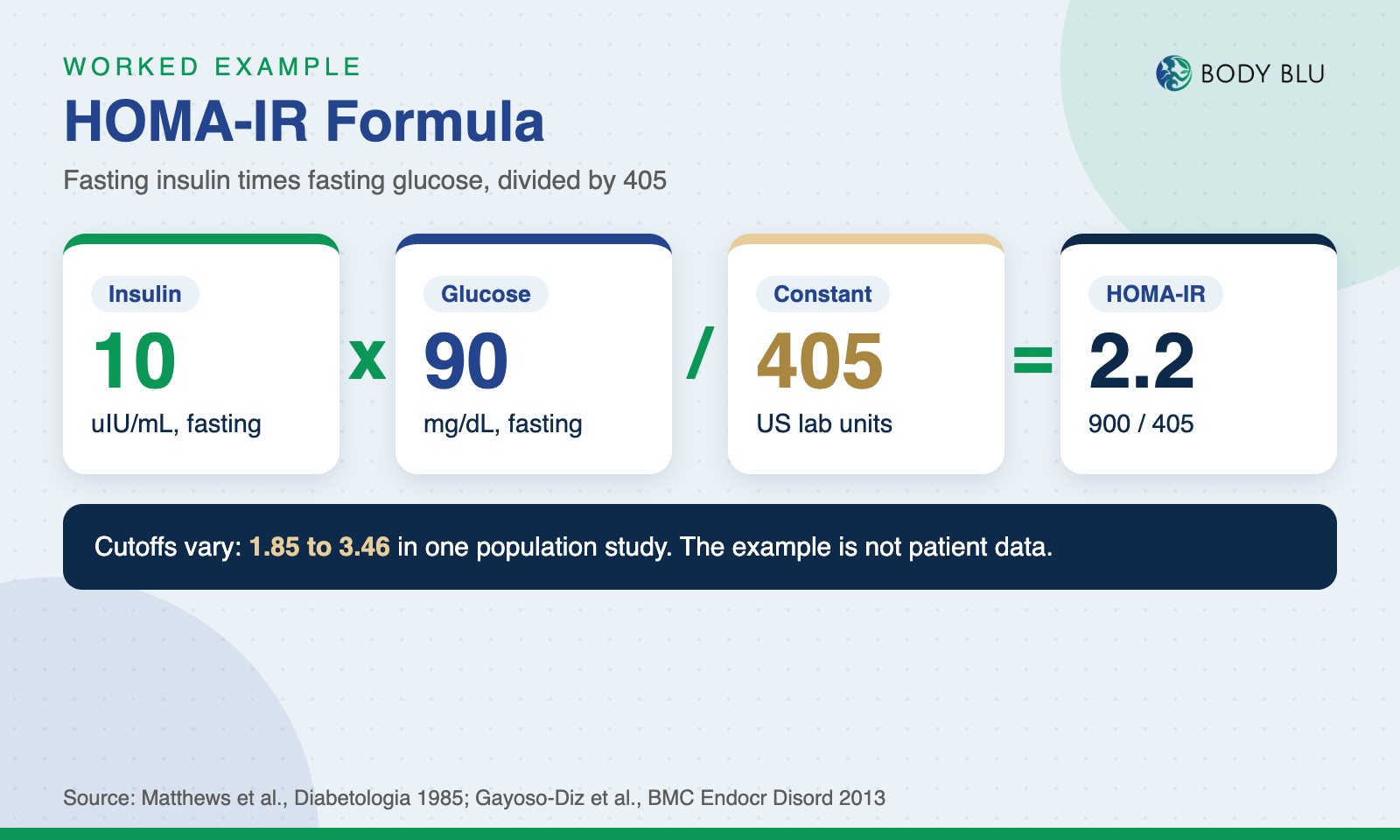
The graphic above works through an example. Insulin of 10 uIU/mL and glucose of 90 mg/dL multiply to 900, and 900 divided by 405 gives a HOMA-IR of 2.2. The example is for illustration and is not patient data.
Cutoffs for the score vary by study. Gayoso-Diz and colleagues analyzed 2,459 Spanish adults and found 3.46 at the 90th percentile. The same study found 2.05 using metabolic syndrome components and 1.85 in non-diabetic men.
The original model also has limits. Matthews and colleagues reported a coefficient of variation of 31% for the insulin resistance estimate, which means repeat estimates can differ widely. That imprecision explains why providers read HOMA-IR next to other results.
Does A1C Test for Insulin Resistance or Only Blood Sugar?
A1C does not test for insulin resistance, because the test reports average blood glucose over 3 months, NIDDK states. The result is a percentage of hemoglobin that carries glucose. Insulin never enters the calculation.
NIDDK sets prediabetes at an A1C of 5.7% to 6.4% and diabetes at 6.5% or above. Fasting plasma glucose follows the same pattern, with prediabetes at 100 to 125 mg/dL and diabetes at 126 mg/dL or above. NIDDK notes that a second test confirms a diabetes result.
Insulin resistance glucose levels can stay in a healthy range while the pancreas keeps up, Cleveland Clinic explains. Glucose results alone therefore cannot show how much insulin the body needed to hold that range.
NIDDK adds that the A1C test may miss prediabetes in people with certain health conditions. Hemoglobin variants can also interfere with A1C readings. A glucose test that adds a timed challenge covers part of that gap.
What Does an Oral Glucose Tolerance Test Show?
An oral glucose tolerance test shows how blood glucose responds 2 hours after a high-sugar drink, per NIDDK. The patient fasts at least 8 hours and gives a baseline blood sample. A second sample follows 2 hours after the drink.
NIDDK sets prediabetes at 140 to 199 mg/dL and diabetes at 200 mg/dL or above at the 2-hour point. The agency adds that the OGTT is harder to give, takes more time and costs more than the other tests.
Researchers also measure insulin during the test. Matsuda and DeFronzo built an index from fasting and OGTT glucose and insulin values. The index correlated with the euglycemic clamp at r = 0.73 in 153 adults who drank 75 g of glucose.
A routine lipid panel offers a simpler clue than the OGTT, and the next section covers it.
Can the Triglyceride to HDL Ratio Show Insulin Resistance?
The triglyceride to HDL ratio can point toward insulin resistance, but it works as a screening clue, not a diagnosis. Divide triglycerides by HDL cholesterol, with both in mg/dL, using results from a lipid panel. Triglycerides of 150 mg/dL and HDL of 50 mg/dL give a ratio of 3.0.
The Stanford study of 258 overweight adults used 3.0 as its cut-point. That ratio identified insulin resistance with 64% sensitivity and 68% specificity. Specificity is the share of insulin-sensitive adults that a marker correctly clears.
NHLBI lists triglycerides over 150 mg/dL and HDL under 40 mg/dL in men or 50 mg/dL in women as metabolic syndrome criteria. NIDDK adds that blood fat levels may rise with insulin resistance or prediabetes. Good preparation keeps all of these numbers reliable.
How Should You Prepare for an Insulin Resistance Test?
Prepare for an insulin resistance test by fasting at least 8 hours and drinking only sips of water. NIDDK states that the fasting glucose test is given in the morning. Mayo Clinic Laboratories also asks patients to skip supplements that contain biotin (vitamin B7) for 12 hours before the draw.
- Fast for at least 8 hours before the blood draw.
- Drink only sips of water during the fast.
- Skip biotin supplements, common in hair, skin and nail products, for 12 hours.
- Book a morning appointment.
- Repeat later tests at the same lab.
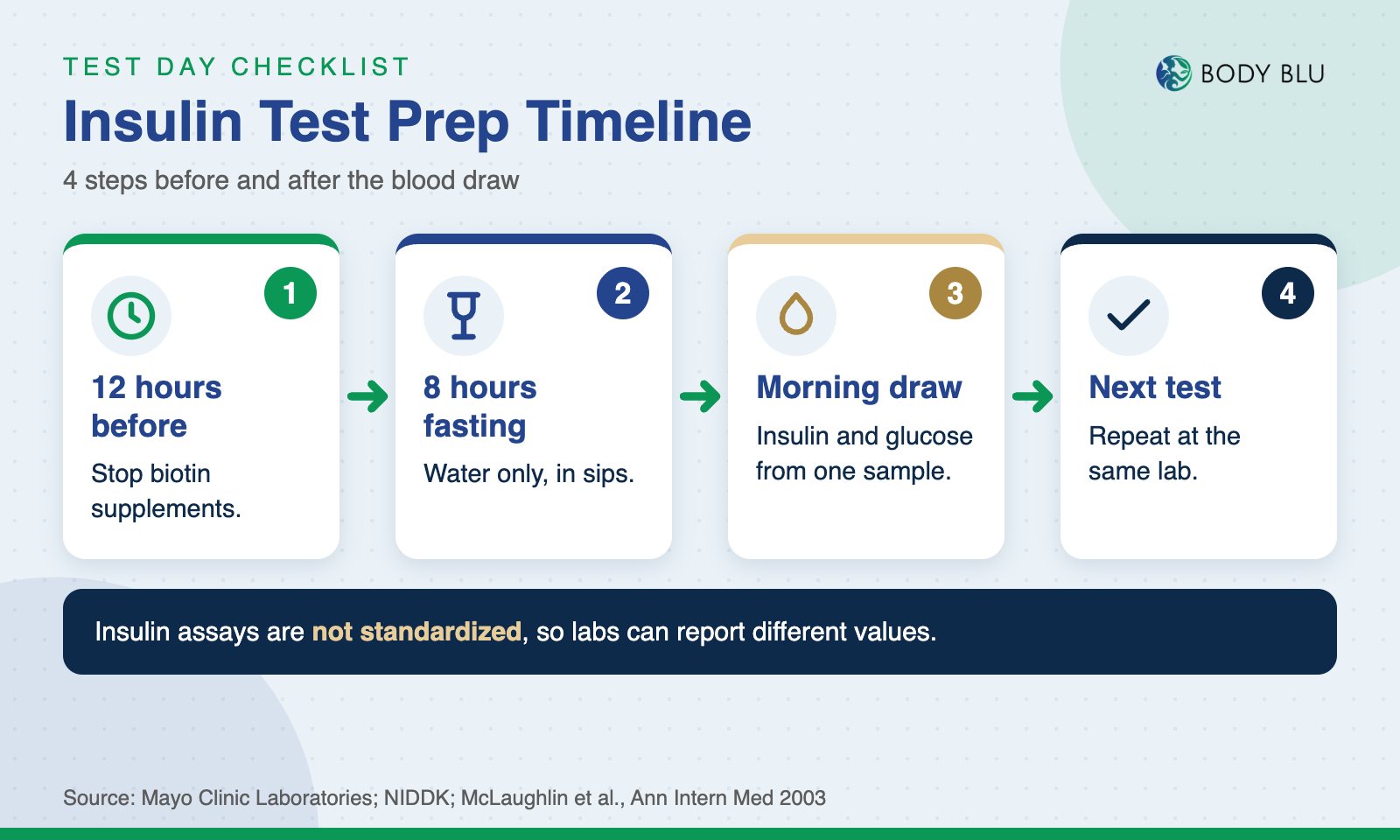
The timeline above puts the checklist in order. The same-lab step matters because insulin assays are not standardized, the Stanford authors noted. Different labs can report different insulin values from the same sample.
Sleep also affects the score. A 6-week trial of 38 women found that 6.2 hours of sleep per night raised HOMA-IR by 0.30 (Zuraikat, Diabetes Care 2024). Prepared results still need careful reading, as the next section shows.
What Do Normal or Mixed Results Mean?
Normal or mixed results mean that no single number settles the question. Cleveland Clinic states that a provider weighs medical history, family history, a physical exam and symptoms. Lab values then fit into that larger picture.
Four limits explain why one number can mislead.
- Insulin assays are not standardized across laboratories.
- HOMA-IR cutoffs ranged from 1.85 to 3.46 in one population study.
- The HOMA estimate has a coefficient of variation of 31%.
- The A1C test may miss prediabetes in people with certain health conditions.
A provider combines these limits with the full history before drawing conclusions. Body Blu reviews insulin, glucose and lipid results together as part of prediabetes support. Results belong in a conversation with your provider, not in a self-diagnosis.
Who Should Get Tested for Insulin Resistance and How Often?
Adults age 35 or older should talk with a provider about testing. NIDDK states that providers may order prediabetes tests at that age. Adults with overweight or obesity and other risk factors may qualify earlier. People with normal results but risk factors may be retested at least every 3 years.
People with prediabetes should be tested for type 2 diabetes every year, NIDDK states. The CDC reports that 115.2 million US adults had prediabetes in 2023, and 8 in 10 were unaware.
NIDDK also states that insulin resistance and prediabetes do not cause symptoms for many people. A guide to insulin resistance indicators therefore cannot replace a lab test.
NIDDK lists polycystic ovary syndrome (PCOS), sleep apnea and Cushing's syndrome among conditions related to insulin resistance. Adults with a related condition can ask a provider about PCOS testing and metabolic labs.
What Else Should You Know About Testing for Insulin Resistance?
Can You Test for Insulin Resistance at Home?
A home glucose meter reads blood glucose only, so a home reading cannot report insulin or HOMA-IR. NIDDK states that providers diagnose prediabetes with blood tests. A lab draw ordered by a provider covers the insulin step.
Does Weight Change Affect Test Results?
Weight change can shift test results, because Cleveland Clinic states that lifestyle changes can lower insulin resistance, glucose, triglycerides and blood pressure. The NIDDK Diabetes Prevention Program cut type 2 diabetes risk by 58% over about 3 years. That program set goals of 7% weight loss and 150 minutes of weekly activity. Retesting after changes shows progress, and a provider can pair it with medical weight management.
How Is Insulin Resistance Different From Prediabetes on a Test?
Prediabetes is diagnosed with glucose cutoffs on the A1C, fasting glucose or OGTT, while insulin resistance has no routine test. NIDDK describes the insulin resistance test as primarily a research tool. Prediabetes therefore appears on standard labs, and insulin resistance needs extra interpretation.
How Does Body Blu Help With Insulin Resistance Testing?
Body Blu helps by testing fasting insulin and glucose together, then explaining both results in context. Dr. Joseph Scarpuzzi, ND, a licensed naturopathic doctor, reviews the numbers with your history and symptoms. A functional lab review keeps every result in one place for that conversation.
Results then guide the next steps, which the care team plans with you after reviewing each lab value and its limits. Our functional medicine providers look at sleep, activity, nutrition and weight alongside the labs. That review turns one set of numbers into a plan you can repeat and retest.
Anyone asking how to test for insulin resistance can schedule lab testing at our Cardiff clinic.
Talk to your primary care provider before changing medicines or supplements. Bring your lab reports, fasting notes and supplement list to every visit. The pages on Body Blu services describe each service in detail.


Resources
From Our Blog
Naturopathic insights, wellness tips, and updates from the Body Blu team.
Wellness
How to Test for Insulin Resistance and the Blood Test to Ask For
Testing for insulin resistance starts with a fasting insulin and fasting glucose blood draw after a fast of at least 8 hours. A provider then calculates HOMA-IR and reads A1C, OGTT and lipid results alongside it.

Treatments
BPC-157 Peptide Benefits and BPC-157 Benefits for Men and Women
BPC-157 peptide benefits come mainly from animal studies, and the FDA has not approved it for any use. Only 3 small human studies exist, and none was designed around men.

Wellness
What Causes Insulin Resistance and Does It Cause Weight Gain
What causes insulin resistance is a mix of excess belly fat, inactivity, family history, short sleep and some medicines. Insulin resistance and weight gain feed each other, but research shows the link does not run only one way.