


How to Treat Insulin Resistance and What Helps Insulin Resistance


How to treat insulin resistance starts with lifestyle changes. The goals are 150 minutes of weekly activity, enough sleep and 5% to 7% weight loss. The Diabetes Prevention Program cut diabetes risk by 58% with lifestyle changes and by 31% with metformin. GLP-1 medicines add options for higher-risk adults, and supplements lack proven benefit without a deficiency.
Key Takeaways
- Lifestyle changes are the primary treatment, and no medicine treats insulin resistance itself.
- The CDC recommends 150 minutes of moderate activity a week plus strength work on 2 or more days.
- Metformin lowered type 2 diabetes chances by 31%, and tirzepatide cut diagnoses from 13.3% to 1.3% over 176 weeks.
- Vitamin D showed a nonsignificant 12% lower diabetes hazard in 2,423 adults with prediabetes.
- A provider should review any medicine or supplement, especially with PCOS, menopause or other conditions.
How to Treat Insulin Resistance Step by Step?
Treat insulin resistance with lifestyle changes first and medicine second. Cleveland Clinic calls lifestyle changes the primary treatment, because genetic factors and age cannot be treated. The same source says no medication treats the condition itself. Providers prescribe medicines for linked problems such as prediabetes, high blood pressure and cholesterol.
A fixed order keeps the plan simple. The 5 steps below follow NIDDK and Cleveland Clinic guidance and show how to treat insulin resistance in sequence.
- Confirm the diagnosis with fasting glucose, A1C and a lipid panel.
- Build up to 150 minutes of activity a week, plus strength work on 2 days.
- Aim for 5% to 7% weight loss when excess weight is present.
- Protect sleep, because short sleep raised insulin resistance scores in a 6-week trial.
- Ask a provider about metformin or GLP-1 medicine when risk stays high.
The graphic below shows the 5 steps in order.
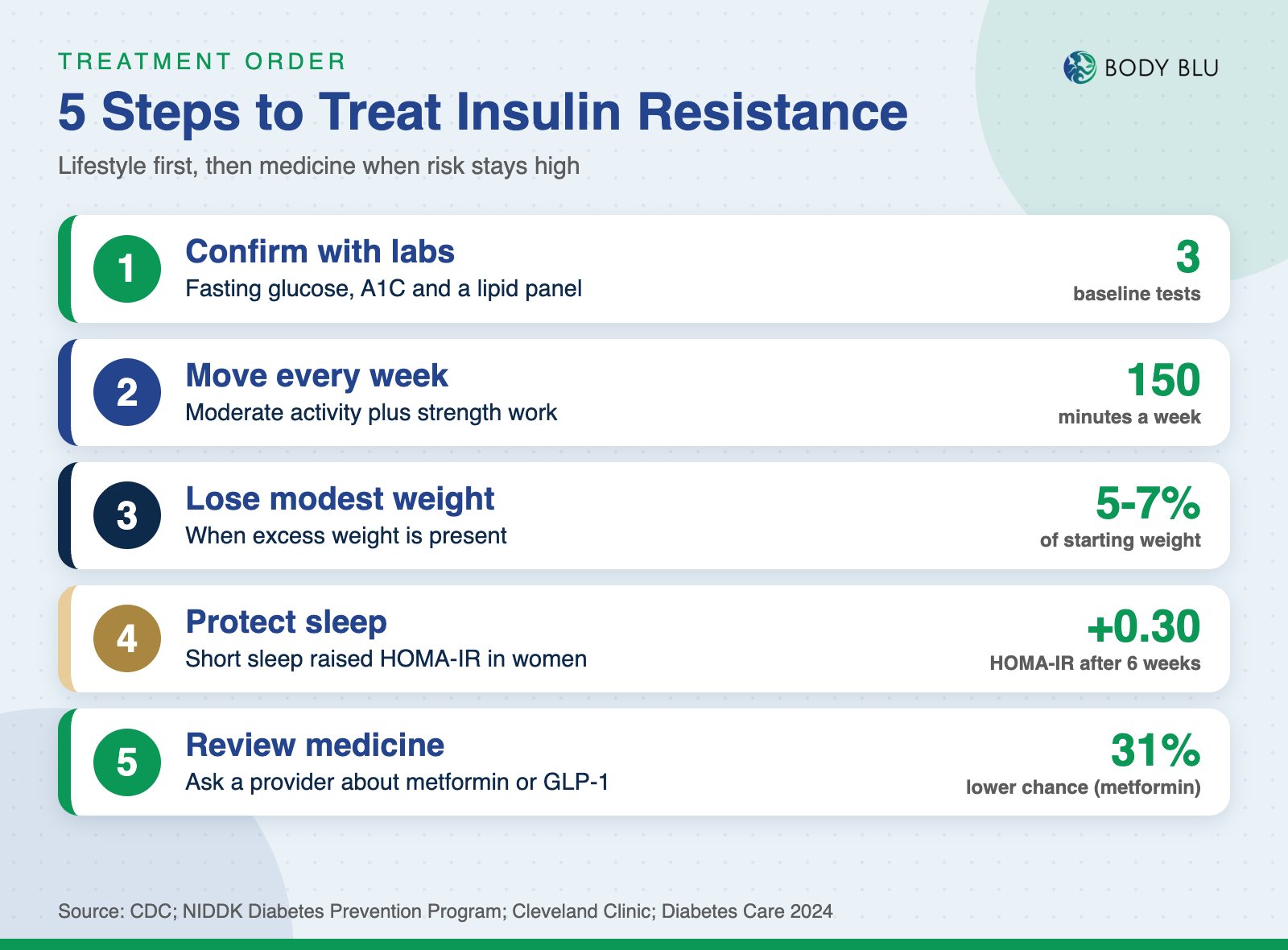
Body Blu builds this sequence into insulin resistance treatment plans that start with fasting insulin and glucose labs. Lifestyle targets come before any medicine. Exercise and weight are the first targets, so the next section covers which lifestyle changes help insulin resistance.
What Lifestyle Changes Help Insulin Resistance?
Lifestyle changes that help insulin resistance are regular exercise, modest weight loss and enough sleep. Trial data show what helps insulin resistance in measurable terms. Each change below has a named source.
Exercise comes first. The CDC recommends 150 minutes of moderate activity a week and muscle-strengthening on 2 or more days. A 2026 network meta-analysis pooled 86 randomized trials with 4,358 adults who had overweight or obesity. Aerobic, resistance, combined and high-intensity interval training all lowered fasting insulin and HOMA-IR against usual care. HOMA-IR is the homeostasis model assessment of insulin resistance. High-intensity intervals showed the largest drop, 0.67 HOMA-IR points, although certainty was low to moderate.
Weight loss adds to the effect. NIDDK reports that high-risk adults who lost 5% to 7% of starting weight cut their diabetes chance in the Diabetes Prevention Program. The program's lifestyle group aimed for 7% weight loss and 150 minutes of weekly activity.
Sleep changes the numbers too. In a 2024 Diabetes Care trial, 38 women slept 1.5 hours less per night for 6 weeks. Their HOMA-IR rose by 0.30, regardless of changes in body fat.
Food choices matter as well, and a separate Body Blu guide covers diet in detail. Readers new to the condition can start with our insulin resistance overview, which explains how cells stop responding to insulin. Medicine adds a second layer to lifestyle care, so the next section covers what medicine helps with insulin resistance.
What Medicine Helps With Insulin Resistance?
What medicine helps with insulin resistance depends on the goal, because no medicine treats insulin resistance itself. Cleveland Clinic lists metformin for diabetes or prediabetes, blood pressure medicine and statins for cholesterol. Each drug targets a linked condition.
Metformin has a 15-year follow-up record in the Diabetes Prevention Program Outcomes Study, according to NIDDK. It lowered type 2 diabetes chances by 31% in the Diabetes Prevention Program, against 58% for the lifestyle program, according to NIDDK. A 2026 meta-analysis of 18 trials found a 35% lower progression risk, with a relative risk of 0.65. NIDDK adds that metformin was most effective in women with prior gestational diabetes. It also worked well in adults aged 25 to 44 and in people with a body mass index of 35 or higher.
Metformin carries a trade-off. A meta-analysis of 17 studies in type 2 diabetes found vitamin B12 deficiency in 23.16% of metformin users and 17.4% of nonusers. The table below compares the main options and their evidence limits.
| Option | What trials show | Main limit |
|---|---|---|
| Lifestyle program | 58% lower diabetes chance over about 3 years | Included at least 16 coaching visits in 24 weeks |
| Metformin | 31% lower chance in the DPP, 35% in 18 trials | Vitamin B12 deficiency in 23.16% vs 17.4% |
| GLP-1 agonists | Relative risk of diabetes 0.26 in a 378-trial network analysis | Mostly mild to moderate gastrointestinal effects |
| Tirzepatide (GLP-1 plus GIP) | Diabetes in 1.3% vs 13.3% over 176 weeks | Trial included only adults with obesity and prediabetes |
| Vitamin D | Hazard ratio 0.88, not significant | No proven benefit without a deficiency |
The table shows incretin-based drugs at the top of the 2026 network analysis. GLP-1 medicines ranked second in that analysis, so the next section covers them.
Do GLP-1 Medicines Help Treat Insulin Resistance?
GLP-1 medicines help treat insulin resistance indirectly, because they lower weight and delay type 2 diabetes in adults with prediabetes. Yale researchers say weight loss and lower liver fat likely explain much of the effect. The trial numbers are large.
In SURMOUNT-1, 1,032 adults with obesity and prediabetes took tirzepatide or placebo for 176 weeks. Type 2 diabetes was diagnosed in 1.3% of the tirzepatide group and 13.3% of the placebo group. Weight fell 12.3% to 19.7% across the 3 tirzepatide arms and 1.3% with placebo. In STEP 1, semaglutide cut weight by 14.9% against 2.4% with placebo over 68 weeks.
The graphic below compares these results with the Diabetes Prevention Program figures for lifestyle and metformin.

Side effects were mostly gastrointestinal and mild to moderate, mainly in the first 20 weeks. Body Blu reviews GLP-1 therapy within its weight loss program, and a provider decides whether it fits. A provider also weighs the evidence limits, since the trial was funded by Eli Lilly.
Source quality matters for these drugs. The FDA states that compounded GLP-1 products are not FDA-approved. The agency had 990 adverse event reports for compounded semaglutide and over 730 for compounded tirzepatide as of May 31, 2026. Our guide to weight loss injections compares the approved options. Medicine is only one route, and supplements raise more questions, so the next section covers what vitamins help with insulin resistance.
What Vitamins Help With Insulin Resistance?
Vitamins help with insulin resistance only when a deficiency exists, according to the American Diabetes Association as quoted by WebMD. The association sees no proven supplement benefit without a specific deficiency. The D2d trial tested that idea directly.
D2d gave vitamin D3 or placebo to 2,423 adults with prediabetes, regardless of their starting vitamin D level. Diabetes developed in 293 people on vitamin D and 323 on placebo over a median 2.5 years. The hazard ratio was 0.88 with a 95% confidence interval of 0.75 to 1.04, so the gap was not significant.
Other supplements have only partial data. The list below shows what the research says.
- Berberine: an umbrella review of meta-analyses found lower HOMA-IR, but its authors noted that earlier findings were inconsistent.
- Inositol: Australian Prescriber says inositol appears to have limited metabolic benefit in PCOS and fewer adverse effects than metformin.
- Selenium: a 2026 meta-analysis of 52 treatment arms found lower fasting insulin and HOMA-IR, with no clear change in A1C.
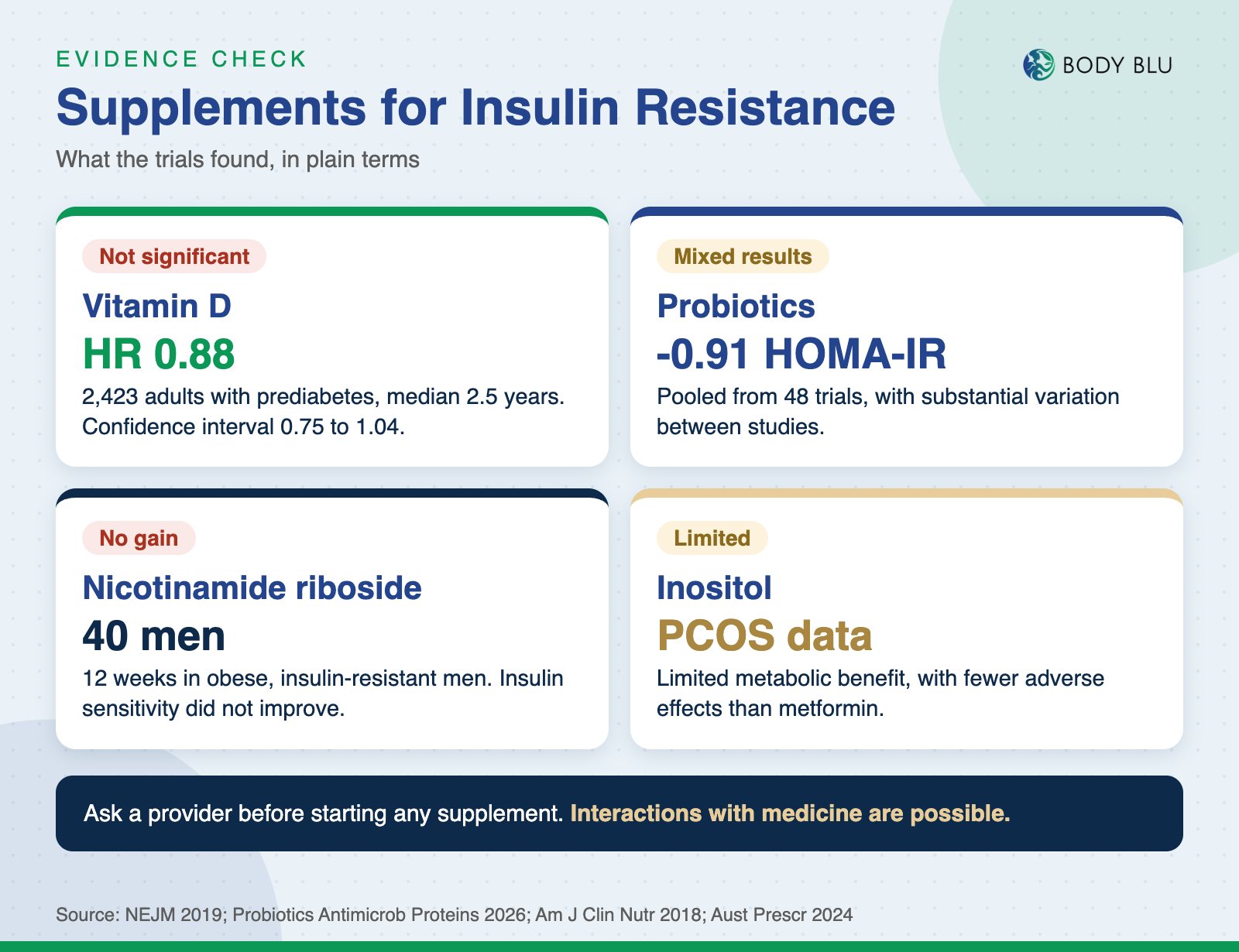
The graphic above summarizes trial results for 4 supplements, including 2 covered in the next sections. Healthline adds that supplements can interact with current medication. A provider should therefore review any product before it starts, and the next section covers the treatment for insulin resistance in women.
What Is the Treatment for Insulin Resistance in Women?
The treatment for insulin resistance in women follows the same lifestyle-first plan, with extra options when PCOS or menopause is involved. Polycystic ovary syndrome (PCOS) is closely tied to insulin resistance. Menopause raises separate hormone questions.
Australian Prescriber says metformin improves weight and metabolic outcomes in PCOS when body mass index exceeds 25 kg/m2. The same review found inositol has limited metabolic benefit and fewer adverse effects than metformin. A 2021 systematic review found that berberine lowered HOMA-IR in PCOS without changing body weight.
Body Blu provides PCOS treatment and reviews each option case by case in a consult. Australian Prescriber advises that drug choices target each patient's key concerns, so the plan matches the person.
Menopause care follows its own path. Women in perimenopause or menopause can raise menopause hormone care with a provider alongside lifestyle steps. Several side questions follow from these options, so the next section covers what else to know about treating insulin resistance.
What Else Should You Know About Treating Insulin Resistance?
Does HRT Help With Insulin Resistance?
HRT lowered insulin resistance scores in postmenopausal women in a 2006 meta-analysis of 107 trials. Hormone replacement therapy (HRT) cut HOMA-IR by 12.9% and new-onset diabetes risk by 30% in women without diabetes. The relative risk was 0.7. The review covered postmenopausal women only, so the result does not apply to men or younger women.
On 2026-02-12, the FDA removed boxed-warning statements on cardiovascular disease, breast cancer and probable dementia from 6 menopausal hormone therapy labels. A provider weighs these facts against symptoms and personal history.
Does NAD Help With Insulin Resistance?
NAD has no proven effect on insulin resistance in people so far. Nicotinamide adenine dinucleotide (NAD+) precursors improved glucose handling in animal models. In a 12-week trial of 40 obese, insulin-resistant men, nicotinamide riboside did not improve insulin sensitivity. The supplement was safe in that trial.
Patients who ask about NAD+ injections should hear this evidence gap before starting.
What Peptides Help With Insulin Resistance?
Peptides that help with insulin resistance in trials are the GLP-1 and GIP medicines, which are peptide hormones. A 2026 network meta-analysis of 378 trials found a diabetes relative risk of 0.10 with dual GLP-1 plus GIP agonists. Single GLP-1 agonists had a relative risk of 0.26.
Body Blu reviews peptide options case by case in a consult, and its peptide programs page lists GLP-1 therapy and glutathione.
Do Probiotics Help With Insulin Resistance?
Probiotics lowered insulin resistance scores in pooled trials, although results varied widely. A 2026 meta-analysis of 48 randomized trials in prediabetes and type 2 diabetes found HOMA-IR fell 0.91 points. Heterogeneity across the trials was substantial. That variation limits how far the result can guide a choice of product.
Who Are the Doctors Who Treat Insulin Resistance?
The doctors who treat insulin resistance start with primary care providers. Cleveland Clinic says they may refer patients to an endocrinologist or dietitian. Endocrinologists focus on hormone and metabolic disease. Naturopathic doctors such as Dr. Joseph Scarpuzzi, ND, at Body Blu also evaluate it with fasting insulin and glucose labs.
How Do You Know Treatment Is Working?
Follow-up labs show whether treatment is working. NIDDK says people with prediabetes should be tested for type 2 diabetes every year. Providers track A1C (5.7% to 6.4% marks prediabetes) and fasting plasma glucose (100 to 125 mg/dL marks prediabetes).
Body Blu tests fasting insulin and glucose together, and follow-up labs repeat those markers. Repeat testing shows the trend over months rather than a single day.
Symptoms make poor markers, since NIDDK says people with insulin resistance and prediabetes usually have no symptoms. Fatigue, cravings and weight changes can still appear. Our symptom checklist lists the clues that do show up.
Can Insulin Resistance Be Fully Reversed?
Insulin resistance can improve, but Cleveland Clinic says not all causes are reversible. Genetic factors and age cannot be treated. NIDDK reports that lifestyle changes or metformin can prevent or delay type 2 diabetes for at least 15 years. That finding comes from the Diabetes Prevention Program Outcomes Study.
How Does Body Blu Help Treat Insulin Resistance?
Body Blu helps people treat insulin resistance with lab-guided nutrition and lifestyle plans from licensed naturopathic doctor Dr. Joseph Scarpuzzi, ND. The clinic tests fasting insulin and glucose together, to see the full metabolic picture before numbers cross into diabetes. Patients who want to know how to treat insulin resistance in a personal plan can start with a conversation.
The clinic's prediabetes treatment page describes this approach for people whose blood sugar is already above normal. The plan centers on nutrition, lifestyle changes and lab review rather than waiting for numbers to worsen.
Each person receives an insulin sensitivity plan built from their own lab results. The plan names lifestyle targets first, then lists any medicine or supplement questions for a provider.
A consult can review evidence limits for any medicine or supplement you ask about. It can also set an order of next steps. The Body Blu doctors start with the lifestyle targets.
Medicines, supplements and lab results all fit into one conversation, so questions about any of them are welcome. When you are ready, book a consult to go over them together.


Resources
From Our Blog
Naturopathic insights, wellness tips, and updates from the Body Blu team.
Treatments
How to Treat Insulin Resistance and What Helps Insulin Resistance
Treat insulin resistance with lifestyle changes first: 150 minutes of weekly activity, sleep and 5% to 7% weight loss. Metformin and GLP-1 medicines add options, and supplements lack proven benefit without a deficiency.

Wellness
How to Reverse Insulin Resistance and Can You Reverse It Fast
Insulin resistance can be reversed in many people with movement, 5% to 7% weight loss, sleep and food changes. A first A1C recheck comes at about 3 months, and a full lifestyle program runs about 12 months.

Wellness
Mast Cell Activation Syndrome Symptoms and Signs of MCAS
Mast cell activation syndrome symptoms are recurrent episodes that involve 2 or more organ systems, including skin, gut, heart and airway. No single symptom is specific, so experts also require a mediator rise and a drug response.