


Mast Cell Activation Syndrome Symptoms and Signs of MCAS


Mast cell activation syndrome symptoms are recurrent episodes that involve 2 or more organ systems, such as skin, gut, heart and airway. A 2012 expert consensus lists 11 typical symptoms, and flushing and low blood pressure scored 95% agreement. No single symptom is specific to MCAS. This guide sorts the signs by body system and flags the ones that need urgent care.
Key Takeaways
- MCAS symptoms repeat in episodes and involve 2 or more organ systems at the same time.
- Expert consensus rated flushing and low blood pressure at 95% and wheezing at 70%.
- No single symptom is specific to MCAS, so a mediator rise and a drug response are also required.
- Only 2% of 100 patients with suspected MCAS were confirmed in one prospective study.
- Throat swelling, trouble breathing or fainting needs emergency care.
- A symptom diary with dates, timing and photos gives a provider the pattern.
What Are the Symptoms of Mast Cell Activation Syndrome?
The symptoms of mast cell activation syndrome are recurrent episodes that affect 2 or more organ systems at the same time. Mast Cell Action explains that mast cells sit in tissues throughout the body, so their mediators can reach many organs. The combination differs from person to person. A person does not need every symptom.
The 2012 consensus paper by Valent and colleagues rated 11 symptoms as typical. Consensus level is the percentage of expert members who agreed that the symptom is typical. The table gives a mast cell activation syndrome symptoms list sorted by body system.
| Symptom | Body system | Consensus level |
|---|---|---|
| Flushing | Skin | 95% |
| Itching (pruritus) | Skin | 90% |
| Hives (urticaria) | Skin | 85% |
| Swelling (angioedema) | Skin | 75% |
| Diarrhea | Gut | 90% |
| Low blood pressure (hypotension) | Heart and circulation | 95% |
| Nasal congestion | Nose | 90% |
| Nasal itching | Nose | 90% |
| Throat swelling | Airway | 85% |
| Wheezing | Airway | 70% |
| Headache | Head | 90% |
Flushing and low blood pressure reached the highest agreement at 95% each. Wheezing reached the lowest at 70%. The same members agreed by a 100% vote that no single symptom is specific to MCAS.
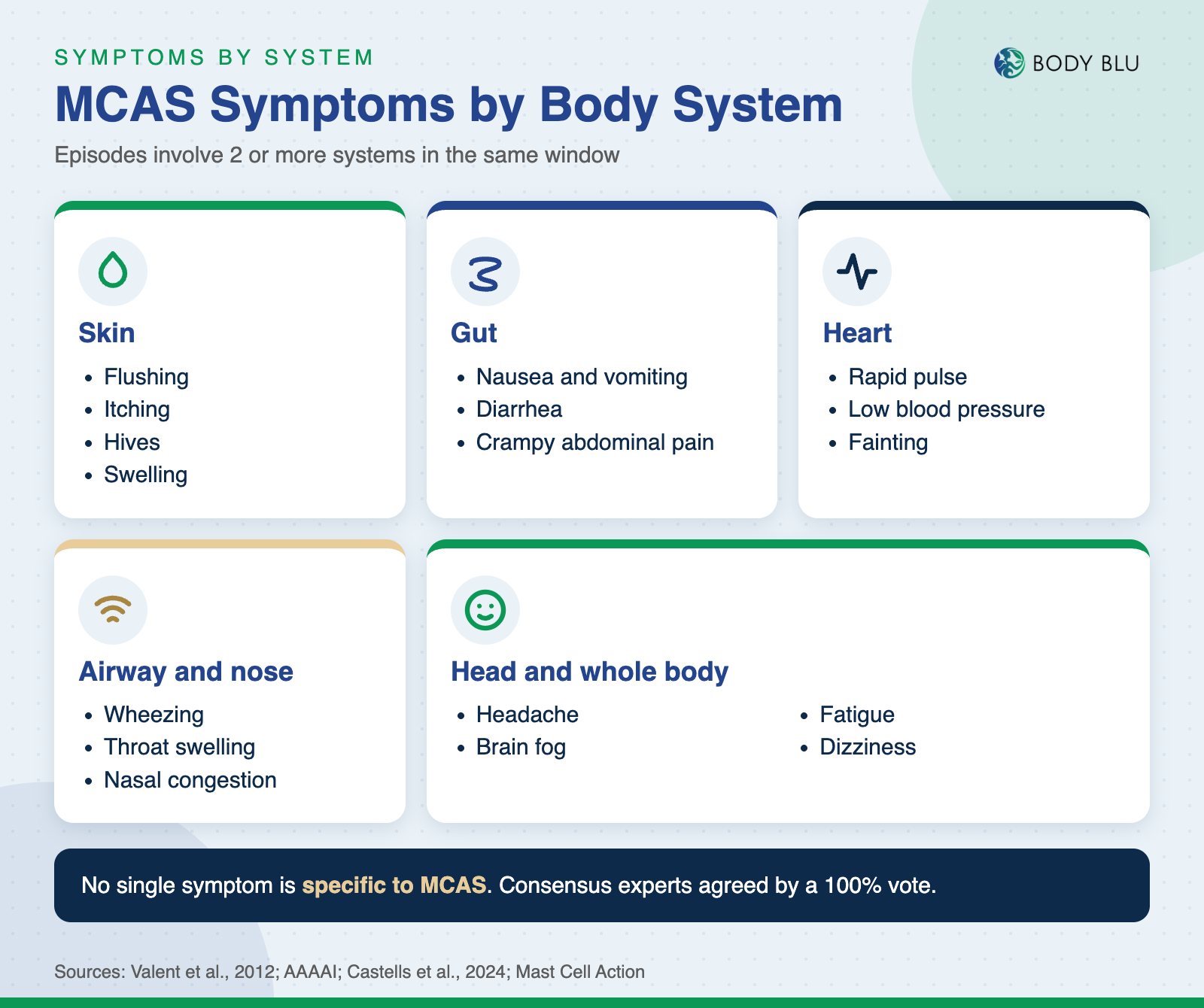
Body Blu reviews these symptom patterns as part of an MCAS evaluation, and that review supports an allergy or immunology work-up. The infographic below groups the same signs into 5 body systems. The sections that follow start with the skin.
What Are Mast Cell Activation Syndrome Skin Symptoms?
Mast cell activation syndrome skin symptoms are flushing, itching, hives and swelling. The American Academy of Allergy, Asthma and Immunology (AAAAI) names these four as the skin-related symptoms. Cleveland Clinic adds discolored, hot or itchy skin to its list for mast cell disorders. Skin signs are visible, so a photo can document them.
Skin symptoms led the picture in one referral study. Zaghmout and colleagues reviewed 703 patients and confirmed idiopathic MCAS in 31 of them, or 4.4%. Hives or angioedema were the most common presentation in those 31 patients. Patients with clonal MCAS showed these symptoms less often.
Photographs help because visible symptoms may fade before an appointment, according to Mast Cell Action. Body Blu also reviews chronic skin care when rashes persist between episodes. Skin signs do not stand alone, and gut symptoms come next.
What Are Mast Cell Activation Syndrome GI Symptoms?
Mast cell activation syndrome GI symptoms are nausea with vomiting, diarrhea and crampy abdominal pain, according to the AAAAI. Cleveland Clinic places mast cells in the gastrointestinal tract. Valent and colleagues rated diarrhea at 90% consensus, the same level as itching and headache.
Gut symptoms also appear among patients who only suspect MCAS. Buttgereit and colleagues followed 100 such patients and logged 87 different symptoms. Fatigue ranked first in 57 patients, and musculoskeletal pain or weakness followed in 49. Abdominal pain ranked third in 43 patients.
Many gut conditions cause the same symptoms, so a provider checks for them as well. Castells and colleagues note that autonomic dysfunction can mimic abnormal gut motility and pain. Body Blu looks for gut contributors through SIBO evaluation when digestive symptoms repeat. Gut and circulation symptoms can share the same window.
Which Heart, Airway and Nose Symptoms Can MCAS Cause?
MCAS can cause rapid heart rate, low blood pressure, fainting, wheezing and nasal congestion. The AAAAI groups rapid pulse, low blood pressure and passing out as heart-related symptoms. The same page lists wheezing, shortness of breath and a harsh breathing noise called stridor as lung-related symptoms. Stridor occurs with throat swelling.
- Heart and circulation: rapid pulse, low blood pressure and fainting.
- Airway: wheezing, shortness of breath and throat swelling.
- Nose: congestion and nasal itching.
Valent and colleagues rated low blood pressure at 95%, nasal congestion at 90% and throat swelling at 85%. Castells and colleagues add that orthostatic intolerance and palpitations are commonly reported. Orthostatic intolerance means symptoms that worsen on standing.
Autonomic dysfunction can mimic these heart symptoms, which makes overlap a real concern. One study followed 69 patients with postural orthostatic tachycardia syndrome (POTS) like symptoms. Of those, 44 also reported mast cell symptoms, and 29 of the 44 had a raised mast cell mediator. Head symptoms and mental fog are the next group.
Can MCAS Cause Brain Fog, Headache and Fatigue?
MCAS can be linked with headache, brain fog and fatigue, although the evidence is thinner than for skin signs. Headache scored 90% in the 2012 consensus. Castells and colleagues list chronic fatigue, pain and brain fog as commonly reported. The same review states that the true incidence of neurologic complications is not defined.
Mast Cell Action lists brain fog, fatigue and dizziness among MCAS symptoms. Some patients describe mental fog in daily life. Fatigue has many causes, so a provider reviews other explanations too.
Fatigue was the top complaint in the Buttgereit study, yet only 2 of 79 tested patients showed the tryptase rise. Fatigue alone therefore does not point to MCAS. Our October guide on ME/CFS symptoms covers one other fatigue condition. The pattern over time matters next.
What Does Mast Cell Activation Syndrome Feel Like Day to Day?
Mast cell activation syndrome feels like sudden flare-ups across several body systems, with calmer stretches in between. Mast Cell Action reports that symptoms fluctuate and that some people have stable periods followed by more frequent or severe flares. Symptoms can also change after an illness, infection or medical procedure.
Triggers are individual and can change over time. Mast Cell Action lists foods, fragrances, medications, infections, temperature changes, exercise, hormones and stress. Hormones matter because flushing also occurs in perimenopause, where frequent hot flashes lasted a median of 7.4 years in the SWAN study.
Our October guide on perimenopause symptoms explains that overlap. Timing and companion symptoms help separate the two. A short record turns scattered episodes into a pattern, and the steps below follow Mast Cell Action's tracking advice.
- Write the date, start time and duration of the episode.
- List every symptom and the body system it affects.
- Note foods, medicines, activity, temperature and stress before the episode.
- Photograph visible signs such as hives, flushing or swelling.
- Record what helped and how long recovery took.
A record of several episodes shows whether symptoms cluster in the same window. Providers use that cluster as the starting point for testing. Some episodes, however, become emergencies.
When Are MCAS Symptoms an Emergency?
MCAS symptoms become an emergency when they match anaphylaxis, such as throat swelling, trouble breathing or fainting. The NHS states that anaphylaxis symptoms usually start within minutes of contact with a trigger. Signs include a hoarse voice, wheezing, feeling faint or dizzy, cold skin and pale or blue skin, lips or tongue.
Mast Cell Action notes that hives, flushing or swelling may occur but are not always present. The NHS advises using an adrenaline auto-injector if one is prescribed and calling emergency services. The AAAAI states that treatment of acute episodes follows anaphylaxis recommendations, starting with epinephrine when severity calls for it.
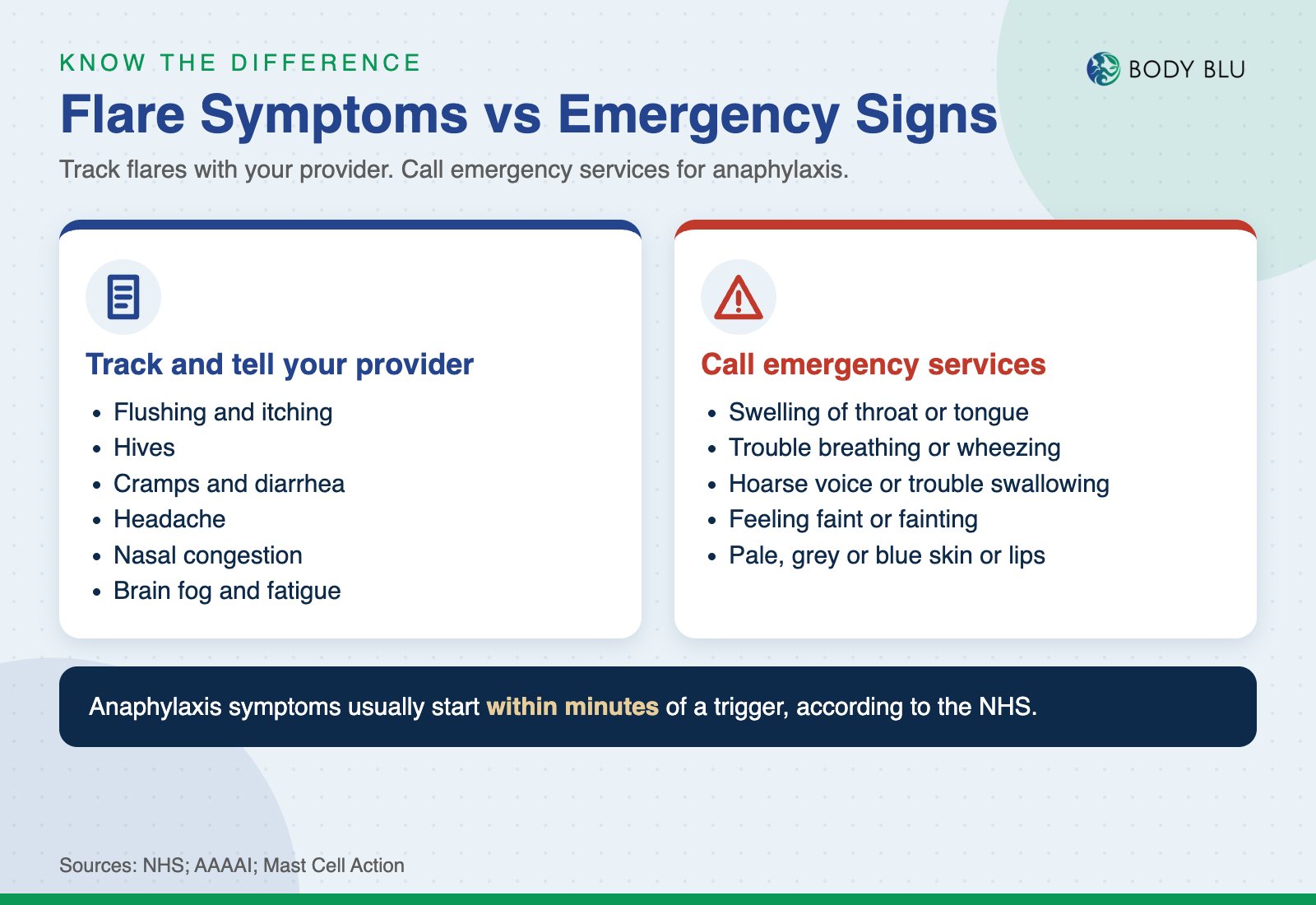
The infographic above separates flare symptoms from emergency signs. Emergency signs need a call, not a diary entry. Flares that fall short of anaphylaxis raise the next concern, which is whether the pattern is MCAS at all.
Do I Have Mast Cell Activation Syndrome or Something Else?
Whether you have mast cell activation syndrome depends on 3 criteria: matching symptoms, a mediator rise and a drug response. Symptoms alone cannot settle the question. Akin and Valent wrote in 2019 that MCAS is rare and that many patients who believe they have it have another condition.
Two studies put numbers on that gap. Buttgereit and colleagues followed 100 patients with suspected MCAS, and 53% based the suspicion on self-evaluation. Only 2 of 79 tested patients had a tryptase rise above 20% plus 2 ng/mL after an episode. MCAS was confirmed in 2% of the 100 patients.
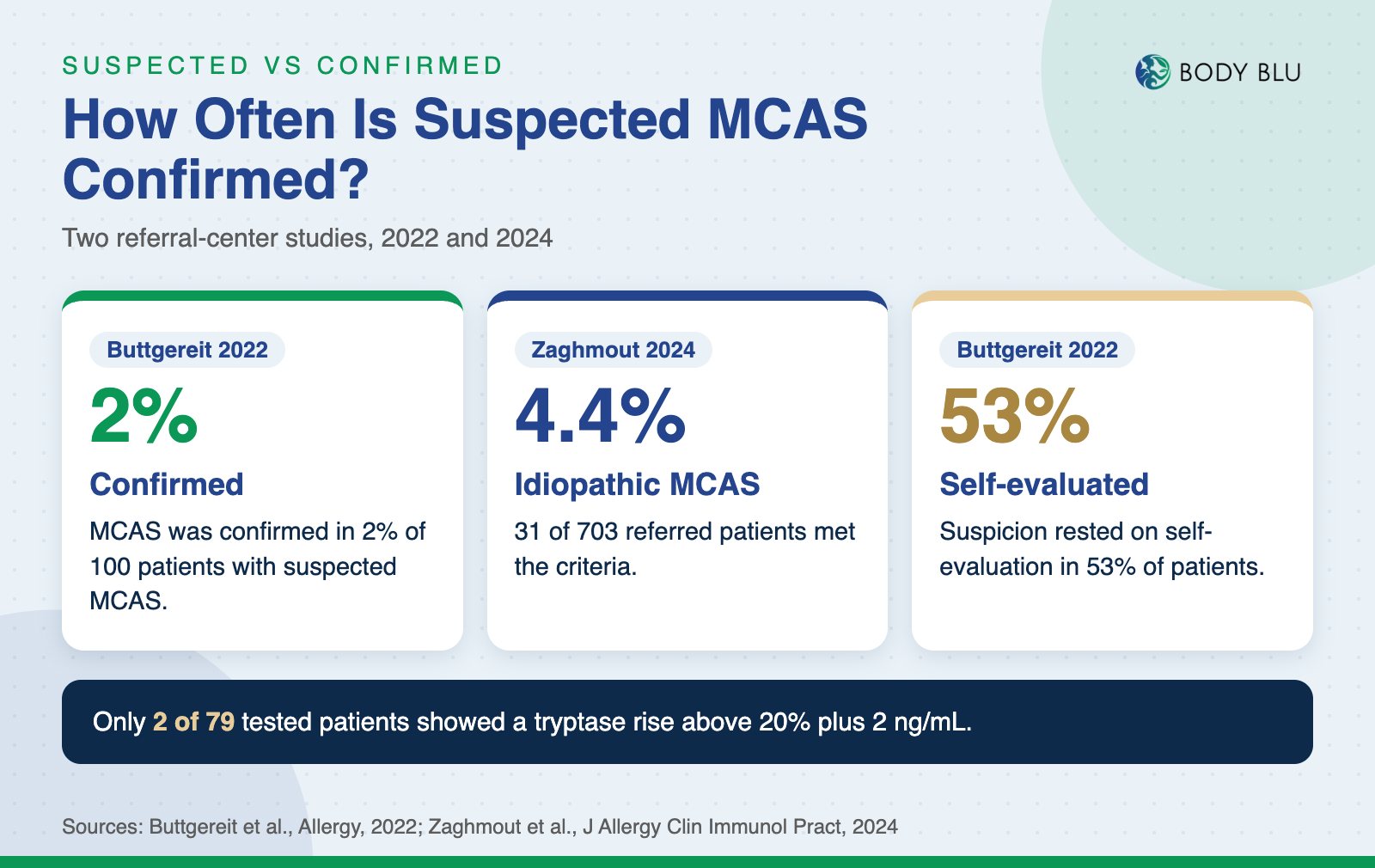
Zaghmout and colleagues found idiopathic MCAS in 4.4% of 703 referred patients. Both studies come from referral centers, so the percentages describe suspected patients and not the general public.
The companion guide on what MCAS is explains the 3 criteria. The tryptase rule is a 20% rise plus 2 ng/mL within 4 hours. Tests need timing, and an allergist or immunologist orders them. Valent and colleagues note that a normal baseline tryptase does not exclude MCAS.
Mimics include autonomic disorders, and Buttgereit and colleagues found anxiety and depression in 23 patients each. A provider therefore weighs mood, circulation and mast cell causes together. Body Blu offers anxiety care alongside that evaluation. Treatment is the next question.
What Treatment Helps MCAS Symptoms?
Treatment for MCAS symptoms follows the mediator and the symptom involved, and a provider chooses each medicine. Mast cell activation syndrome symptoms treatment draws on the AAAAI list below, and this article gives no dosing advice.
- Antihistamines for itching, abdominal discomfort and flushing.
- Histamine type 2 blockers such as famotidine for abdominal pain and nausea.
- Montelukast and similar drugs for wheezing and abdominal cramping.
- Epinephrine for anaphylaxis, and omalizumab to reduce anaphylactic episodes.
The AAAAI adds that lack of response to these treatments suggests MCAS is not present. A drug response is therefore part of the diagnosis, as the third criterion states. Corticosteroids are a last resort, according to the AAAAI.
Body Blu builds a MCAS support plan around triggers, gut health and mold exposure, alongside your allergist's care. Several side questions remain.
What Else Should You Know About MCAS Symptoms?
Do MCAS Symptoms Differ in Women?
Female sex is overrepresented in idiopathic MCAS, according to Castells and colleagues. Buttgereit and colleagues found that 80% of 100 suspected patients were female. Castells and colleagues call for research on the genetic and hormonal mechanisms. No symptom list is specific to women.
Can Exercise Trigger MCAS Symptoms?
Exercise appears on Mast Cell Action's trigger list, together with temperature changes, hormones and stress. Triggers differ by person and change over time. A diary entry for activity, temperature and symptoms shows whether exercise precedes an episode.
Can Children Have MCAS Symptoms?
Children can have MCAS symptoms, but few data exist in children. Castells and colleagues state that signs are consistent across all ages. Mast Cell Action reports that MCAS can develop in both children and adults. The pediatric prevalence is unknown.
Which Doctor Treats MCAS Symptoms?
An allergist or immunologist leads the work-up, since the AAAAI advises patients to work with a local allergist. The allergist orders tryptase and urine tests with the right timing. Other providers then add support for triggers, gut health and related conditions. Bring the symptom diary to the first visit.
Can People With MCAS Live a Normal Life?
Mast Cell Action reports that symptoms are manageable for some people and have a substantial impact for others. The sources we reviewed give no outcome figure for daily function. Management plans vary with the type, the triggers and the response to treatment.
How Does Body Blu Help With MCAS Symptoms?
Body Blu helps by mapping your symptoms by body system, reviewing triggers and coordinating with your allergist or immunologist. A licensed naturopathic doctor leads that review. Our mast cell support starts with the diary and the timing of each episode.
Functional testing adds context to the diary. Nutrient, gut and hormone results can show contributors that symptoms alone cannot show. Our diagnostic labs do not confirm MCAS by themselves, because the 3 criteria still need an allergist's work-up.
A blog post cannot diagnose MCAS, and our team gives no diagnosis here or medical advice in its place. Talk to your provider about repeated episodes in 2 or more body systems. Call emergency services for anaphylaxis. The Body Blu clinicians can help you organize your mast cell activation syndrome symptoms into a pattern your provider can use.


Resources
From Our Blog
Naturopathic insights, wellness tips, and updates from the Body Blu team.
Wellness
Mast Cell Activation Syndrome Symptoms and Signs of MCAS
Mast cell activation syndrome symptoms are recurrent episodes that involve 2 or more organ systems, including skin, gut, heart and airway. No single symptom is specific, so experts also require a mediator rise and a drug response.

Treatments
What Is BPC-157 Peptide and What Does BPC-157 Peptide Do?
BPC-157 peptide is a lab-made chain of 15 amino acids that the FDA has not approved for any use. Evidence comes mainly from animal studies, and only 3 small human studies exist.

Treatments
BPC 157 Side Effects and BPC 157 Peptide Side Effects for Women
BPC 157 side effects reported by users include injection-site pain, fatigue and anxiety, but only 3 small human studies exist. The FDA has not approved BPC-157, so risks remain unknown.