


What Is Sermorelin Peptide and What Does Sermorelin Do?


Sermorelin is a lab-made peptide that copies the first 29 of the 44 amino acids in growth hormone-releasing hormone (GHRH). It prompts the pituitary gland to release growth hormone. FDA approved the brand drug GEREF in 1990 and 1997, then withdrew approval in 2009. Compounded sermorelin today is not FDA-approved. Trials show small, slow changes in growth hormone markers rather than dramatic results.
Key Takeaways
- Sermorelin is a 29-amino-acid peptide that mimics the front end of GHRH, a 44-amino-acid signal.
- Sermorelin works at the pituitary gland, so the body's own feedback still limits growth hormone release.
- Trials of 11 to 19 adults found higher growth hormone or IGF-1, but weight did not change.
- FDA approved GEREF only for a pituitary test and childhood growth failure, and compounded versions lack FDA approval.
- A licensed provider should review labs, history and goals before any peptide plan starts.
What Is Sermorelin Peptide?
Sermorelin peptide is a lab-made chain of 29 amino acids that copies the front end of GHRH. The National Library of Medicine describes GHRH as a 44-amino-acid peptide that stimulates growth hormone release. The hypothalamus, a control center at the base of the brain, makes GHRH.
NIH PubChem lists sermorelin with the formula C149H246N44O42S and a molecular weight of 3357.9. Peptides are short chains of amino acids, and proteins are longer chains. We do not list sermorelin as a service, so peptide options get a peptide candidacy review case by case.
Readers asking what is sermorelin peptide usually want 3 answers: what it is, what it does and whether FDA approved it. The first answer starts with a simple label, because sermorelin sits between a peptide and a hormone.
Is Sermorelin a Peptide or a Hormone?
Sermorelin is a peptide that copies a releasing hormone, not growth hormone itself. Pharmacologists group it with growth hormone secretagogues, which are compounds that prompt growth hormone release. Readers who ask what type of peptide is sermorelin get that same answer in the research.
Growth hormone comes from the pituitary gland, a pea-sized gland under the brain. The table lists the 4 molecules in the chain and where each one comes from.
| Molecule | Source | Role |
|---|---|---|
| GHRH (44 amino acids) | Hypothalamus | Signals the pituitary gland to release growth hormone |
| Sermorelin (29 amino acids) | Made in a lab | Copies the first 29 amino acids of GHRH |
| Growth hormone | Pituitary gland | Released in pulses and raises IGF-1 |
| IGF-1 | Liver | Blood marker of growth hormone activity |
The table shows sermorelin one step before growth hormone in the chain. That position explains how sermorelin works in the body.
How Does Sermorelin Work in the Body?
Sermorelin works in the body by copying GHRH at the pituitary gland, which then releases growth hormone in pulses. The steps below show the full chain.
- The hypothalamus releases GHRH, a 44-amino-acid signal.
- GHRH reaches the pituitary gland, where somatotroph cells release growth hormone.
- Growth hormone prompts the liver to make IGF-1, a marker of growth hormone activity.
- Somatostatin and negative feedback slow further release.
Sigalos and Pastuszak reviewed secretagogues in 2018. They found that secretagogues keep release pulsatile and subject to negative feedback, which can prevent supratherapeutic growth hormone levels.
Injected growth hormone skips that control, according to a 2006 editorial by Walker. The dose enters the blood as one bolus, so normal feedback does not modulate it.
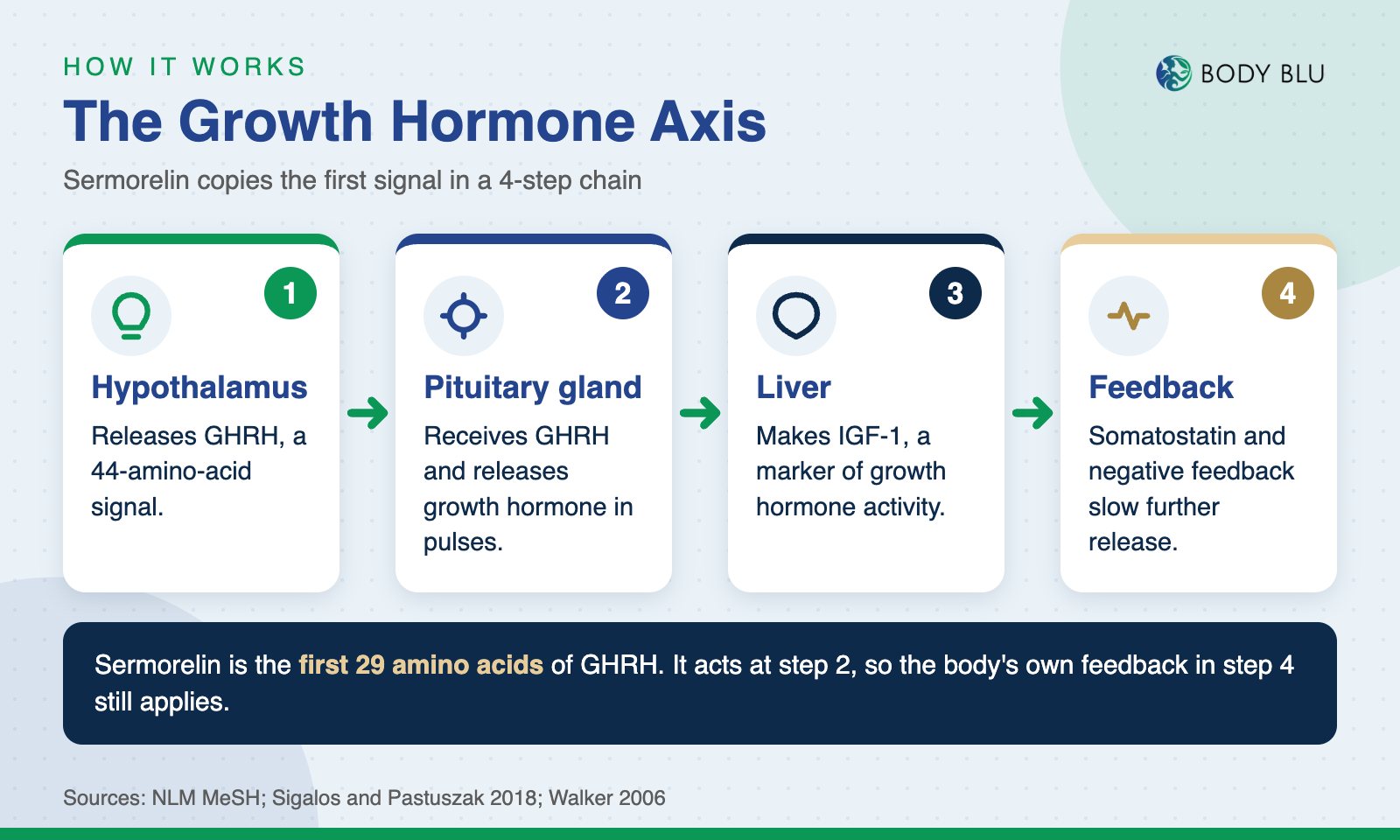
The graphic above places sermorelin at step 2 of 4. Knowing the chain sets up the next question, which is what researchers measured after sermorelin injections.
What Does Sermorelin Do?
Sermorelin does raise growth hormone release and IGF-1, and trials found only small changes beyond those blood markers. Khorram and colleagues tested a close sermorelin analog in 19 healthy adults aged 55 to 71. Participants received placebo for 4 weeks and then the analog for 16 weeks.
The same team reported a second set of results from that trial. Twelve-hour growth hormone secretion rose 107% in men and 70% in women, and IGF-1 rose 28% by week 4.
IGF-1 rose within 2 weeks, and skin thickness rose in both sexes. Lean body mass rose in men only, and body weight did not change. The sibling guide on results and timelines covers each measurement in detail.
Vittone and colleagues gave 11 men aged 64 to 76 a single nightly dose for 6 weeks. Nighttime growth hormone rose, yet IGF-1 did not change. The authors concluded that single nightly doses worked less well than multiple daily doses.
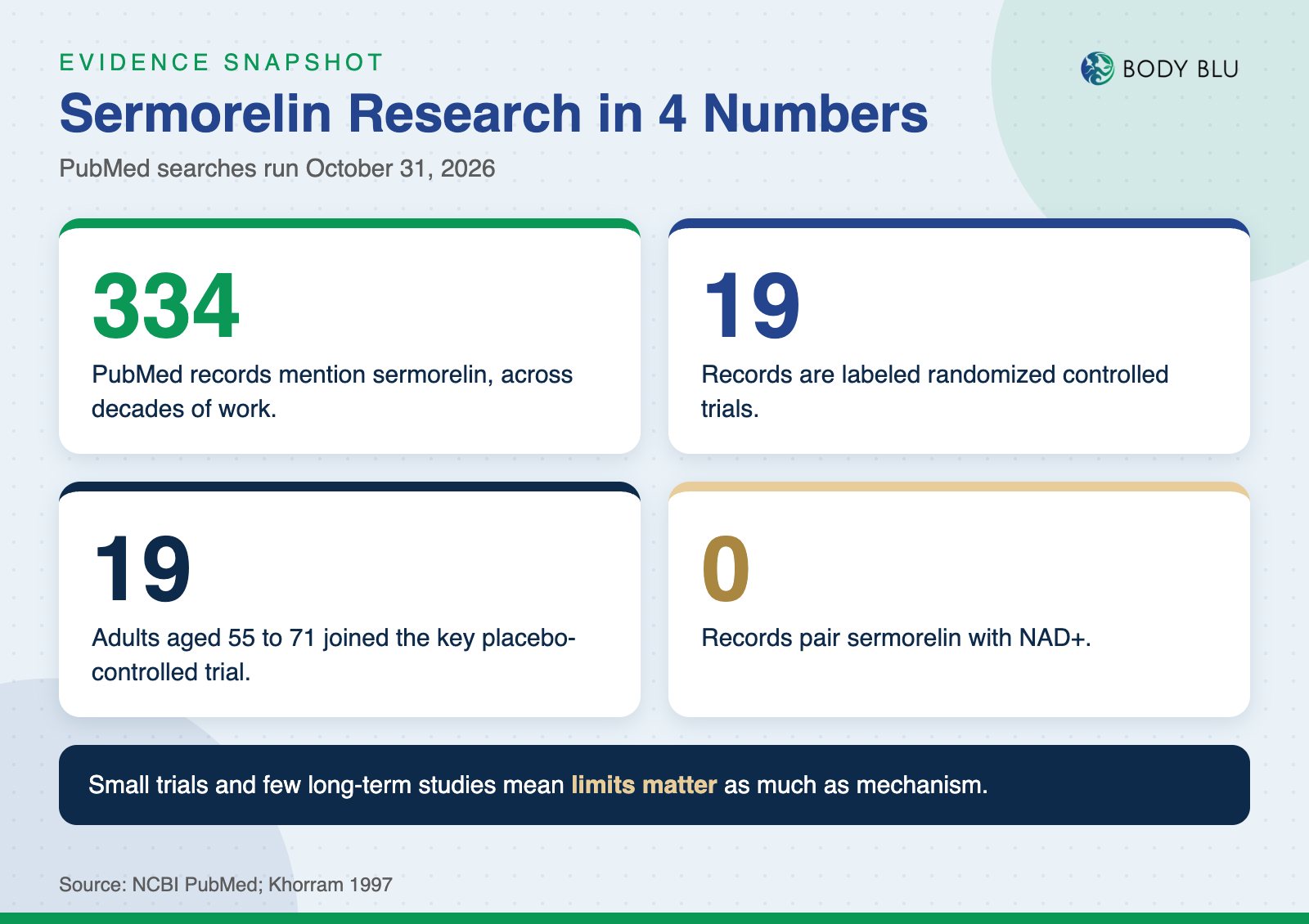
The graphic above shows how small the evidence base is. A PubMed search on October 31, 2026 returned 334 sermorelin records, and 19 carry the randomized controlled trial label. Those numbers lead to the regulatory question.
What Was Sermorelin Approved to Do?
Sermorelin was approved for 2 uses under the brand name GEREF: a pituitary test and treatment of childhood growth failure. The Federal Register records the dates in FDA's 2013 notice about GEREF.
- December 28, 1990: FDA approved GEREF 0.05 mg ampules to test pituitary growth hormone secretion.
- September 26, 1997: FDA approved GEREF vials for children with idiopathic growth hormone deficiency and growth failure.
- 2008: the manufacturer, EMD Serono, discontinued both products.
- June 18, 2009: approval of both applications was withdrawn by FDA.
FDA determined on March 4, 2013 that GEREF was not withdrawn for reasons of safety or effectiveness. Neither approval named adult anti-aging, weight or appearance goals.
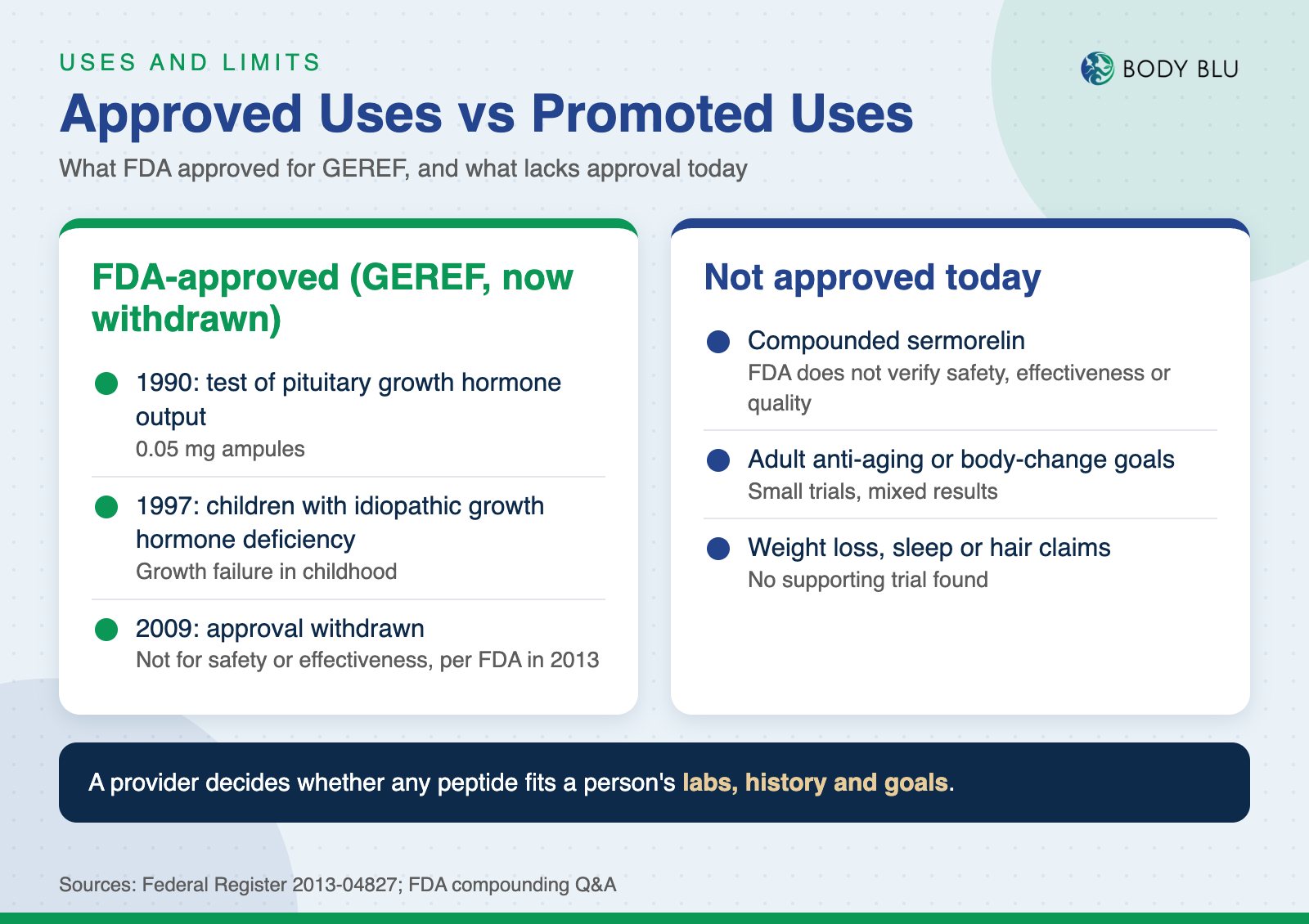
The graphic above separates old approved uses from today's promoted uses. Pharmacies still supply sermorelin, which raises the question of access.
Can I Get Sermorelin From My Doctor?
Licensed providers can prescribe compounded sermorelin through pharmacies, but FDA states that compounded drugs are not FDA-approved. FDA does not verify their safety, effectiveness or quality before marketing. A pharmacy label therefore carries less assurance than an approved drug label.
FDA's Category 2 list of bulk substances with significant safety risks does not include sermorelin. The Category 2 page was current as of April 22, 2026. Six substances appear on the final 503A bulks list in 21 CFR 216.23, and sermorelin is not one of them.
Compounding rules change, so the dispensing pharmacy should confirm current status. Our team handles peptide eligibility screening as a consult topic, not as a sermorelin service. That screening step leads to the question of who qualifies.
Who Should Take Sermorelin?
Who should take sermorelin is a provider's decision, since FDA's approved uses covered only a pituitary test and childhood growth failure. Adults who use it do so off label, and adult studies are scarce, according to Healthline's medical review. A provider reviews 5 areas before any peptide plan.
- Growth hormone markers, including IGF-1.
- Thyroid status, because untreated hypothyroidism is a reason to avoid sermorelin.
- Blood glucose, because secretagogues may lower insulin sensitivity.
- Allergy history, because allergic reactions are possible.
- Pregnancy or breastfeeding status.
Baseline numbers matter, and pituitary lab testing shows where growth hormone markers start. Tracking the same markers later shows whether a plan changed anything.
Midlife symptoms such as fatigue or low drive have many causes besides growth hormone. A broader endocrine evaluation checks thyroid, sex hormones and adrenal function first. Safety belongs in the same conversation.
How Safe Is Sermorelin?
Sermorelin showed few side effects in small trials, but long-term safety is unknown. Khorram's 16-week trial reported transient hyperlipidemia, meaning a short rise in blood fats, as the only adverse effect. Vittone's 6-week trial observed no significant adverse effects.
Healthline lists injection-site reactions as the most common effect. These include irritation, itching, swelling, pain and redness. Less common effects include headache, flushing, dizziness and nausea.
Sigalos and Pastuszak noted some concern for higher blood glucose, because secretagogues may lower insulin sensitivity. They also called for study of cancer incidence with long-term use. People with blood sugar concerns can ask about glucose screening before any hormone-related plan.
Medication overlap also matters. Healthline lists thyroid medications such as levothyroxine, glucocorticoids such as prednisone and insulin as possible interactions. Providers therefore review every prescription and supplement before a peptide plan.
A 2026 review in Sports Medicine by Mendias and Awan adds that rigorous human safety data for unapproved peptides is scarce. That limit applies to compounded sermorelin as well.
Hives, swelling of the face or mouth, or shortness of breath signal a severe allergic reaction. These symptoms need emergency care. The safety picture sets up a few side questions.
What Else Should You Know About Sermorelin?
What Is Sermorelin Therapy?
Sermorelin therapy is a prescribed course of subcutaneous injections, which means injections under the skin. Healthline notes that patients can self-administer after a prescription and instructions from a doctor. Dosing belongs to the prescribing provider, not to an article. Compounded products come from a pharmacy rather than from a manufacturer with an FDA-approved label, so the pharmacy's quality standards matter.
Does Sermorelin Peptide for Sleep Work?
Sermorelin peptide for sleep lacks trial support, because sleep quality did not change in either sex in Khorram's placebo-controlled trial. A PubMed search for sermorelin together with sleep returned 8 records on October 31, 2026. None of the titles reviewed was a placebo-controlled sleep trial of sermorelin.
Animal work does link growth hormone-releasing factor to sleep. A 1991 rat study found that blocking the factor reduced both sleep and growth hormone secretion. That finding explains the interest, but it is not proof of a human sleep benefit.
Can You Combine Sermorelin and NAD+?
Sermorelin and NAD+ act on different systems, and no PubMed record pairs them. A search for sermorelin with NAD returned 0 records on October 31, 2026. NAD+ is a coenzyme for redox reactions that is central to energy metabolism, according to a 2021 Nature Reviews review.
Sermorelin is a hormone-releasing signal, while NAD+ supports cellular chemistry. Our clinic offers NAD+ injection therapy as a separate service. Any combination plan needs a provider's review, since no combined trial data exist.
The same review states that much remains unknown about restoring NAD+ safely in humans. Our overview of NAD+ and aging explains that evidence in plain terms.
How Is Sermorelin Different From Human Growth Hormone?
Sermorelin differs from human growth hormone because sermorelin prompts the pituitary gland, while injected growth hormone replaces the pituitary signal. Pituitary release stays pulsatile and under feedback. The Code of Federal Regulations restricts recombinant growth hormone in adults to AIDS or diagnosed growth hormone deficiency, as Walker notes.
How Does Sermorelin Compare With BPC-157?
Sermorelin and BPC-157 are different peptides with different evidence. A 2025 review found only 3 published human studies of BPC-157. Sermorelin has a longer research record, including 19 randomized trial records, and FDA once approved its brand drug.
BPC-157 is not FDA-approved. Our guide to BPC-157 explained covers its status and evidence.
How Does Body Blu Help With Peptide Questions?
Body Blu helps by reviewing peptide questions case by case, with labs and history first. We do not list or sell sermorelin. At our Cardiff clinic, Dr. Scarpuzzi's team reviews hormone, thyroid and metabolic markers before discussing any peptide.
The answer to what is sermorelin peptide is a 29-amino-acid GHRH copy with an old approval and thin modern evidence. Patients who want a plain evidence review can use the contact page to ask for a consult. Patients should bring questions, a medication list and recent lab results.
Our naturopathic approach starts with root causes rather than a single hormone number. That approach keeps education and care separate, which is why every peptide question starts with a conversation with the Body Blu practitioners.


Resources
From Our Blog
Naturopathic insights, wellness tips, and updates from the Body Blu team.
Treatments
What Is Sermorelin Peptide and What Does Sermorelin Do?
Sermorelin is a lab-made peptide that copies the first 29 amino acids of GHRH and prompts the pituitary gland to release growth hormone. FDA withdrew approval of the brand drug in 2009.
Wellness
Is Insulin Resistance Diabetes? Insulin Resistance vs Prediabetes
No, insulin resistance is not diabetes. It describes cells that respond poorly to insulin, while diabetes starts at an A1C of 6.5% or above. Compare insulin resistance, prediabetes and type 2 diabetes.
Wellness
What Is the Epstein Barr Virus and How Do You Know You Have It?
Epstein-Barr virus (EBV) is a common herpes family virus that infects about 95% of US adults. It spreads through saliva, and an antibody blood test shows a current or past infection.